Table Of Content
- Design Language & Execution
- Technical Architecture: Battery, Powertrain, & Performance
- Battery Cells & Chemistry
- Performance Spec Ledger
- Commercial Footprint & Sales Markets
- Cost Dynamics: US Pricing vs. Tesla Model Y
- The Family Verdict: Is the bZ Worth Buying?
- The Positives (Unique Selling Propositions)
- The Negatives (Compromises)
- 10 Reasons the Toyota bZ Lags in Popularity Against Tesla
- 21 Comprehensive FAQs Regarding the Toyota bZ
Toyota bZ4X (2026 Toyota bZ) Review: Specs, Pricing, and the Ultimate Tesla Competitor Breakdown
When Toyota first introduced its maiden voyage into the all-electric landscape with the Toyota bZ4X, the automotive world met it with a mixture of high expectations and harsh initial criticisms regarding its real-world range and charging speeds. Fast forward to today, and the newly rebranded and heavily re-engineered 2026 Toyota bZ has completely rewritten that narrative.
Sitting squarely as a mid-size crossover positioned right alongside the legendary RAV4 in physical footprint, this vehicle represents far more than just another option in the showroom, it is Toyota’s global sandbox for its next-generation modular eTNGA architecture and a critical shield against aggressive international EV competition. For the American EV buyer, this launch demands immediate attention.
Backed by Toyota’s bulletproof legacy of reliability, massive price adjustments that under-cut the segment, a dense new 74.7 kWh battery packaging up to 314 miles of range, and factory-integrated NACS ports for seamless access to Tesla’s Supercharger grid, the 2026 Toyota bZ has officially graduated from a compliance car into a dominant, value-packed threat to the Tesla Model Y’s long-held throne.
Design Language & Execution
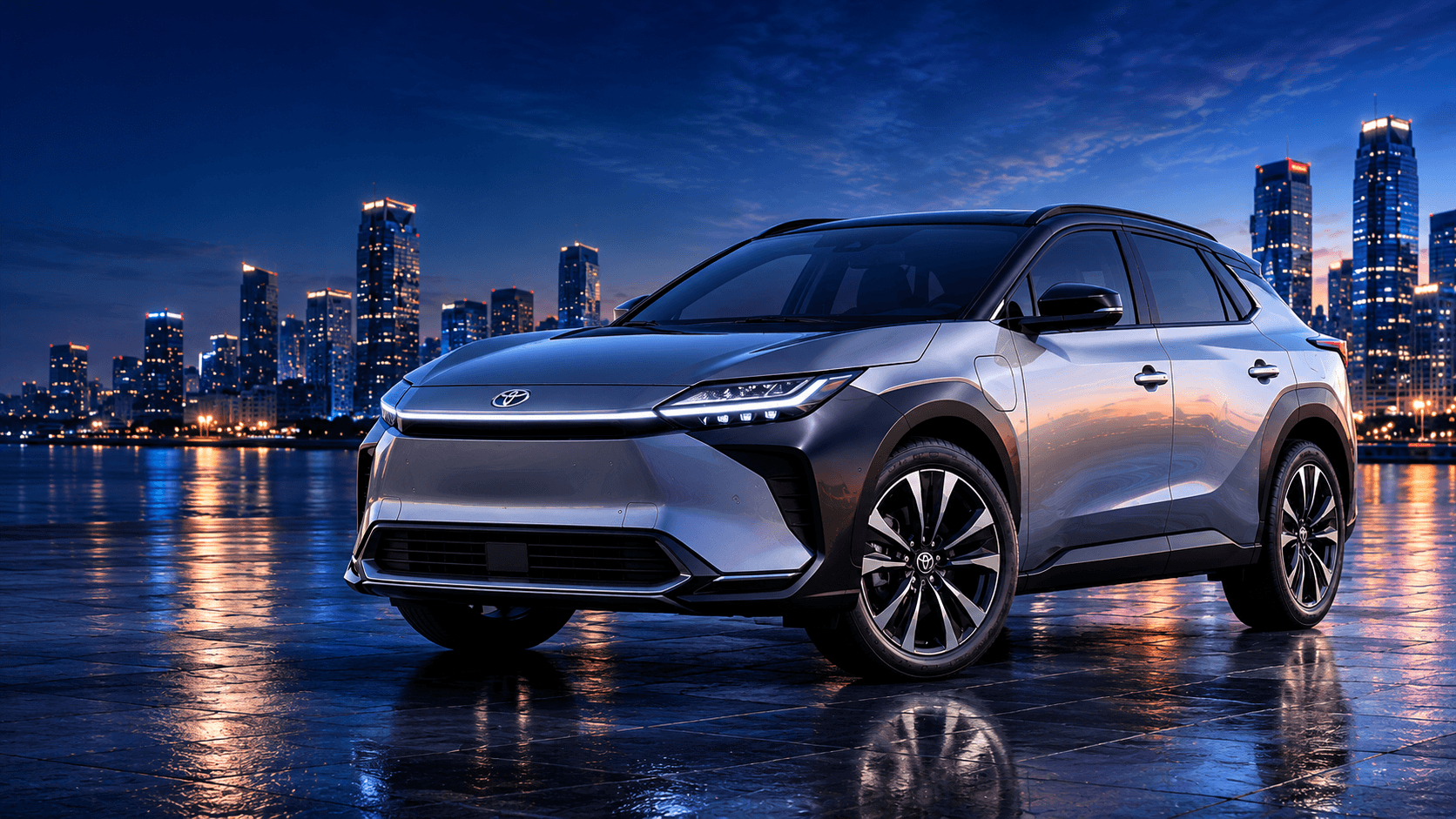
The exterior execution utilizes a sharp, striking hammerhead front design language with a low-slung, sweeping aerodynamic silhouette.
Inside, the cabin swaps out early glossy black plastics for texturized fabrics, mounting a massive 14-inch multimedia screen as a standard focal point across all lines. The digital driver display sits uniquely elevated above the steering wheel layout, mirroring a futuristic heads-up view that successfully delivers a premium space-age cockpit feel tailored precisely to competitive American tastes.
Technical Architecture: Battery, Powertrain, & Performance
Built upon the modular eTNGA platform, the 2026 configuration splits features neatly down drivetrain layouts to optimize cost against range metrics.
Battery Cells & Chemistry
The packs are developed by Prime Planet Energy & Solutions (PPES), shifting cell densities to package more raw capacity inside the exact structural frame dimensions of earlier iterations.
- Base Architecture: Utilizes a compact 57.7 kWh structural pack optimized for urban thermal management.
- Long Range Architecture: Stepped up to a dense 74.7 kWh battery pack featuring advanced thermal conditioning management loops.
Performance Spec Ledger
- Base XLE FWD (57.7 kWh): Produces a modest 168 horsepower, clocking a linear 0–60 mph sprint in 8.0 seconds flat with an EPA-estimated range of 236 miles.
- XLE Plus / Limited FWD (74.7 kWh): Bumps horsepower limits up to 221 hp, delivering a manufacturer-estimated range of 314 miles on a full charge.
- Dual Motor AWD (74.7 kWh): Incorporates updated eAxles utilizing silicon carbide semiconductors to punch out a combined 338 horsepower. This cuts the 0–60 mph time down to a brisk 4.9 seconds while preserving an EPA range of 278 to 288 miles.
Charging Interface: Moves away from isolated CCS connectors by adopting standard native NACS ports, granting direct access to Tesla’s Supercharger grid without structural adapters.
Commercial Footprint & Sales Markets
The Toyota bZ is a global platform tailored for markets experiencing aggressive regulatory shifts. It is currently actively distributed in the United States, Canada, the European Union, Japan, and parts of Southeast Asia. For the North American footprint, vehicles are sourced out of specialized production tracks in Japan, avoiding localized manufacturing gridlocks but rendering the car subject to complex leasing loop loopholes to unlock domestic federal incentives.
Cost Dynamics: US Pricing vs. Tesla Model Y
For the first time, Toyota has aggressively weaponized pricing to capture market share from the Model Y Standard lines.
| Trim Grade | Drivetrain Layout | Pack Size | 2026 Base MSRP (USD)* | Direct Tesla Alternative |
|---|---|---|---|---|
| XLE Base | Front-Wheel Drive | 57.7 kWh | $34,900 | Model Y Standard RWD ($39,990) |
| XLE AWD | All-Wheel Drive | 74.7 kWh | $36,900 | Model Y Standard AWD ($41,990) |
| XLE Plus | Front-Wheel Drive | 74.7 kWh | $37,900 | Model Y Premium RWD ($44,990) |
| Limited | All-Wheel Drive | 74.7 kWh | $45,300 | Model Y Premium AWD ($48,990) |
*Excludes standard local destination fee of $1,450.
The Family Verdict: Is the bZ Worth Buying?
The Positives (Unique Selling Propositions)
- Standard Wireless Integration: Unlike Tesla’s locked ecosystem, Apple CarPlay and Android Auto run wirelessly across all trims.
- Predictable Safety Architectures: The standard Toyota Safety Sense 3.0 suite packs radar-guided adaptive cruise, lane-tracing, and evasive steering assists without hidden paywalls or premium software monthly subscriptions.
Compliant Ride Quality: The suspension tuning isolates cabin spaces over potholes significantly better than Tesla’s sports-firm dampening profiles.
The Negatives (Compromises)
- Absent Front Storage: The layout of the front eAxle eliminates any chance of an external front trunk (frunk).
- Conservative Charging Curves: While NACS access is included, the peak charging speeds are strictly capped, lagging behind Tesla’s linear high-voltage charge acceptance.
10 Reasons the Toyota bZ Lags in Popularity Against Tesla
- The Initial Launch Shadow: The infamous 2022 mechanical wheel hub recall permanently scarred the car’s initial viral footprint.
- Naming Gridlock: The alphabet-soup branding of “bZ4X” confused consumers before the 2026 simplification.
- Frunk Absence: Traditional EV buyers treat the front storage cavity as a non-negotiable benchmark.
- Subdued Highway Range: Top-tier specs peak at 314 miles, trailing behind Tesla’s long-range numbers.
- Conservative Top Speed Profiles: Speed ceilings are electronically restricted to 99 mph.
- Dealership Reluctance: Legacy dealer distribution frameworks often steer buyers toward hybrid RAV4 or Highlander options instead.
- The “Compliance Car” Perception: Marketing footprints remain muted compared to the highly vocal social media ecosystem surrounding Tesla.
- Complex Federal Incentive Routes: Purchasing upfront limits direct access to localized tax credits due to overseas manufacturing locations.
- Minimalist Infotainment Layouts: Software setups lack the integrated gaming software or media options native to Tesla touchscreens.
The Brand Status Dynamic: Tesla holds an “Apple-like” premium status allure, whereas Toyota is valued for utilitarian reliability over forward tech luxury.
21 Comprehensive FAQs Regarding the Toyota bZ
The “bZ” acronym represents Toyota’s core global environmental vision: “Beyond Zero” emissions.
No. The 2026 update dropped the “4X” suffix, expanded battery capabilities by 25%, standardized a larger 14-inch screen, upgraded onboard AC charging units to 11 kW, and integrated a native NACS charge port.
Yes. Because it features a native NACS port from the factory, the 2026 model plugs directly into compatible Tesla Supercharging hubs without structural adapters.
With its upgraded 11 kW onboard charger combined with a standard Level 2 home charging station, it will replenish from empty to full capacity in roughly 7.5 hours.
No. The space under the front hood is occupied entirely by the integrated climate hardware, motor systems, and standard eAxle electronics.
Every Toyota bZ unit is manufactured and assembled at specialized facilities located in Japan.
It features a high-regen mode called Regenerative Braking Boost, but it does not bring the vehicle to a complete, abrupt stop without the driver stepping lightly on the brake pedal.
Toyota guarantees the electric vehicle battery pack for 8 years or 100,000 miles against significant structural drop-offs or cell failures.
Exclusive to AWD trims, X-MODE reconfigures torque vectoring and brake applications to safely pilot the car through snow, deep mud, and uneven off-road trails.
Yes. Wireless Apple CarPlay and Android Auto are standard features across every single trim line without premium fees.
The vehicle delivers roughly 27.7 cubic feet of rear storage space behind the second row, expanding substantially when seats are folded flat.
Ventilated cooling front seats alongside a radiant foot-and-leg space heater are standard options on the top-tier Limited trim lines.
Yes. The standard Toyota Safety Sense 3.0 includes Lane Tracing Assist (lane-centering) and full adaptive cruise control out of the box.
Base XLE trims roll on efficient 18-inch alloy wheels, while higher-grade Limited variants feature stylized 20-inch multi-spoke rims.
Toyota leverages high-density Lithium-ion chemistry optimized for thermal stability and cyclic longevity across both capacity options.
Yes. Every new unit ships with a dual-voltage 120V/240V portable charging cable that plugs directly into standard home outlets.
A fixed panoramic glass roof with an automated power sunshade is a standard feature included on the XLE Plus and Limited tiers.
All-wheel drive (AWD) variants are officially rated to tow up to 1,500 kg (approx. 3,300 lbs) when pulling braked trailers.
The platform packages eight standard airbags, including front knee protection arrays and deep side-curtain layers.
The Limited grade upgrades cabin spaces with a high-fidelity, 9-speaker JBL premium audio network featuring a dedicated subwoofer.
Direct purchases do not qualify for the instant $7,500 credit due to foreign assembly, but the full $7,500 incentive can be unlocked when routing the acquisition through a standard dealership lease structure.
Spread Some Love
Author