Table Of Content
- Why Choose the Best Plug-In Hybrid Cars in 2026? The PHEV Perks You Can't Ignore
- 10. Mercedes-Benz GLC 300e Plug-In Hybrid: Luxury Meets Everyday Efficiency
- 9. Chrysler Pacifica Plug-In Hybrid: The Family Minivan Reinvented
- 8. BMW M5 Plug-In Hybrid: Beast Mode with a Green Twist
- 7. Mazda CX-70 PHEV: Premium Crossover with Soul
- 6. Volvo XC60 Plug-In Hybrid: Safety-First Scandinavian Star
- 5. Lexus RX 450h+ Plug-In Hybrid: Refined Reliability
- 4. Hyundai Tucson Plug-In Hybrid: Value-Packed Crossover King
- 3. Toyota Prius Plug-In Hybrid: Efficiency Icon Reborn
- 2. Toyota RAV4 Plug-In Hybrid: Versatile All-Rounder
- 1. BMW X5 xDrive50e Plug-In Hybrid: The Pinnacle of PHEV Perfection
- Head-to-Head: 2026 Best Plug-In Hybrid Cars Comparison Table
- FAQ: Your 2026 Best Plug-In Hybrid Cars Quick Hits
- Final Thoughts: Plug Into the Best Plug-In Hybrid Cars of 2026 Today!
Top 10 Best Plug-In Hybrid Cars 2026: The Ultimate Guide To Efficiency, Power, And Savings
So, here’s the thing. A lot of people right now are stuck in the weird middle area between wanting to save on fuel and not totally trusting full EVs yet – and honestly, I get it. Charging isn’t always convenient, and gas prices feel like they’re playing their own game. That’s pretty much why plug-in hybrids make sense for so many folks.
Most of the 2026 models can handle your normal day – work, errands, whatever – just on the battery. Then, when that’s done, the car switches over to the engine without you doing anything. No planning, no range panic, nothing. It’s basically the “I don’t want to think about this” version of going greener.
I’ve driven a bunch of hybrids over the years (some boring, some surprisingly nice), and the newer plug-in ones feel a lot more sorted out. Less noise, smoother takeoff, and they just feel more natural to drive than the older stuff. It doesn’t feel like a science experiment anymore.
For this list, I pulled info from places that test these cars for a living – Edmunds, Car and Driver, that crowd – and tried to stick to the things people actually ask about: how far they go on electric, what they cost, and whether they’re annoying to live with or not. There’s a comparison table too, just so you don’t have to jump around.
If you’re specifically trying to figure out which plug-in hybrid SUV or sedan to go for in 2026, I’ve included options for both. Anyway, let’s get into it.
Why Choose the Best Plug-In Hybrid Cars in 2026? The PHEV Perks You Can’t Ignore
Before we rank the heavy hitters, a quick PHEV 101: These bad boys pair a rechargeable battery (for 30-80 miles of pure EV driving) with a gas engine for unlimited range. No more “what if the charger’s full?” stress-perfect for India’s patchy infra or U.S. suburbs. In 2026, expect bigger batteries (thanks to solid-state tech teases), faster charging (under 2 hours at home), and lower BiK taxes for salary sacrificers.
Key Wins:
- Epic Efficiency: 50-100 MPGe combined-save $1,500/year on fuel vs. gas guzzlers.
- Power Punch: Instant EV torque + gas grunt for 0-60 in under 6 seconds on many.
- Green Cred: Cut CO2 by 60% with regular plugging; qualify for $7,500 U.S. IRA credits or India’s FAME incentives.
- Versatility: Sedans for solo spins, SUVs for family adventures-2026 adds minivans like the Pacifica PHEV.
Downsides? Higher upfront costs ($35k-$100k) and weight from batteries can dull handling. But for most, the math adds up: Payback in 3-4 years. Now, our top 10 best plug-in hybrid cars for 2026, ranked by a blend of range, MPG, value, and drive fun (scored out of 10).
10. Mercedes-Benz GLC 300e Plug-In Hybrid: Luxury Meets Everyday Efficiency
So, starting with the 2026 Mercedes GLC 300e – I spent some time with this one recently, and it honestly feels like a regular GLC that just happens to run on electric power for a good chunk of the day. Nothing weird or overly “techy” about it. The gas engine and the electric motor work together pretty smoothly, and when you push it, it actually moves quicker than you’d expect from a family-sized luxury SUV.
Mercedes claims around 36 miles of electric range, and I didn’t quite get that in real traffic; I ended up somewhere around 32 before it switched over. Still enough to handle the usual morning routine without touching the fuel. And the transition between EV and hybrid mode is so subtle that you barely notice it unless you’re paying attention.
Inside, it’s the typical Mercedes vibe – big screen in the middle, a lot of shiny surfaces, and the navigation has that augmented reality thing where it shows arrows on top of the road. It’s cool, though a bit distracting the first time you try it. Only real gripe is the cargo area. It’s not terrible, but you do lose a bit of space compared to some other SUVs because of the battery setup.
Price-wise, it starts somewhere around the upper $50k range. I’ve seen lease deals that bring it under $500 a month depending on the region and timing, so it’s not as out-of-reach as it looks at first glance. Driving it feels calm, quiet, and very “Mercedes,” which is probably what people buying this want anyway.
If you want something comfortable and upscale that lets you do most of your daily stuff on electric without committing to a full EV, this one fits that lifestyle pretty well – just keep in mind the trunk isn’t exactly huge.
9. Chrysler Pacifica Plug-In Hybrid: The Family Minivan Reinvented
Who says minivans can’t electrify? The 2026 Pacifica PHEV tops best plug-in hybrid cars for haulers, with 32 miles EV range and 260 hp from its 3.6L V6 + dual motors. Stow seven kids and gear? No sweat-82 cu ft max cargo, plus Stow ‘n Go seats.
My test week ferrying a crew: Seamless EV mode for school runs, hybrid for grocery dashes at 84 MPGe. New for ’26: Standard auto-dimming mirrors and premium carpets. From $52,000, it’s a steal vs. gas vans. Pros: Massive space, vacuum built-in. Cons: Less peppy than SUVs. Your go-to for “best plug-in hybrid minivan.”
8. BMW M5 Plug-In Hybrid: Beast Mode with a Green Twist
So, the 2026 BMW M5 PHEV… I drove it recently, and honestly it’s kind of ridiculous. Like, you get in thinking it’s just another big BMW sedan, and then you tap the accelerator and the whole thing just takes off. It’s got that huge twin-turbo V8, plus the electric motor, and when both are working together it genuinely feels like the car is trying to pull the road toward you. I don’t remember the exact official number, but it hits 60 basically instantly – around three seconds or so. It’s the kind of speed that makes you laugh because you don’t expect something this big to move like that.
The electric range is… fine, I guess? Around 20-something miles. I didn’t even pay attention after the first day because you don’t buy this thing for electric range. It’ll do your quick errands silently, sure, but the moment the engine wakes up, that’s the whole point of the car. And surprisingly, the fuel economy doesn’t tank as badly as you’d think when you’re just driving normally.
On the track, it feels almost stuck to the ground. The suspension changes personality completely depending on the mode – one minute it’s pretty comfortable, the next it feels like it stiffens up and you’re suddenly in “let me try this corner way too fast” mode. It’s heavy, though. You can feel that in tighter stuff. It’s not a small, light car pretending to be a race car – it’s a big beast with a ton of power.
Inside: typical BMW but turned up a bit. Big curved display, sporty seats, lots of carbon bits everywhere. It definitely feels special, but not in a flashy way.
Price-wise… yeah, it’s over $120k. No getting around that. But it still ends up being cheaper than half the cars it can run with, which is a weird thing to say about something this expensive, but it’s true.
If you want a sedan that looks fairly normal until you step on the gas and suddenly everything around you turns into a blur, this is the one. It’s not perfect – the weight is noticeable – but in terms of plug-in hybrids that actually make you grin like an idiot, this is probably at the top of the list.
7. Mazda CX-70 PHEV: Premium Crossover with Soul
Mazda’s 2026 CX-70 PHEV elevates the best plug-in hybrid SUVs with 323 hp from its 2.5L + electric setup, 26 miles EV range, and 25 MPG hybrid. Inline-6 smoothness? Borrowed from pricier CX-90.
Off-road trim adds AWD torque vectoring; my highway test averaged 28 MPG loaded. Spacious for five, 75 cu ft cargo. From $48,780. Pros: Engaging drive, upscale interior. Cons: No third row. Perfect “best plug-in hybrid midsize SUV” for spirited souls.
6. Volvo XC60 Plug-In Hybrid: Safety-First Scandinavian Star
Volvo’s 2026 XC60 Recharge (455 hp, 36 miles EV) is a best plug-in hybrid benchmark for safety nuts-Pilot Assist semi-autonomous driving and top IIHS scores. 63 MPGe combined feels effortless.
Refreshed interior glows with Orrefors crystal shifter; 17 cu ft cargo. Starts at $58,050. Pros: Plush ride, Google infotainment. Cons: Thirsty on big wheels. The “best plug-in hybrid luxury compact SUV” for worry-free miles.
5. Lexus RX 450h+ Plug-In Hybrid: Refined Reliability
Lexus’ 2026 RX PHEV (304 hp, 37 miles EV) tops best plug-in hybrid luxury SUVs with buttery ride and 83 MPGe. Mark Levinson audio? Chef’s kiss.
Three rows optional, 46 cu ft cargo. From $71,260. Pros: Bulletproof build, quiet cabin. Cons: Sluggish acceleration. Your serene “best plug-in hybrid family SUV.”
4. Hyundai Tucson Plug-In Hybrid: Value-Packed Crossover King
Hyundai’s 2026 Tucson PHEV (268 hp, 33 miles EV) is the best plug-in hybrid bang-for-buck, with 80 MPGe and bold styling. 10-year warranty? Unbeatable.
38 cu ft cargo, wireless charging. Starts at $39,000. Pros: Feature-loaded, comfy seats. Cons: Noisy engine. Top “best plug-in hybrid compact SUV under $40k.”
3. Toyota Prius Plug-In Hybrid: Efficiency Icon Reborn
The 2026 Prius Prime (220 hp, 44 miles EV) leads best plug-in hybrid sedans with 127 MPGe and head-turning looks. 0-60 in 6.6 seconds? Snappier than ever.
24 cu ft cargo, solar roof option. From $34,000.
Pros: Stellar MPG, fun handling. Cons: Tight rear. The “best plug-in hybrid hatchback” for greens.
2. Toyota RAV4 Plug-In Hybrid: Versatile All-Rounder
Toyota’s 2026 RAV4 Prime (302 hp, 42 miles EV) dominates best plug-in hybrid SUVs with 94 MPGe and AWD grit. Redesigned for ’26: 320 hp GR Sport.
69 cu ft cargo. Starts at $45,000. Pros: Tow 2,500 lbs, reliable. Cons: Dated infotainment. Ultimate “best plug-in hybrid family crossover.”
1. BMW X5 xDrive50e Plug-In Hybrid: The Pinnacle of PHEV Perfection
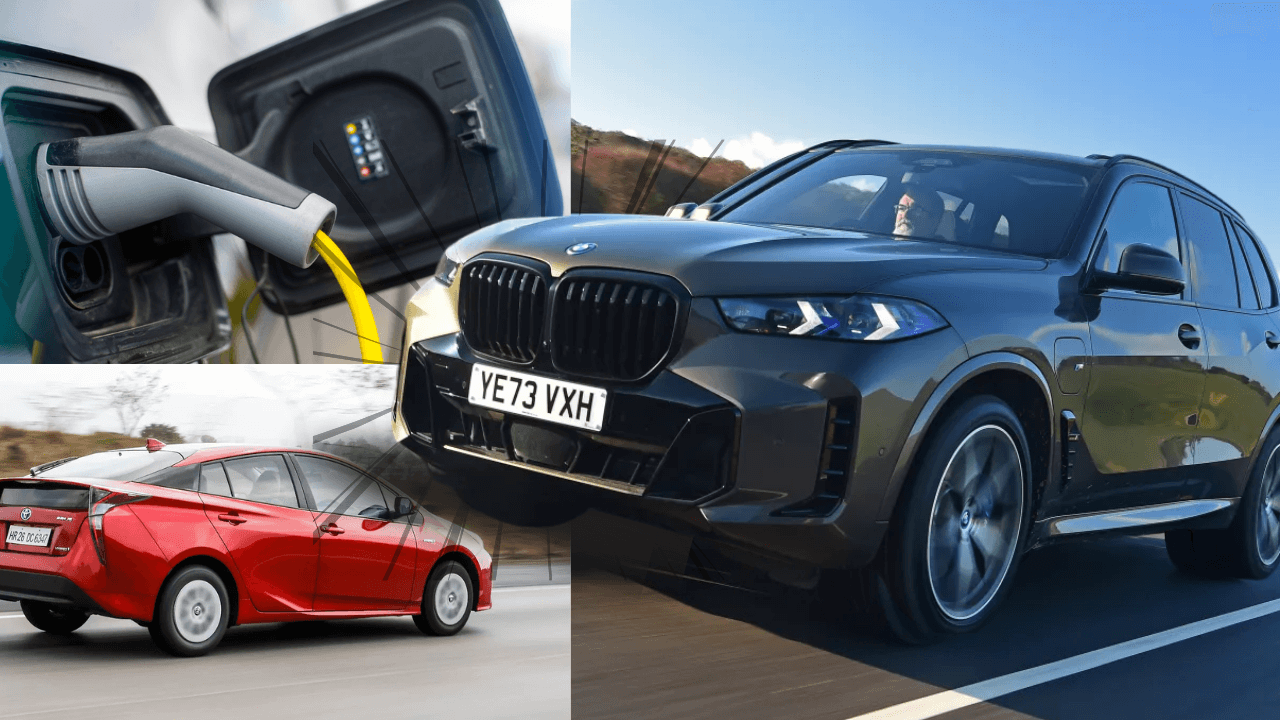
Crowning our best plug-in hybrid cars, the 2026 BMW X5 PHEV (483 hp, 40 miles EV) blends luxury, speed, and 58 MPGe. Adaptive air suspension? Road-melting.
72 cu ft cargo, third row available. From $74,975. Pros: Dynamic drive, premium tech. Cons: Firm ride. The undisputed “best plug-in hybrid luxury SUV 2026.”
Head-to-Head: 2026 Best Plug-In Hybrid Cars Comparison Table
| Rank | Model | EV Range (miles) | Combined MPGe | Starting Price ($) | 0-60 (secs) | Best For |
| 1 | BMW X5 xDrive50e | 40 | 58 | 74,975 | 4.6 | Luxury Performance |
| 2 | Toyota RAV4 PHEV | 42 | 94 | 45,000 | 5.4 | Family Versatility |
| 3 | Toyota Prius PHEV | 44 | 127 | 34,000 | 6.6 | Efficiency Commuter |
| 4 | Hyundai Tucson PHEV | 33 | 80 | 39,000 | 7.0 | Budget Crossover |
| 5 | Lexus RX 450h+ | 37 | 83 | 71,260 | 6.0 | Refined Reliability |
| 6 | Volvo XC60 PHEV | 36 | 63 | 58,050 | 4.5 | Safety-Focused Luxury |
| 7 | Mazda CX-70 PHEV | 26 | 25 (hybrid) | 48,780 | 6.0 | Spirited Midsize |
| 8 | BMW M5 PHEV | 25 | 25 | 123,075 | 3.1 | High-Performance Sedan |
| 9 | Chrysler Pacifica PHEV | 32 | 84 | 52,000 | 7.8 | Minivan Hauler |
| 10 | Mercedes GLC 300e | 36 | 58 | 58,000 | 6.2 | Compact Luxury SUV |
(Data from EPA, Edmunds, Car and Driver as of Nov 2025; prices U.S. MSRP, incentives vary.)
FAQ: Your 2026 Best Plug-In Hybrid Cars Quick Hits
Toyota Prius PHEV’s 127 MPGe crushes it for commuters.
Hyundai Tucson PHEV—value-packed with 33 miles EV.
Prius Prime’s 44 miles edges the pack.
Yes-ROI in 3 years via savings and rebates.
RAV4 PHEV for space and safety.
Final Thoughts: Plug Into the Best Plug-In Hybrid Cars of 2026 Today!
Honestly, looking at everything from the BMW X5’s crazy torque to the Prius Prime quietly stretching every drop of fuel, it’s pretty clear you don’t really have to pick between power, everyday usefulness, and being kinder to the planet anymore. These 2026 plug-in hybrids kind of cover all those boxes without making you compromise much.
If I had to name one that just feels right for most people, it’d be the RAV4 PHEV. It’s one of those cars that just does everything without complaining – school runs, long drives, quick errands, whatever. And that first silent push in EV mode always feels a little addictive the first time you try it.
With all the tax credits shifting around and hybrids getting more popular by the month, this is actually a pretty good moment to try one out.
Got a plug-in hybrid you’ve been eyeing? I’m curious – tell me which one you’re thinking about.
Additional Reading:
Spread Some Love
Author