How Many Miles Do Teslas Really Last

How Many Miles Do Teslas Really Last? The Ultimate 2026 Guide

The most common question for any prospective or current Tesla owner is: When will I need to replace the battery? 

While many assume an EV is like a smartphone that dies after two years, the data tells a much more impressive story.

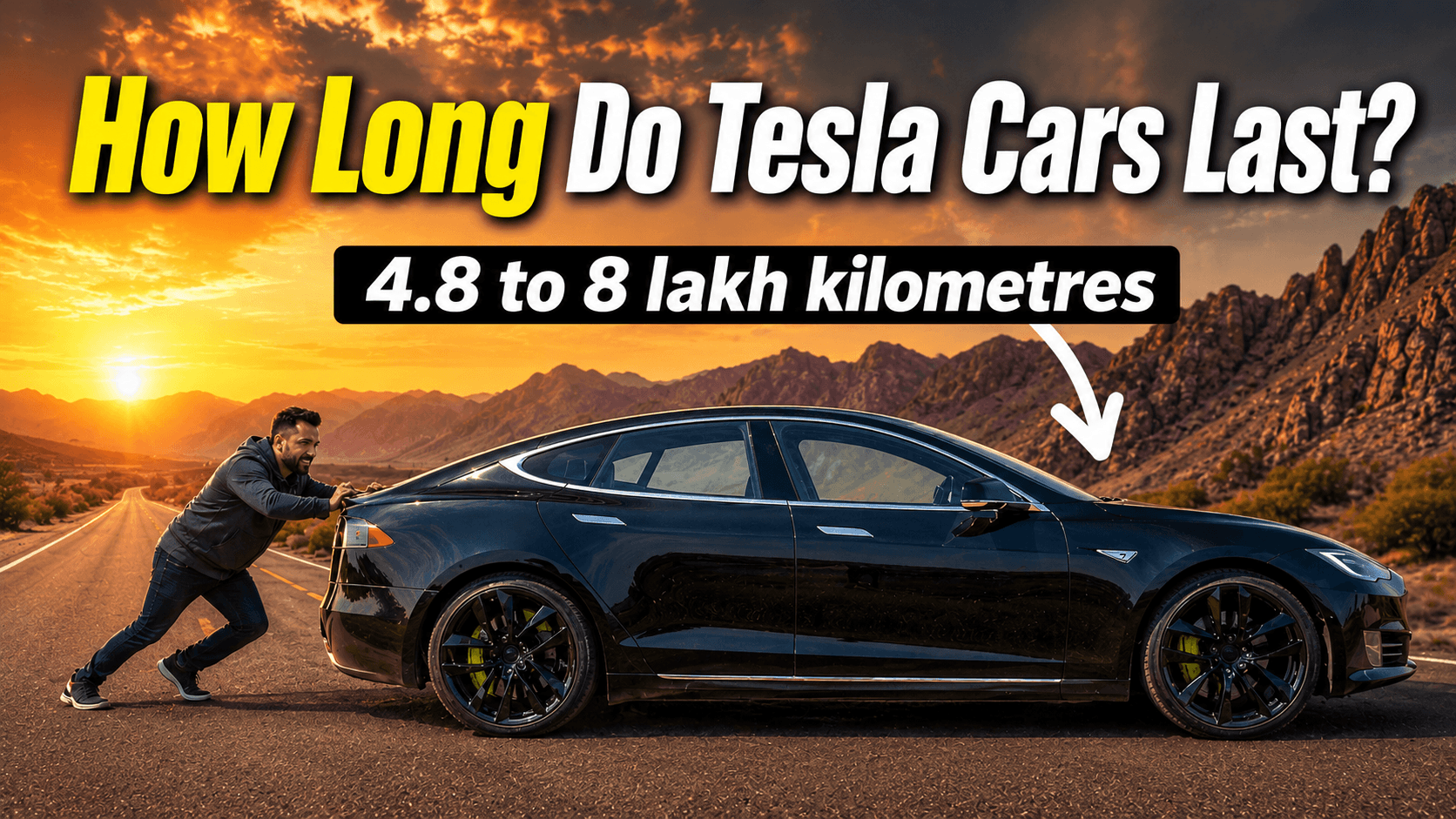
According to Tesla’s 2024–2025 Impact Reports and aggregated fleet data, a Tesla battery is designed to last between 300,000 and 500,000 miles.

For the average American driver, this translates to roughly 21 to 35 years of use, likely outlasting the car’s chassis itself.

In this informative article on how many miles do Teslas last, we are going to cover the following-

  1. Factors affecting Tesla Battery Life and Range
  2. How to optimize your Driving Style for Maximum Range and Battery Life
  3. Common Maintenance Tips for Longer Tesla Battery Life
  4. Different Battery Packs that come with Tesla Car Models
  5. The 5 Tesla Car Models currently on Sale in the USA Market and Battery Packs
  6. Top 10 Mistakes that kill your Tesla Battery Range and Life
  7. 10 Proven Ways You Can Make Your Tesla Last Longer and Protect the Battery
  8. How long do people keep their Teslas in the USA (actual data)
  9. 21 Important FAQs on How Many Miles do Teslas Last

If you are an existing Tesla owner or are in the market for a new one, it is highly recommended that you spend the next twenty minutes going through the article!

Factors That Affect Tesla Battery Life And Range:

Factors That Affect Tesla Battery Life And Range

Battery longevity isn’t just about the odometer; it’s about chemical age. 

A lot of users don’t understand that while driving styles are a part of how you can optimize your Tesla’s battery life and longevity, at the end of the day, you cannot outrun science. 

1. Temperature Extremes:

    High heat is the #1 enemy of lithium-ion batteries. 

    While Tesla’s thermal management system (TMS) actively cools the pack, consistent exposure to 100°F+ temperatures accelerates degradation.

    2. Cycle Depth:

      Frequently running your battery from 100% down to 0% creates more stress than smaller, frequent charges (e.g., 20% to 80%).

      3. Charging Speed: 

        Frequent use of High-Voltage DC Fast Chargers (Superchargers) generates heat and can cause faster degradation compared to Level 2 (Home) charging.

        4. Time: 

          Even if you don’t drive, batteries undergo calendar aging. However, this is significantly slower than usage-based wear.

          To protect your Tesla from extreme heat conditions like the ones that are routine in the Midwest America, it’s important to keep your Tesla indoors. 

          Be consistent with your charging. Try to charge the vehicle every other day, rather than waiting until the end of the week when it drops below 5%. 

          Avoiding superchargers is important. Home charging solutions work best. 

          Driving Styles For Maximum Range:

          If you want to beat the EPA estimate on a road trip. 

          If you want to take out an additional twenty miles of range per charge, adopt the following habits to make your Tesla last. 

          1. The Chill Mode Advantage:

            Switching your acceleration setting to Chill prevents high-current draws that heat up the battery and waste energy.

            2. One-Pedal Driving:

              Mastering regenerative braking is essential. By easing off the accelerator rather than hitting the brakes, you feed energy back into the battery.

              3. Speed Management:

                Aerodynamic drag increases exponentially. Driving at 65 mph instead of 80 mph can increase your real-world range by up to 15-20%.

                4. Consistent Velocity: 

                  Using Autopilot or Traffic-Aware Cruise Control on highways helps maintain a steady energy draw, which is more efficient than manual pulse driving.

                  The important thing to note is that you want to build these habits over time. 

                  Again, when we are looking at a three-to-five-year vehicle ownership experience, you will see a positive compounding effect by mastering the above. 

                  In total, it’s estimated that you will add between 5000 and 10000 additional miles of range over the vehicle’s lifetime!

                  Maintenance Tips To Protect Your Tesla Battery:

                  Teslas require very little maintenance. They are engineered to perfection. 

                  However, at the end of the day, they are automobiles that are influenced by human beings and their driving and maintenance styles.  

                  If you want your Teslas to last thousands of miles, these steps are critical:

                  1. ABC (Always Be Charging):

                    Tesla recommends keeping the car plugged in when not in use. This allows the car to use wall power rather than battery power for background tasks like battery heating/cooling.

                    2. Set Your Limit:

                      For daily use, set your charge limit to 80%. Only charge to 100% immediately before a long road trip.

                      3. LFP Exception:

                        If you own a Model 3 RWD with an LFP (Lithium Iron Phosphate) battery, Tesla actually recommends charging to 100% at least once a week to calibrate the battery sensor.

                        4. Tire Pressure:

                          Check your PSI monthly. Low tire pressure creates rolling resistance, forcing the battery to work harder.

                          These small and slight adjustments are guaranteed to help you improve the life of your Tesla vehicle. 

                          Tires play a major role in removing resistance, easing the battery to perform at a lower output but giving the same level of performance. 

                          Tesla Battery Packs And Their Range:

                          So, Tesla uses different chemistries depending on the model’s purpose.

                          Battery TypeChemistryFound InKey Characteristic
                          Standard RangeLFPModel 3/Y RWDExtremely durable; can be charged to 100% regularly.
                          Long RangeNMC/NCAModel 3/Y/S/XHigher energy density; better for cold weather and performance.
                          Structural Pack4680 CellsNewer Model YsIntegrated into the car’s frame for better safety and efficiency.

                          Tesla Models Ranked By Range (2025 Specs):

                          1. Model S (Long Range): 402 miles
                          2. Model 3 (Long Range): 363 miles
                          3. Model X (Long Range): 335 miles
                          4. Model Y (Long Range): 310–330 miles
                          5. Cybertruck (AWD): 340 miles (470+ with Range Extender)

                          Even if you are not in the market for a long-range Tesla, experts recommend stretching your budget slightly and going for one. 

                          Anytime you are purchasing an EV, it’s important that you go for the highest battery pack available. 

                          Why? Simply because it’s not always about the range. 

                          It’s also the structural reinforcements, the parts usage, the reduced maintenance and service cycles, and most importantly, the lower ownership costs over a five-year period. 

                          Top 10 Mistakes That Kill Your Tesla Battery Range And Life

                          1. Ignoring the Aero Covers: Removing the plastic wheel covers on a Model 3/Y can reduce range by 3-5%.
                          2. Blasting the Heater: Using the cabin heater is less efficient than using seat heaters.
                          3. Leaving Sentry Mode On Everywhere: Sentry Mode can drain 5-10 miles of range per day while parked.
                          4. Driving with Windows Down: At highway speeds, open windows create massive drag.
                          5. Frequent Floor It Starts: Drag-racing from every stoplight depletes energy exponentially.
                          6. Carrying Unnecessary Weight: 100 lbs of extra gear in the trunk reduces efficiency.
                          7. Ignoring Preconditioning: Not pre-warming the battery before a trip in winter.
                          8. Supercharging to 100%: The last 20% takes as long as the first 80% and stresses the pack.
                          9. Aftermarket Tires: Not all tires are EV-rated. Non-EV tires can drop range by 10%.
                          10. Roof Racks: Leaving empty roof racks on the car ruins the car’s aerodynamics.

                          A lot of car owners want to personalize their vehicles by doing off-market mods on them. Teslas are not built for them. 

                          Avoid using anything aftermarket on a Tesla. This includes rims, alloys, and larger or thicker tire profiles. 

                          The same thing with the stereo and speakers as well. Everything is proportioned to the Tesla’s battery pack in a way that it delivers range. 

                          By changing or altering the OEM setup, you are inviting trouble. 

                          Top 10 Things That Increase The Life Of Your Tesla:

                          In this section, let’s check out the top ten things you can do to increase the life of your Tesla. 

                          1. Master The 80/20 Rule (For Most Models):

                            Unless you have an LFP battery (Rear Wheel Drive models), the Sweet Spot for lithium-ion health is between 20% and 80%.

                            Keeping your car within this range prevents the chemical stress that occurs at the extreme ends of the charge cycle. 

                            Think of it like a human lung—it’s most efficient when it’s not completely empty or over-inflated.

                            2. Prioritize AC Home Charging:

                              While Superchargers are convenient, they use high-voltage DC current that generates significant heat. 

                              Frequent heat spikes can accelerate battery degradation. 

                              Using a Tesla Wall Connector or Mobile Connector at home provides a slower, cooler AC charge that is much gentler on the battery cells over a 10-year period.

                              3. ABC – Always Be Charging:

                                Tesla’s mantra is simple: Always Be Charging.

                                When your car is plugged in, it uses shore power (from your house) to run onboard computers, Sentry Mode, and battery temperature management. 

                                This prevents the high-voltage battery from having to cycle just to keep the car awake, saving its life for actual driving.

                                4. Use Scheduled Departure For Thermal Health:

                                  Cold batteries are inefficient; hot batteries degrade faster. Use the Scheduled Departure feature in the Tesla app. 

                                  This tells the car to warm the battery and cabin using wall power right before you leave. Driving a “preconditioned” battery reduces internal resistance and wear.

                                  5. Rotate Tires Every 6,250 Miles:

                                    Because Teslas are heavy and have instant torque, they eat through tires faster than gas cars. 

                                    Regular rotations (every 6,250 miles) prevent uneven wear and protect your suspension components from the vibrations and alignment issues caused by “cupped” or balding tires.

                                    6. Use Regenerative Braking Exclusively:

                                      Setting your braking to Standard (or using the Hold mode) allows the motors to do the work of slowing the car down. This doesn’t just put energy back into the battery; it saves your brake pads and rotors from physical wear. Many Tesla owners reach 150,000 miles on their original factory brake pads.

                                      7. Lubricate Brake Calipers (In Cold Climates):

                                        Because you rarely use the physical brakes (thanks to the tip above), the calipers can actually seize up from rust or road salt in winter. 

                                        If you live in a snowy region, cleaning and lubricating your calipers once a year prevents expensive brake failures that occur purely from lack of use.

                                        8. Keep Sentry Mode For High Risk Areas Only:

                                          Sentry Mode is a great security feature, but it keeps the car awake, consuming about 200–300 watts of power continuously. 

                                          Over a year, this constant vampire drain adds hundreds of extra charge cycles to your battery. 

                                          Set Sentry Mode to Exclude Home or Exclude Work to let the car enter a deep sleep.

                                          9. Manage Your Aero Profile:

                                            If you have the plastic Aero wheel covers, keep them on for long trips. They reduce turbulence around the wheels, which lowers the load on the drive unit. 

                                            Similarly, keep your windows up at highway speeds. Reducing the mechanical strain on the motors and battery to fight wind resistance extends their functional life.

                                            10. Avoid 0% At All Costs:

                                              While 100% is stressful, 0% is dangerous. 

                                              If a Tesla sits at 0% for an extended period, the battery can brick, meaning it becomes a chemical paperweight that requires a total replacement ($15k+). 

                                              If you ever arrive home with a very low charge, plug it in immediately; even a standard 110V outlet can be a lifesaver.

                                              Ownership Data: How Long Do People Keep Their Tesla Cars?

                                              In the United States, the average car ownership duration is roughly 6 to 8 years. Because Tesla batteries are projected to last 20+ years, the second-life market is booming. 

                                              Most Tesla owners trade in their vehicles not because the battery died, but to upgrade to newer software, faster processors, or improved hardware (like Hardware 4.0 for Full Self-Driving).

                                              Frequently Asked Questions:

                                              Check out the 21 most common FAQs on how to make your Tesla last:

                                              1. Does the battery die if I don’t drive it? 

                                              No, but it will slowly discharge. Keep it plugged in to avoid vampire drain.

                                              2. How much does a replacement battery cost? 

                                              Out-of-warranty replacements typically cost between $12,000 and $20,000.

                                              3. What is the battery warranty? 

                                              8 years or 100,000–150,000 miles (depending on the model) with 70% capacity retention.

                                              4. How much range is lost in winter?

                                              Expect a 20-30% drop in freezing temperatures without preconditioning.

                                              5. Is supercharging bad for the battery? 

                                              Occasional use is fine; daily use may cause slightly faster degradation (1-2% extra over several years).

                                              6. What is Phantom Drain?

                                              Energy is lost while the car is parked due to Sentry Mode, App pings, or cabin cooling.

                                              7. Can I jump-start a Tesla? 

                                              You can jump-start the 12V/16V low-voltage battery, but never the high-voltage pack.

                                              8. Does 100,000 miles mean the car is old? 

                                              For a Tesla, 100k miles is considered middle-aged, with most components still in excellent health.

                                              9. Should I charge to 100% for a road trip?

                                              Yes, just try to start driving immediately after it hits 100%.

                                              10. How do I check my battery health? 

                                              Go to “Service Mode” in the car’s settings to run a health test.

                                              11. What is LFP? 

                                              A cobalt-free battery that is heavier but more durable and cheaper.

                                              12. Does rain affect range?

                                              Yes, the water on the road increases rolling resistance and aerodynamic drag.

                                              13. Why does my range drop faster at 80 mph? 

                                              Wind resistance increases with the square of speed.

                                              14. Is it better to charge at 110V or 240V? 

                                              240V (Level 2) is more efficient because the car stays awake for less time during charging.

                                              15. Does the AC affect range as much as the heater?

                                              No, Tesla’s heat pumps make AC very efficient; the heater uses more energy.

                                              16. How many miles can a Tesla go on 0%?

                                              Usually, a “buffer” of 5-15 miles, but you should never rely on it.

                                              17. What is Preconditioning?

                                              Warming the battery to the ideal temperature for charging or driving.

                                              18. Do Tesla batteries get recycled?

                                              Yes, Tesla recycles nearly 100% of the materials in old packs.

                                              19. Can I use a non-Tesla charger?

                                              Yes, with an adapter (J1772 or NACS to CCS).

                                              20. Is the Model 3 battery the same as the Model Y?

                                              They share many components, but the Y often uses larger capacity packs.

                                              21. Does Full Self-Driving use more battery?

                                              The computer hardware uses a small amount of power, but the smoother driving of the AI often saves more energy than it uses.

                                              Will Your Tesla Last As Long As A Toyota?

                                              The answer is- it just might. From its very inception, the company has sold over 7.2 million vehicles all over the world. 

                                              There is no denying the fact that, as compared to other makes and manufacturers, it is a superiorly engineered product. 

                                              If you are really in the market for a Tesla and want to keep it for the next decade, make sure you memorize the content and keep your Tesla’s battery life in good shape for the next 100,000 miles!

                                              Additional Reading:

                                              samik ghoshal

                                              Samik Ghosal is a passionate content writer with a keen interest in sustainable mobility and the future of electric vehicles. At EV Authority, he crafts insightful articles that decode the latest trends, technologies, and innovations shaping the EV industry. With a background in creating engaging, research-driven content, Samik focuses on delivering clarity and depth to readers who want to stay ahead in the rapidly evolving world of clean transportation. His work blends technical accuracy with an approachable tone, making complex topics accessible to enthusiasts and professionals alike. When he’s not writing about battery breakthroughs or charging infrastructure, Samik enjoys exploring emerging green technologies and advocating for eco-friendly solutions. Through his writing, he aims to empower readers with knowledge that drives smarter, greener choices for a sustainable future.

                                              Leave a Reply

                                              Your email address will not be published. Required fields are marked *

                                              RELATABLE