Table Of Content
- Why Everyone Is Searching for Electric Cars Under ₹5 Lakhs
- Are There Really Electric Cars Under ₹5 Lakhs?
- Best Electric Cars in India Under ₹5 Lakhs
- PMV EaS E – The Car That Challenges Conventional Thinking
- Why It Stands Out
- Strom Motors R3 – Small but Different
- Tata Tiago EV (BaaS) – Affordable EV Ownership
- Used Electric Cars – The Smarter Choice?
- Life With a Budget Electric Car
- The Reality Check
- Who Should Buy an Electric Car Under ₹5 Lakhs?
- Who Should Wait?
- Our Verdict
- One Last Thought
- Frequently Asked Questions
Electric Cars in India Under 5 Lakhs 2026: The Truth Most Websites Will Never Tell You
Imagine walking into a showroom with a budget of ₹5 lakh and asking one simple question:
“Can I buy an electric car?”
A few years ago, the answer would have been a straightforward no.
Today, it’s yes… but with a catch.
Affordable electric cars are finally entering the Indian market, but many buyers walk in expecting a Tata Tiago EV for ₹5 lakh and leave disappointed. That’s because most EVs in this price range aren’t designed to replace your family hatchback—they’re designed to solve one specific problem: making everyday city travel cheaper and easier.
If your daily routine consists of commuting to work, visiting the local market, dropping your child at school, or running errands within the city, spending ₹12–15 lakh on an EV might not always make sense.
That’s where this guide comes in.
Instead of chasing marketing claims, let’s answer the real question:
Which electric cars under ₹5 lakh are actually worth considering—and who should buy them?
Why Everyone Is Searching for Electric Cars Under ₹5 Lakhs
Let’s be honest.
Most people aren’t buying an EV to save the planet.
They’re buying one because petrol prices continue to rise, maintenance costs are increasing, and city traffic is becoming more frustrating every year.
For someone travelling 30–40 km daily, an affordable EV isn’t just another vehicle—it could mean fewer trips to the fuel station, lower servicing costs, and a quieter, stress-free drive.
The dream is simple:
Spend less on running the car and more on enjoying where it takes you.
Are There Really Electric Cars Under ₹5 Lakhs?
Yes—but it’s important to understand what you’re getting.
At this budget, don’t expect a spacious five-seater with premium features and a long highway range.
Instead, you’ll mostly find micro EVs, compact city cars, and a few low-speed electric vehicles designed for urban use.
Think of them as specialists rather than all-rounders.
Just as you wouldn’t buy a sports bike to carry an entire family, you shouldn’t expect a ₹5 lakh EV to do everything a ₹15 lakh car can.
Best Electric Cars in India Under ₹5 Lakhs
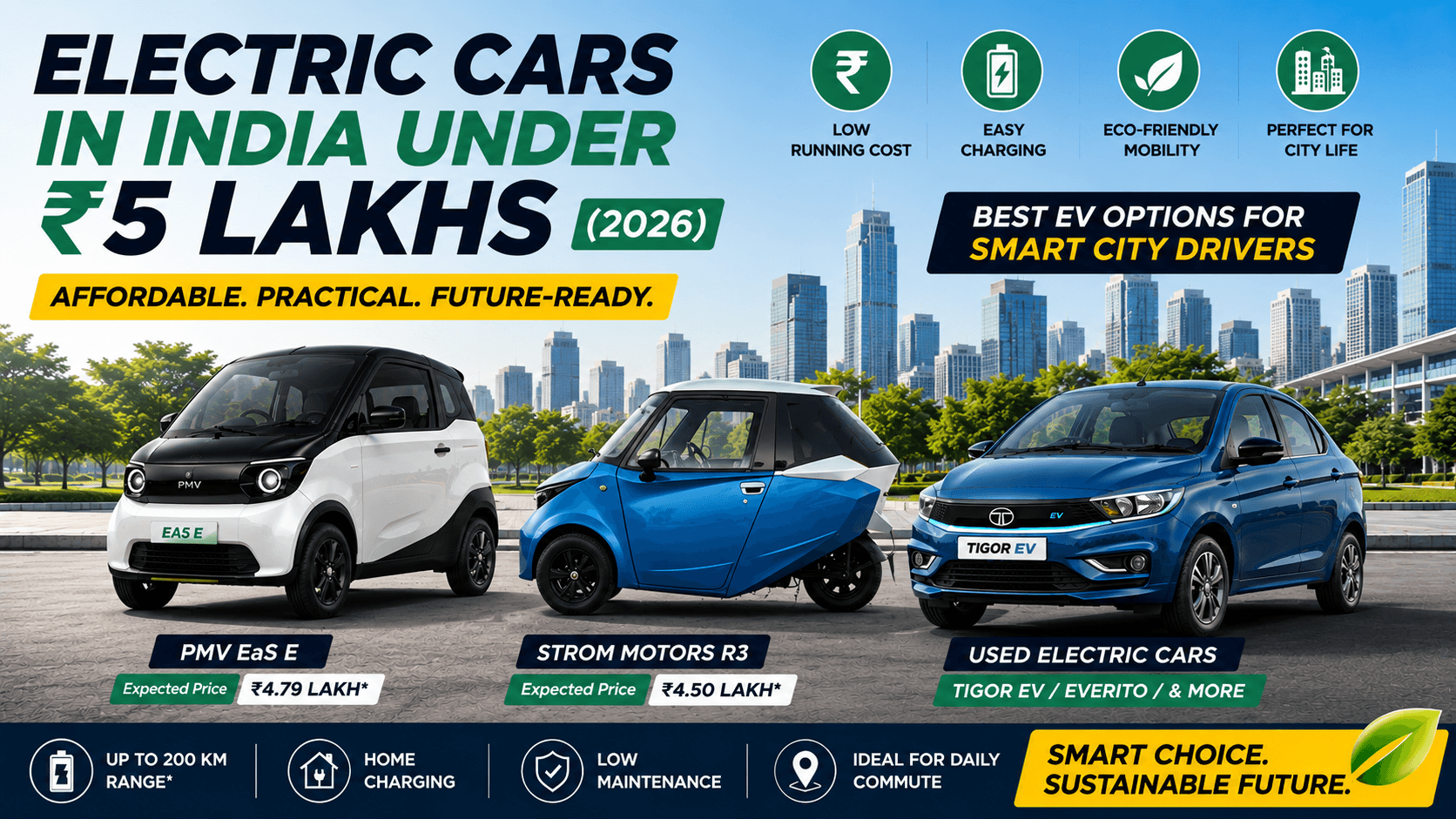
PMV EaS E – The Car That Challenges Conventional Thinking
Expected Price: Around ₹4.79 lakh*
The PMV EaS E isn’t trying to become another hatchback.
Instead, it asks a question most of us never stop to consider:
How often do you actually use all five seats in your car?
For many office-goers, the answer is surprisingly rare.
Most weekdays involve one person driving alone through traffic before spending several minutes searching for parking.
PMV looked at that reality and built a car around it.
The result is a compact two-seater electric vehicle that focuses on everyday practicality rather than unnecessary size.
Why It Stands Out
- Up to 200 km claimed range
- Compact size ideal for crowded cities
- Easy home charging
- Low running costs
- Beginner-friendly automatic driving
It’s not a car you’ll buy for weekend road trips.
It’s a car you’ll appreciate every Monday morning.
Strom Motors R3 – Small but Different
Expected Price: Around ₹4.5 lakh*
The Strom R3 has been around in discussions for several years and still attracts attention because of its unusual three-wheel design.
It looks futuristic and promises affordable electric mobility for urban buyers.
However, buyers should also consider production timelines and service availability before making a decision.
A good idea only becomes a good purchase when ownership is equally dependable.
Tata Tiago EV (BaaS) – Affordable EV Ownership
Expected Price: Around ₹5 lakh (excluding battery)*
The Tata Tiago EV BaaS lowers the upfront cost by separating the battery from the vehicle price. Buyers pay a monthly battery subscription, making EV ownership more affordable.
With Tata’s trusted service network and practical range, it’s a smart choice for city commuters—but compare the subscription cost before buying.
Used Electric Cars – The Smarter Choice?
Here’s something many buyers overlook.
Instead of stretching your budget to buy a brand-new micro EV, you might find a used Tata Tigor EV, Mahindra eVerito, or even an older fleet EV within a similar price range.
They may not be the newest vehicles on the road, but they often come with one major advantage:
An established service network.
Sometimes, peace of mind is worth more than a brand-new registration certificate.
Life With a Budget Electric Car
Let’s forget specifications for a moment.
Imagine this.
It’s 8:30 on a Tuesday morning.
You’re running late.
Traffic is already building.
You slide into a parking space that larger SUVs drive past because it’s simply too small.
After work, instead of stopping at a petrol station, you return home, plug the car into a regular charging socket, and head inside for dinner.
By morning, it’s ready to go again.
That’s the part of EV ownership brochures rarely talk about.
The biggest luxury isn’t instant acceleration.
It’s convenience.
The Reality Check
Affordable electric cars are exciting.
But they’re not magic.
Before buying one, ask yourself a few honest questions.
Do you have a place to charge it at home?
Will two seats be enough most days?
Is there a nearby service centre?
Can the manufacturer support the vehicle five years from now?
These questions matter far more than another 20 km of claimed driving range.
Who Should Buy an Electric Car Under ₹5 Lakhs?
You’ll probably enjoy owning one if:
- Your daily commute is under 50 km.
- Most of your driving happens inside the city.
- You have access to home charging.
- You’re looking for a second family car.
- You’re tired of spending money on petrol every week.
Who Should Wait?
A budget EV may not be right if:
- You regularly travel long distances.
- You need a spacious family car.
- You often drive on highways.
- You rely on a strong nationwide service network.
- You frequently carry passengers or luggage.
Sometimes spending a little more upfront can save you from making compromises later.
Our Verdict
The search for electric cars in India under ₹5 lakhs isn’t really about finding the cheapest EV.
It’s about finding the right EV.
Vehicles like the PMV EaS E prove that affordable electric mobility is no longer just an idea—it has started becoming a reality.
Will these cars replace traditional hatchbacks?
Not yet.
But they don’t have to.
For thousands of urban commuters, they simply need to make one everyday task easier:
Getting from home to work… and back again.
And maybe that’s the biggest lesson budget EVs teach us.
The future of electric mobility isn’t always about bigger batteries or faster charging.
Sometimes, it’s about building a car that quietly fits into your life so well that you stop thinking about it altogether.
One Last Thought
Twenty years ago, power steering was considered a luxury.
Then automatic transmissions became “too expensive.”
Today, both are part of everyday driving.
Affordable electric cars may be following the same path.
The first generation won’t be perfect.
Neither was the first smartphone.
But every new idea starts somewhere.
Perhaps the question isn’t,
“Can I buy an electric car under ₹5 lakh?”
Maybe the better question is,
“Will we look back five years from now and wonder why we ever thought it was impossible?”
Frequently Asked Questions
The PMV EaS E is among the most affordable electric cars expected to be available in India, with an estimated starting price of around ₹4.79 lakh (ex-showroom).
Yes, if your daily commute is mostly within the city and you have access to home charging. They’re designed for urban mobility rather than long-distance touring.
Yes. Most affordable electric cars support charging through a standard AC household power outlet.
If long-term service support and practicality are your priorities, a well-maintained used EV from an established brand may offer better value. If you want a brand-new vehicle focused on city commuting, a micro EV like the PMV EaS E is worth considering.
Spread Some Love
Author