Table Of Content
- Petrol Costs vs Electric Savings: The Bigger Financial Picture
- 1. Ola Electric Battery Pricing (2026 Generation Update)
- Estimated EV Battery Prices:
- 2. Ather Energy Battery Pricing (Focused on Longevity)
- Estimated EV Battery Prices:
- 3. Hero Vida Battery Pricing (Battery-as-a-Service Model)
- Estimated EV Battery Prices:
- 4. Bajaj Chetak Battery Pricing (Durability-Focused Design)
- Estimated EV Battery Prices:
- 5. TVS iQube Battery Pricing (Wide Range of Options)
- Estimated EV Battery Prices:
- Why Electric Vehicles Are the Future
Battery Replacement Costs of Leading Electric Scooters in India (2026 Guide)
If you’re exploring electric scooters in 2026, you’re stepping into a market that has finally reached maturity. What once seemed uncertain has now become practical, reliable, and financially rewarding. Electric two-wheelers are no longer just about sustainability—they are now one of the smartest commuting choices available.
A major concern earlier was EV Battery Prices, especially when it came to replacement costs. Today, that narrative has changed significantly. With improvements in battery technology, stable raw material pricing, and flexible ownership options, EV Battery Prices have become far more manageable and predictable.
This guide provides a detailed look at EV Battery Prices across some of the most popular electric scooter brands in India, helping you understand real ownership costs and long-term value.
Petrol Costs vs Electric Savings: The Bigger Financial Picture
Before diving into EV Battery Prices, it’s important to understand the overall cost advantage of electric vehicles.
Over five years, a typical petrol scooter owner in India spends around ₹1.5 lakh on fuel and maintenance. In comparison, an electric scooter owner spends roughly ₹10,000–₹15,000 on electricity.
Even after factoring in EV Battery Prices for replacement, electric vehicle owners still come out significantly ahead financially. The savings generated through daily usage often offset battery expenses comfortably.
In essence, an electric scooter is not just a vehicle—it’s a long-term financial advantage.
1. Ola Electric Battery Pricing (2026 Generation Update)
Ola’s latest scooters feature advanced 4680-format lithium cells, offering higher efficiency and improved energy density. These advancements directly influence EV Battery Prices by providing better performance per kWh.
Estimated EV Battery Prices:
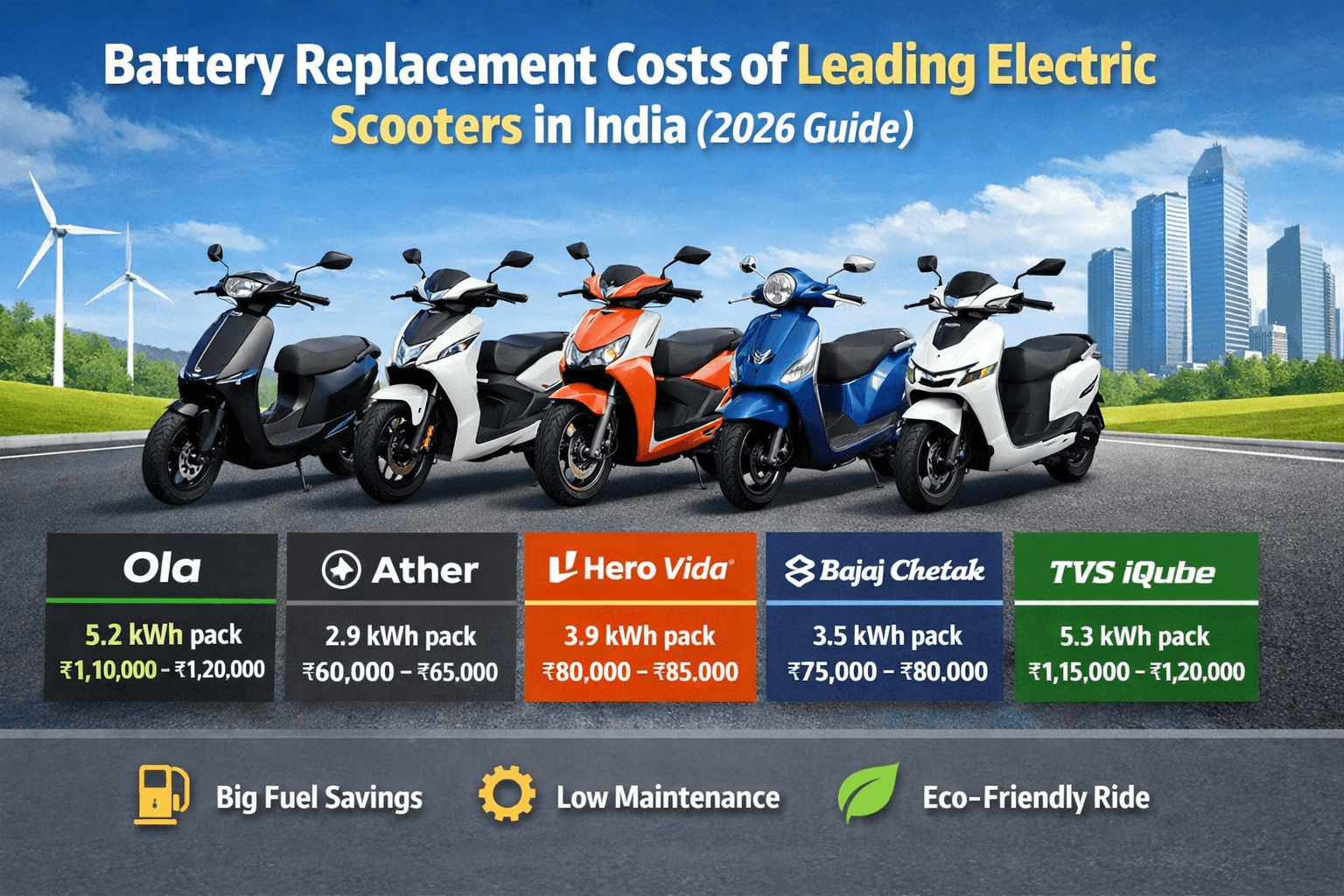
- 5.2 kWh pack: ₹1,10,000 – ₹1,20,000
- 4 kWh pack: ₹85,000 – ₹90,000
- 3 kWh pack: ₹70,000 – ₹75,000
- 2 kWh pack: ₹45,000 – ₹50,000
These EV Battery Prices reflect a balance between performance and cost efficiency, making them competitive in the current market.
2. Ather Energy Battery Pricing (Focused on Longevity)
Ather has built a strong reputation for durability and consistent performance. Its battery systems are designed to last longer, which plays a crucial role in reducing long-term impact of EV Battery Prices.
Many users report that these batteries retain excellent health even after several years of usage, minimizing the need for early replacement.
Estimated EV Battery Prices:
- 2.9 kWh pack: ₹60,000 – ₹65,000
- 3.7 kWh pack: ₹70,000 – ₹80,000
While the upfront EV Battery Prices may seem standard, their longevity often results in better overall value.
3. Hero Vida Battery Pricing (Battery-as-a-Service Model)
Hero’s Vida lineup introduces a flexible approach that directly addresses concerns around EV Battery Prices. With its Battery-as-a-Service (BaaS) model, users can avoid paying the full battery cost upfront.
Additionally, the modular battery design allows partial replacements, further optimizing EV Battery Prices over time.
Estimated EV Battery Prices:
- 3.9 kWh pack: ₹80,000 – ₹85,000
- 3.4 kWh pack: ₹70,000 – ₹75,000
- 2.2 kWh pack: ₹45,000 – ₹50,000
This model provides greater affordability and flexibility compared to traditional ownership.
4. Bajaj Chetak Battery Pricing (Durability-Focused Design)
Bajaj focuses on long-term durability, ensuring that EV Battery Prices are justified through extended battery life. Their robust battery casings are built to withstand tough environmental conditions.
This approach reduces the frequency of replacements, making EV Battery Prices less of a recurring concern.
Estimated EV Battery Prices:
- 3.5 kWh pack: ₹75,000 – ₹80,000
- 3 kWh pack: ₹70,000 – ₹75,000
- 2.5 kWh pack: ₹55,000 – ₹60,000
The emphasis here is on reliability and long-term peace of mind.
5. TVS iQube Battery Pricing (Wide Range of Options)
TVS offers one of the most versatile electric scooter lineups, with multiple battery configurations catering to different needs. This diversity gives consumers flexibility when evaluating EV Battery Prices.
Estimated EV Battery Prices:
- 2.2 kWh pack: ₹45,000 – ₹50,000
- 3.1 kWh pack: ₹65,000 – ₹70,000
- 3.5 kWh pack: ₹75,000 – ₹80,000
- 4.4 kWh pack: ₹85,000 – ₹1,00,000
- 5.3 kWh pack: ₹1,15,000 – ₹1,20,000
These options allow users to choose based on their budget and range requirements.
Why Electric Vehicles Are the Future
Focusing only on EV Battery Prices can sometimes distract from the bigger picture. It’s similar to worrying about engine replacement costs in petrol vehicles—important, but not the defining factor of ownership.
Electric vehicles have proven to be not only environmentally friendly but also financially superior. They eliminate dependence on fluctuating fuel prices and significantly reduce maintenance expenses.
Every kilometer traveled contributes to savings, which eventually offset EV Battery Prices when replacement becomes necessary.
Beyond cost benefits, EVs offer:
- Cleaner air and reduced emissions
- Quiet and smooth rides
- Lower running costs
- Continuous upgrades through software
The shift to electric mobility is no longer optional—it’s inevitable. Traditional fuel-based vehicles had their era, but the future clearly belongs to efficient, quiet, and technologically advanced electric transportation.
Additional Reading:
Spread Some Love
Author