Table Of Content
- Understanding Tesla’s 2026 Battery Lineup:
- Cost Breakdown By Model (2026 Estimates):
- The Financial Safety Net: Insurance Vs. Warranty
- The Role Of Insurance: Damage And Accidental Loss
- The Standard Tesla Battery Warranty:
- Can You Extend The Battery Warranty? (The 2026 Update)
- The Battery & Drive Unit ESA (Extended Service Agreement):
- The Monthly ESA Subscription:
- Third-Party EV Life Insurance:
- Where To Get Your Tesla Battery Replaced? Major U.S. Service Hubs
- 1. Western United States (California & Pacific NW)
- 2. Central & Southern United States (Texas & Midwest)
- 3. Eastern United States (New York, Florida, And NE)
- How To Find Your Nearest Service Center (Real-Time)?
- 10 Warning Signs You Need A New Battery:
- Top 10 Mistakes To Avoid When Replacing Your Battery
- Tesla Battery Replacement: The Final Takeaway
The 2026 Guide To Tesla Battery Replacement Costs: Models, Warranty, And Expert Tips
Tesla’s battery technology is widely considered the pinnacle of automotive engineering because it represents a shift from buying parts to engineering a cohesive ecosystem.
By 2026, Tesla will have moved beyond simply making a battery; they will have turned the battery into the primary structural component of the vehicle.
Tesla hasn’t just built a better battery; they’ve built a vehicle that is defined by its battery.
From the tableless chemistry to the structural floor, every millimeter of the pack is engineered to be lighter, cheaper, and more durable than anything else on the road today.
In other words, for anyone buying a Tesla in 2026, the battery is the heart and soul of the vehicle.
This is the same priority you would assign to the engine and transmission in any ICE vehicle. For Tesla, it all begins and ends with the battery.
As a Tesla owner, it’s essential that you understand what you need to do if you are in the market for a Tesla battery replacement.
In this article, we are going to educate and inform you about the most important points regarding Tesla battery replacement.
Understanding Tesla’s 2026 Battery Lineup:
Tesla has diversified its battery chemistry to balance cost, performance, and longevity.
Different battery constructions are meant to offer different outputs and performance. There is no single battery type that is consistent across the product range.
That is Tesla’s beauty.
The battery performance is optimized to seamlessly blend into the character of the vehicle you are getting from Tesla.
- LFP (Lithium Iron Phosphate):
Found in Standard Range Model 3/Y. These are cobalt-free, incredibly durable, and can be charged to 100% daily.
This is the workhorse model that is found in its highest-selling and most efficient bread-and-butter products- the Model 3 and the Model Y.
- NMC/NCA (Nickel Manganese Cobalt/Aluminum):
Found in Long Range and Performance models. These offer higher energy density for longer trips and faster acceleration.
This is the battery pack you are going to employ when you turn on the Plaid model in the Model X.
- 4680 Structural Cells:
These cells are integrated into the vehicle’s frame (Model Y and Cybertruck), offering better safety but potentially more complex full-pack replacement procedures.
This is the newer battery development from Tesla that is completely integrated into the vehicle’s chassis and frame.
Cost Breakdown By Model (2026 Estimates):
While battery prices have stabilized, labor and shop fees vary. These figures reflect out-of-pocket costs at a Tesla Service Center for a full pack swap.
It’s always advisable that when it comes to vehicles like Tesla, which are more tech than engineering, visiting Tesla’s own service center is your best and safest bet.
If you are going to go for a full Tesla battery replacement, do it at authorized centers only!
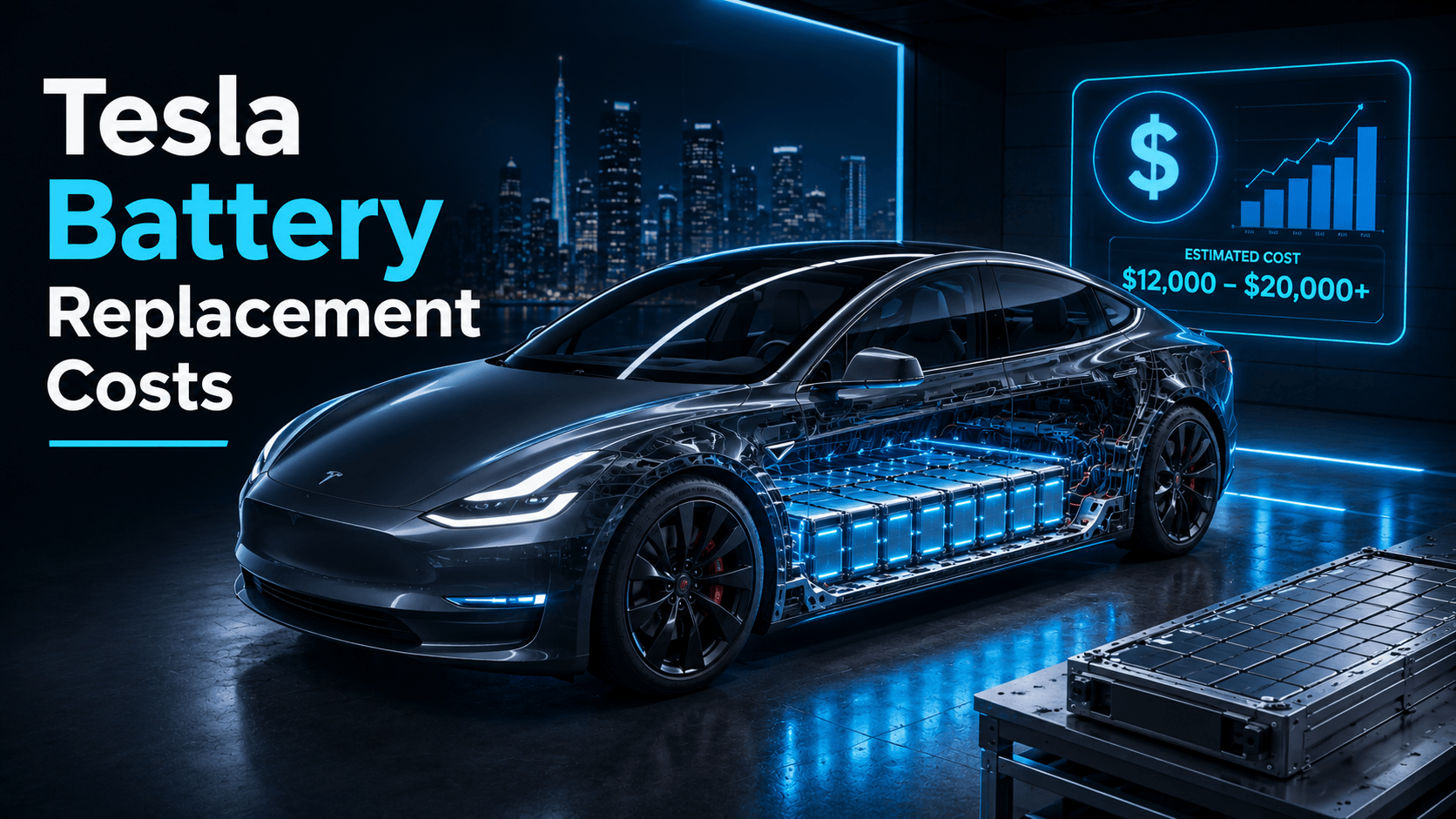
| Tesla Model | Battery Size (Est.) | Estimated Replacement Cost (Parts + Labor) |
|---|---|---|
| Model 3 (RWD/LFP) | 60 kWh | $11,000 – $13,500 |
| Model 3 (Long Range) | 82 kWh | $14,000 – $17,000 |
| Model Y (All Variants) | 75-82 kWh | $13,500 – $18,000 |
| Model S (Long Range/Plaid) | 100 kWh | $18,000 – $22,000 |
| Model X (Long Range/Plaid) | 100 kWh | $19,000 – $24,000 |
| Cybertruck | 123 kWh | $22,000 – $28,000 |
In recent years, there have been many highly rated auto repair shops that have come up where you can take your vehicle as well if you want to get your battery replaced.
However, make sure that you do your research, check online reviews, and talk to the shop before you get any work done.
Replacing a Tesla battery is not the same as doing one for a Dodge truck.
The Financial Safety Net: Insurance Vs. Warranty
When a battery fails or is damaged, the first question is always: Who pays for it? In 2026, the answer depends on why the battery stopped working.
There is a critical distinction between failure (covered by Tesla) and damage (covered by Insurance).
The Role Of Insurance: Damage And Accidental Loss
Standard auto insurance does not cover mechanical failure or battery “death” due to old age.
However, because the battery is the most expensive part of the car, your insurance policy is your primary protection against external hazards.
- Road Debris & Punctures:
If you hit a rock or a piece of metal on the highway that punctures the battery casing, this is a Comprehensive Claim. Given that a replacement costs $15,000+, insurers will often Total the vehicle rather than pay for a new pack, especially on older models.
- Collisions:
If another vehicle hits yours and the high-voltage pack is compromised, the at-fault party’s liability insurance (or your Collision coverage) handles the replacement.
- Environmental Damage:
Floods (water ingress) and fires are typically covered under Comprehensive insurance.
- Gap Insurance is Essential:
Because Tesla prices can fluctuate, Gap Insurance is highly recommended. If your car is totaled due to battery damage, Gap insurance covers the difference between what you owe on your loan and the car’s current market value.
The Standard Tesla Battery Warranty:
Every new Tesla comes with a Battery and Drive Unit Limited Warranty. In 2026, the terms are standardized based on the model:
| Model | Warranty Period | Mileage Limit | Retention Guarantee |
|---|---|---|---|
| Model 3 / Y (RWD) | 8 Years | 100,000 Miles | 70% Capacity |
| Model 3 / Y (Long Range/Perf) | 8 Years | 120,000 Miles | 70% Capacity |
| Model S / X / Cybertruck | 8 Years | 150,000 Miles | 70% Capacity |
What is the 70% Guarantee? If your battery health drops below 70% of its original capacity within the 8-year window, Tesla will repair or replace the pack for free.
However, they may replace it with a remanufactured pack that matches the age and mileage of your vehicle, rather than a brand-new one.
Can You Extend The Battery Warranty? (The 2026 Update)
For the first time, Tesla has introduced official options to extend protection beyond the factory 8-year mark.
The Battery & Drive Unit ESA (Extended Service Agreement):
- Availability: Currently offered for Model 3 and Model Y owners in the US and Canada.
- The Coverage: Adds an additional 2 years or 30,000 miles of protection (whichever comes first).
- The Cost: Typically $2,000 USD (one-time upfront payment).
- The Catch: You must purchase this while your original factory battery warranty is still active. There is also a $500 deductible per service visit.
The Monthly ESA Subscription:
For general vehicle components (screens, door handles, suspension), Tesla offers a monthly subscription in the app (approx. $50–$150/month).
While this covers many expensive parts, it is separate from the specialized High-Voltage Battery ESA mentioned above.
Third-Party EV Life Insurance:
In 2026, specialized third-party companies will offer EV Component Insurance.
For a monthly premium, these plans act like a mechanical breakdown policy specifically for the battery.
These are popular for owners of older Model S vehicles (2014–2018) that are now out of their original 8-year warranty window.
If the battery fails because it’s defective, Tesla pays (Warranty). Alsao, the battery fails because you hit a pothole, your insurance company pays (Insurance).
If you want peace of mind for years 9 and 10, buy the Tesla Battery ESA for $2,000.
Where To Get Your Tesla Battery Replaced? Major U.S. Service Hubs
While minor repairs can be handled by Tesla’s Mobile Service fleet, a high-voltage battery replacement requires a specialized lift and high-voltage safety equipment found at brick-and-mortar Service Centers.
Below are the primary regional hubs equipped for major battery operations:
1. Western United States (California & Pacific NW)
- Tesla Fremont: 45500 Fremont Blvd, Fremont, CA 94538
- Tesla Rocklin: 4361 Granite Drive, Rocklin, CA 95677
- Tesla Seattle-SODO: 2200 6th Ave S, Seattle, WA 98134
- Tesla Las Vegas: 3150 W Sahara Ave, Las Vegas, NV 89102
2. Central & Southern United States (Texas & Midwest)
- Giga Texas Service (Austin): 1 Tesla Road, Austin, TX 78725
- Tesla Houston-Westchase: 9633 Westheimer Rd, Houston, TX 77063
- Tesla Chicago-Grand Ave: 500 W Grand Ave, Chicago, IL 60654
- Tesla Denver: 8200 E 96th Ave, Henderson, CO 80640
3. Eastern United States (New York, Florida, And NE)
- Tesla Brooklyn: 160 Van Brunt St, Brooklyn, NY 11231
- Tesla Jacksonville: 11650 Abess Blvd, Jacksonville, FL 32225
- Tesla Cherry Hill: 1605 NJ-70, Cherry Hill, NJ 08034
- Tesla Tysons Corner: 8281 Greensboro Dr, McLean, VA 22102
How To Find Your Nearest Service Center (Real-Time)?
For your blog readers, it is best to direct them to the live directory, as Tesla often relocates or opens larger Delivery & Service Centers to handle high volume.
- The Tesla App: Open the app > Service > Schedule Service. The app will automatically suggest the nearest center based on your vehicle’s GPS location.
- Tesla Find Us Map: Use the official Tesla Find Us interactive map. Tip: Filter the map specifically for Service to hide Superchargers and Stores.
- In-Car Navigation: On the main touchscreen, tap the Search bar and select the Service icon. It will list all nearby addresses with their current distance from you.
10 Warning Signs You Need A New Battery:
There is no denying the fact that the battery pack (whichever one you opt for) on a Tesla is an engineering marvel.
In terms of sustenance or longevity, you are easily looking at over 200,000+ miles.
However, in the event that there are certain issues, primarily of an unnatural nature, it’s best to keep your eyes open for the following:
- Sudden Range Drop: Losing 20-30% of range overnight without extreme weather.
- Maximum Charge Level Reduced: A specific dashboard alert indicating a cell failure.
- Unable to Supercharge: The car rejects high-voltage DC charging for safety.
- Frequent Vampire Drain: Losing more than 5% charge per day while parked.
- Acceleration Lag: The car feels sluggish even in Insane/Plaid mode.
- Power Shutdowns: The car turns off while driving or at stoplights.
- Excessive Cooling Fan Noise: The car struggles to keep the battery at a temperature during idle.
- App Alerts: Constant notifications regarding “Electrical System Backup” or “BMS” errors.
- Stuck at a Percentage: The charge indicator stays at one number for hours while charging.
- Physical Bulging: Visible deformation of the undercarriage (rare, but critical).
You need to be careful primarily so that you are not left stranded in the middle of nowhere when your Tesla battery dies.
By keeping an eye out for the ten points mentioned above, you will be able to avoid getting stuck and ensure that you and your family members in the car do not run into any inconvenience.
Top 10 Mistakes To Avoid When Replacing Your Battery
It’s essential that, no matter how much you think you know your Tesla, you try to avoid committing the following mistakes.
Not only can they harm the warranty of the Tesla battery, but they can also lead to injuries. Not to mention inflated bills and costs.
- Assuming it’s the Battery: Often, a $500 12V/16V low-voltage battery failure mimics a high-voltage failure.
- Ignoring the Warranty: Always check your app first; you might still have coverage!
- Trying to DIY: 400V–800V systems are lethal. Never open a Tesla battery pack yourself.
- Not Checking Secondary Market Prices: On older cars, it might be cheaper to sell the broken car to a hobbyist and buy a used Model 3.
- Using Uncertified Shops: Non-EV mechanics may lack the proper coolant vacuum tools, leading to air pockets and future fires.
- Buying a Used Pack Without Health Data: If buying a salvage pack, insist on a BMS (Battery Management System) report.
- Neglecting the Cooling System: If your coolant is leaking, a new battery will fail just as fast as the old one.
- Waiting Too Long: A failing battery can eventually brick the car’s computers, adding $2,000+ to the repair.
- Overlooking Insurance Claims: If you hit a pothole or debris, call your insurance before paying out of pocket.
- Not Running a Health Test: Use Tesla’s Service Mode to verify the degradation yourself before talking to a service advisor.
Tesla Battery Replacement: The Final Takeaway
A Tesla battery replacement is the engine rebuild of the 21st century.
While the $15,000–$25,000 price tag is daunting, the reality is that 99% of owners will never face this bill within the first 200,000 miles.
By following proper charging habits and monitoring your vehicle’s health via the app, your Tesla battery is built to outlast the car itself.
Spread Some Love
Author