Table Of Content
- Tesla’s Project Redwood: Elon Musk’s Plan To Kill China’s BYD
- Tesla Model Q: Launch And Major Announcements (2026)
- Introductory Pricing: The $25,000 Milestone For The Tesla Model Q
- Release And Launch Date Of The Tesla Model Q
- Design Language And Inspiration Of The Tesla Model Q:
- Tesla Model Q Performance:
- Tesla Model Q Battery Pack And Range:
- Where Does The Model Q Sit In The Tesla Lineup?
- The Unboxed Next-Gen Platform On Tesla Model Q:
- The Dawn Of The Next-Gen Tesla Era Is Here!
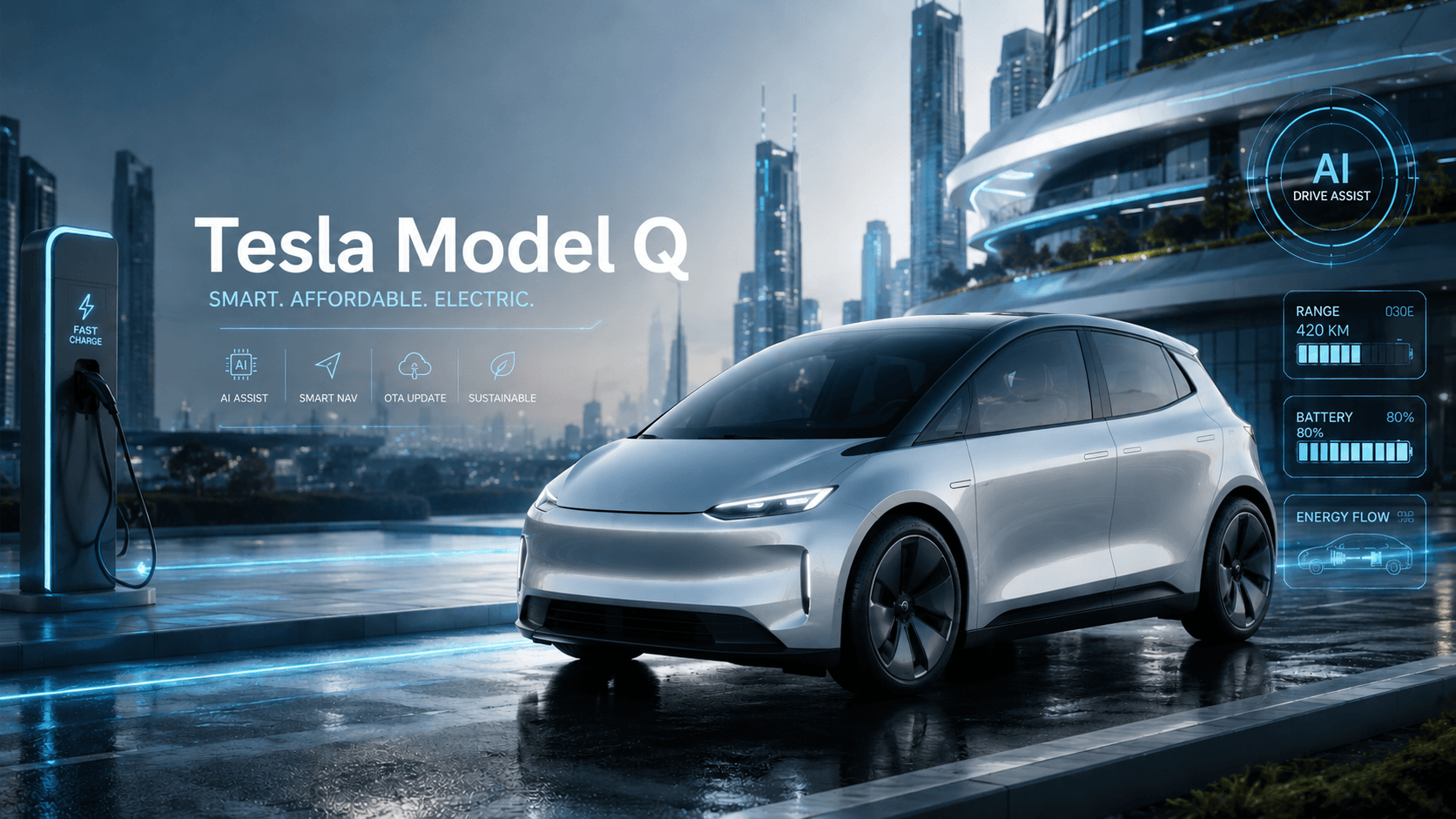
Tesla Model Q (Project Redwood) 2026: Price, Release Date, And Everything We Know
For nearly a decade, the $25,000 Tesla has been the Holy Grail of the electric vehicle industry.
Often referred to in media circles as the Model Q or Model 2, this vehicle is no longer just a rumor.
Codenamed Project Redwood, this compact crossover is the linchpin of Tesla’s plan to put the world on wheels and fend off aggressive competition from global budget EV makers.
In this comprehensive guide for evauthority.net, we dive into the specs, the Unboxed manufacturing revolution, and why this car is the most important release in Tesla’s history.
Most current coverage treats the Model Q as a shrunken Model 3.
Our analysis shows that to understand this car, you must look at Project Redwood as a radical departure in how cars are made.
Unlike other blogs, we focus on the 48V architecture and the Unboxed Process, which are the true reasons the $25,000 price tag is possible without sacrificing profit margins.
Tesla’s Project Redwood: Elon Musk’s Plan To Kill China’s BYD
Project Redwood has officially transitioned from a secretive development program into Tesla’s most critical production priority.
It is the internal codename for Tesla’s Next-Generation Vehicle Platform, which the automotive world has widely dubbed the Model Q or Model 2.
Project Redwood is not just another Tesla; it is Tesla’s defensive and offensive move to dominate the sub-$30,000 market.
It is designed to be the BYD-Killer, aimed directly at budget-friendly Chinese exports and the domestic entry-level market.
By halving production costs, Tesla aims to maintain its high profit margins while selling a car at a mass-market price point.
Project Redwood is the skeleton for two vehicles. The first is the human-driven Model Q crossover, and the second is the Cybercab (Robotaxi).
By sharing the same platform, Tesla ensures that both vehicles benefit from massive economies of scale, making autonomous transport and affordable ownership equally viable.
Tesla Model Q: Launch And Major Announcements (2026)
As of early 2026, Tesla has officially confirmed that the Next-Generation Vehicle Platform is in production.
While Model Q hasn’t been written off yet, Elon Musk referred to the Affordable Compact during the Q1 2026 Earnings Call as the linchpin for Tesla’s 20 million-vehicle-per-year goal.
Major auto journals (MotorTrend, Car and Driver) report that production has officially begun at Giga Texas and is being prepared for Giga Berlin.
As of May 2026, Tesla CEO Elon Musk confirmed during the Q1 earnings call that production for the Next-Gen Platform has moved past the prototype stage.
- The Pivot: Initially rumored to be canceled in favor of a dedicated Robotaxi (the Cybercab), Tesla has pivoted back to a “human-driven” version to capture the massive demand in Europe and North America.
- Production Hubs: Tooling is currently underway at Giga Texas, with Giga Berlin and Giga Shanghai expected to follow by late 2026.
Introductory Pricing: The $25,000 Milestone For The Tesla Model Q
The Model Q is designed to hit a starting MSRP of $24,990.
- Federal Incentives: With the 2026 clean vehicle credits, some U.S. buyers could see an effective price as low as $17,500.
- Subscription Model: To keep the base price low, Tesla is expected to offer features like heated seats, enhanced acceleration, and Full Self-Driving (FSD) as monthly subscriptions rather than bundled hardware costs.
Release And Launch Date Of The Tesla Model Q
- Production Start: Late 2025 (Limited).
- Mass Market Availability: Mid-to-Late 2026.
- Regional Rollout: Texas first, followed by Berlin and the proposed Mexico factory.
Q4 is expected to be the date for the early reservation holders in the United States.
In 2027, according to Tesla sources, production is to be ramped up to 10,000 units per week. Tesla is betting big on this mass market automobile to really go after VW.
Design Language And Inspiration Of The Tesla Model Q:
The Model Q moves away from the S3XY sedan look.
- Body Style: A Compact Crossover / Hatchback.
- Aero-Efficiency: Targeting a drag coefficient of <0.21 Cd to maximize range from a smaller battery.
- Interior: Ultra-minimalist. It is expected to use a pillar-to-pillar horizontal screen similar to the Cybertruck’s UI but simplified. Leaked renders and Redwood supply chain reports suggest a compact crossover/lifted hatchback shape.
- Exterior: Expect a shorter, more aggressive stance than the Model 3, featuring the horizontal LED light bar DNA seen on the Cybertruck.
In addition, a 15-inch central horizontal display remains, but Tesla is rumored to debut a textile-focused interior (recycled materials) to lower costs and appeal to eco-conscious Gen Z buyers.
Tesla Model Q Performance:
- 0-60 MPH: 5.0 to 7.0 seconds (focusing on efficiency over raw speed).
- Drive: Likely Rear-Wheel Drive as standard to save cost, with a high-performance Dual-Motor AWD variant rumored.
- Technology: Standard Hardware 5 (AI 5) for Full Self-Driving capabilities.
With the Tesla Model Q, customers should not expect to win any drag contests like Plaid.
Rather, the push and intention have been heavily tilted towards budget-friendliness, efficiency, and mileage.
The RWD model, which is in the works, is expected to make you hit 0-60 MPH in approximately 6.5 seconds with a Rare Earth Free Magnet.
Tesla Model Q Battery Pack And Range:
- Battery Type: 53 kWh LFP (Lithium Iron Phosphate). LFP is chosen for its lower cost and high durability (1,000+ charge cycles). Why? Simply because there is no degradation even if you charge the battery to 100% every single day. For most buyers, this is what it is going to be.
- EPA Range: Projected 250 – 270 miles. This is something that has not yet been completely disclosed by anyone at Tesla or any of the motoring journalists as well.
The aggressive nature of the pricing is also because Tesla has been able to save big by not adding any cobalt or nickel elements to the battery pack.
Since these elements command unstable international pricing, stability on the MSRP is critical for Tesla to make the Model Q a mass market entity.
Where Does The Model Q Sit In The Tesla Lineup?
It is the Entry-Level Gate to the Tesla ecosystem.
- Hierarchy: Model Q < Model 3 < Model Y < Model S/X.
- It serves as the foundation for the Cybercab (Robotaxi), sharing nearly 70% of its internal components.
In terms of components or features, expect a basic layout, the smallest battery pack, and a compromise on creature comforts.
Since it’s a Tesla, the fit and build quality will be the best in the class as compared to vehicles at similar price points.
Tesla is going all out since this is the model that is going to drive volumes not only in the United States, but also in different countries like China and India.
Expect to see a great many Uber fleet cabs transitioning to this because of the rising fuel costs, especially after the Iran War.
The Unboxed Next-Gen Platform On Tesla Model Q:
The Unboxed Next-Gen Platform is the engineering foundation for the Model Q (Project Redwood) and represents the most significant shift in automotive manufacturing since Henry Ford’s assembly line.
In 2026, as Tesla begins scaling this platform at Giga Texas and Giga Berlin, it is moving away from the traditional linear build process in favor of parallel modularity
The Unboxed Process breaks the car into six distinct modules that are built simultaneously in different areas of the factory:
- The Interior Module: Seats, center console, and dashboard are bolted directly onto the structural battery pack before the car body is even attached. This gives robots and workers 360-degree access.
- The Gigacastings: The front and rear underbodies are produced as single, massive pieces of aluminum, replacing hundreds of stamped parts and welds.
- The Side Panels: Painted and finished independently before being snapped onto the main structure. 48V Architecture: Redefines the wiring, reducing weight and complexity by 70%.
Major Competitors That The Tesla Model Q Goes Up Against:
- BYD Dolphin / Seal: The primary global rivals from China.
- Volkswagen ID.2all: The European affordable EV.
- Chevrolet Bolt (2026 Refresh): The main domestic competitor.
- Used Tesla Model 3: Ironically, its biggest competitor may be a 3-year-old used Model.
Target Audience: Who Is Going To Buy The Tesla Model Q?
- Urban Professionals: Who need a smaller footprint for city parking.
- Gen Z & First-Time Buyers: Attracted by the tech but previously priced out.
- Fleet & Rideshare: The low cost of maintenance makes it the perfect Uber vehicle for the fleet services.
As more and more people become conscious of the lack of civic amenities like parking spaces, Tesla needed to come out with vehicles that are a perfect fit for the new kind of gentrification that’s happening in urban spaces.
Countries like India and China, where overcrowding is a fact, require smaller cars with smaller footprints.
The Tesla Model Q is targeted aggressively at first-time car buyers.
It’s also by far the most affordable in Tesla’s fleet when compared to the Model 3. The difference is between $15,000 to $20,000.
Benefits Over Existing Tesla Models:
- Affordability: Roughly $15,000 cheaper than the Model 3.
- Maintenance: The LFP battery can be charged to 100% daily with almost zero degradation concerns compared to the older NCA batteries.
- Maneuverability: A shorter wheelbase makes it significantly better for European and Asian city streets.
- Insurance: Lower MSRP typically leads to lower monthly insurance premiums—a major pain point for Model 3/Y owners.
The Dawn Of The Next-Gen Tesla Era Is Here!
The Tesla Model Q (Project Redwood) is far more than just a budget-friendly electric vehicle.
It is a declaration of war against the cost barriers that have long kept EVs out of reach for the global masses.
By leveraging the Unboxed Next-Gen Platform, Tesla has effectively rewritten the rules of automotive manufacturing, moving away from century-old linear assembly lines in favor of a modular, parallel process that slashes costs by up to 50%.
For the prospective buyer, the Model Q represents a rare no-compromise entry point into the Tesla ecosystem.
With a projected $24,990 starting price, a durable LFP battery designed for daily 100% charging, and the industry’s most advanced 48V architecture, it bridges the gap between high-end technology and everyday affordability.
As production scales at Giga Texas and Giga Berlin throughout 2026, the Model Q is poised to become the new benchmark for the compact SUV segment, challenging both domestic rivals and global powerhouses like BYD.
Whether you are an urban commuter looking for a maneuverable city car or a first-time EV buyer waiting for the right price, the Model Q isn’t just the next Tesla; it is the vehicle that will likely define the next decade of sustainable transport.
Additional Reading:
Spread Some Love
Author