Table Of Content
- Executive Summary: The Core Differences Model X vs Model Y
- Quick Verdict:
- Performance And Powertrain: Speed Vs. Efficiency
- The Model X: The ‘Plaid’ Powerhouse
- The Model Y: The Efficient All-Rounder
- The Doors: Innovation Vs. Practicality
- Interior Layout And Cargo Space:
- Seating Configurations:
- Cargo Capacity (Max Volume):
- Technology And Hardware (HW4 Vs. HW5)
- Model X Exclusive Tech:
- Towing And Utility:
- Cost Of Ownership And Reliability
- Maintenance:
- Depreciation:
- Which One Should You Buy: Model X Or Model Y?
- Choose the Model X if:
- Choose The Model Y If:
- FAQs: Model X Vs. Model Y
- Final Overview:
- Tesla Model X At A Glance
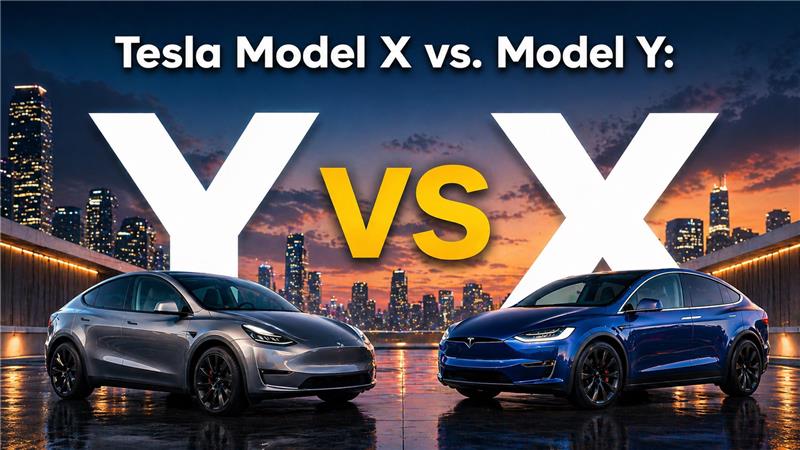
Tesla Model X vs. Model Y: The Ultimate 2026 Comparison Guide
Choosing between the Model X and Model Y used to be a simple question of budget.
Today, with the 2026 refreshes and new battery chemistries, the decision involves towing capacity, door mechanics, seating configurations, and long-term maintenance costs.
Tesla’s SUV lineup is deceptively simple, two vehicles that look similar on paper, yet serve very different buyers in the real world.
The Tesla Model Y is the company’s best-selling EV globally, while the Tesla Model X is its flagship luxury SUV, packed with features, space, and performance.
But which one makes sense for you?
In this in-depth comparison, we’ll cover everything you need to know about the Tesla Model X vs Model Y: pricing, range, battery tech, interior comfort, safety, reliability, ownership costs, and long-term value, using both spec sheets and real-world data.
Executive Summary: The Core Differences Model X vs Model Y
| Feature | Tesla Model X | Tesla Model Y |
|---|---|---|
| Market Segment | Ultra-Luxury Full-Size SUV | Compact/Mid-Size Crossover |
| Starting Price | ~$79,990 – $94,990 | ~$42,990 – $52,490 |
| Max Range | 335 – 352 Miles | 277 – 330 Miles |
| 0-60 MPH | 2.5s (Plaid) – 3.8s | 3.5s (Perf) – 6.6s |
| Rear Doors | Falcon Wing (Double-hinged) | Standard Conventional Doors |
| Seating | 5, 6, or 7-Passenger | 5 or 7-Passenger |
| Suspension | Adaptive Air Suspension | Fixed Coil Suspension |
Quick Verdict:
Buy the Tesla Model Y if you want the best balance of price, range, efficiency, and low ownership cost.
Buy the Tesla Model X if you need maximum space, luxury, power, towing capacity, and premium features.
For most buyers, Model Y is the smarter value. For large families or luxury SUV shoppers, Model X is unmatched in Tesla’s lineup. That’s the pinnacle of Tesla performance.
Performance And Powertrain: Speed Vs. Efficiency
The Model X: The ‘Plaid’ Powerhouse
The Model X is built on Tesla’s flagship platform. The Plaid variant is world-renowned, utilizing a tri-motor setup that produces 1,020 horsepower.
It is currently the quickest SUV in production, hitting 60 mph in a physics-defying 2.5 seconds. Even the base Dual-Motor AWD model is no slouch, delivering 670 hp.
This is the model you need to show off to everyone. It is an absolute electric beast that can take on anything from a Ferrari to a Lamborghini.
The acceleration is unreal and is a testament to the brilliance of Tesla’s engineering.
If you are not used to such power and acceleration, you need to first get comfortable and understand the capabilities of this electrifying vehicle (no pun intended).
The Model Y: The Efficient All-Rounder
The Model Y is optimized for efficiency and daily usability.
The Tesla Model Y has earned its reputation as the efficient all-rounder not just by being a good EV, but by mastering the balance between utility, range, and technology.
As of 2026, it remains the benchmark for the modern family crossover. It offers three main trims:
- Rear-Wheel Drive (RWD): Uses LFP batteries for longevity.
- Long Range (AWD): The sweet spot for most families.
- Performance: Lowers the car and adds track mode for spirited driving.
The Model Y is a no-nonsense daily driver that ticks all the right boxes.
There’s loads of space, the maintenance bit is easy, and the battery is more than responsive for soccer coaching, school trips, and grocery runs.
The Doors: Innovation Vs. Practicality
The Falcon Wing Doors on the Model X are its most iconic feature.
- Pros: They open upward with only 12 inches of side clearance, making entry into the third row incredibly easy in tight parking spots.
- Cons: They are mechanically complex. Long-term, these doors have more sensors and moving parts that can require maintenance compared to the Model Y’s standard doors.
The Model Y uses traditional doors. While less flashy, they are faster to open/close and allow for the installation of heavy-duty roof racks, which is difficult on the Model X.
If you don’t want people staring at you in parking lots, then Model Y makes a lot of sense for you.
Interior Layout And Cargo Space:
Seating Configurations:
- Model X: Offers a 6-seat layout with captain’s chairs in the middle row. This is widely considered the most luxurious configuration in the Tesla lineup, providing a walk-through path to the back. The middle captain seats have a host of functions like recline, ventilation, and the padding is very good, along with adequate under-thigh support.
- Model Y: The 7-seat option in the Model Y is best suited for children. The third row in a Model Y is significantly tighter than the Model X. However, if you are a family that carries a ton of storage, you would want to lay the third row down and carry everything from bicycles to flat-screen televisions.
Cargo Capacity (Max Volume):
- Model X: Up to 92.3 cu-ft. It is a cavernous vehicle, capable of hauling full-sized furniture with all seats folded.
- Model Y: Up to 76.2 cu-ft. While smaller, its flat-fold second row makes it surprisingly competitive for camping and grocery runs.
Technology And Hardware (HW4 Vs. HW5)
In 2026, both vehicles come standard with Hardware 4.0 (or 5.0 in newer batches), featuring high-resolution cameras and upgraded FSD (Full Self-Driving) computers.
Model X Exclusive Tech:
- Instrument Cluster: The X has a dedicated screen behind the steering wheel (the Y only has the central 15-inch screen).
- Rear Screen: Model X features an 8-inch screen for rear passengers to control climate and watch Netflix/YouTube.
- Auto-Presenting Doors: The Model X front door can automatically open as you approach and close when you step on the brake.
Both models come with a lot of engineering and tech superiority that you cannot expect from other manufacturers like Ford or GM.
The tech works perfectly fine without any lags or poor UX. It’s very intuitive, and everything works the way it should.
Even on Teslas that have covered more than 100,000 miles, the tech works seamlessly. Again, a testament to the tech superiority that Tesla enjoys over its competitors.
Towing And Utility:
If you plan on towing a boat or a large camper, the choice is clear:
- Model X Towing: Rated for 5,000 lbs. It features a dedicated Tow Mode that adjusts the air suspension for tongue weight.
- Model Y Towing: Rated for 3,500 lbs. It is perfect for small trailers, bike racks, or jet skis, but struggles with large RVs.
But let’s face it. It’s a very small percentage of Tesla ownership that will use their vehicles for towing. This is something that we associate more with the Ford F-150s and the RAMs.
However, the capability to load a U-Haul in the event you are moving homes, or carrying furniture from IKEA, is always good to have.
You might not use it, but why not have the capability, right?
Cost Of Ownership And Reliability
This is important.
If you plan to keep your Model X or Model Y for an ownership period that is around the five-to-seven-year mark, you need to ensure that your maintenance costs don’t end up burning a big hole in your wallet.
Here, the Model Y shines much brighter.
Maintenance:
- Model X: Higher maintenance potential due to the Air Suspension and Falcon Doors. Air struts eventually leak (usually around the 100k-mile mark), which can be an expensive repair.
- Model Y: Extremely low maintenance. Without air suspension or complex doors, it is essentially a tank that requires only tires, cabin filters, and wiper fluid.
Depreciation:
Historically, the Model Y holds its value better than the Model X.
This is because the luxury SUV market depreciates faster, and the Model Y is in much higher demand on the used market. It is an easier car to own, run, and maintain.
The choice in the used car market is easier.
Which One Should You Buy: Model X Or Model Y?
Choose the Model X if:
- You want the ultimate Wow factor (Falcon Wings).
- You need a legitimate 6 or 7-seat vehicle for adults.
- You need to tow more than 3,500 lbs.
- You prefer a smoother ride via Adaptive Air Suspension.
Choose The Model Y If:
- You want the best Bang for your Buck in the EV world.
- You want a vehicle with the lowest possible long-term maintenance.
- You prefer a smaller footprint for city driving and parking.
- You are a first-time EV buyer looking for a seamless transition.
FAQs: Model X Vs. Model Y
A: Yes, as of 2021, all Model Ys come with the Bioweapon Defense Mode HEPA filtration system standard.
A: Both have 5-star ratings. However, the Model Y currently holds slightly higher scores in Safety Assist categories according to recent Euro NCAP testing.
A: The Model X (especially in the 7-seat or 5-seat config) handles three car seats across much more easily than the narrower Model Y.
A: Yes, but the Model X Big Sky windshield extends over the front seats, whereas the Model Y has a glass panel separated by a crossbar.
Final Overview:
Tesla Model X At A Glance
- Segment: Compact/midsize electric crossover
- Target buyer: Families, commuters, first-time EV owners
- Strengths: Efficiency, affordability, simplicity
- Weaknesses: Less luxury, fewer premium features
Tesla Model X At A Glance
- Segment: Full-size luxury electric SUV.
- Target buyer: Large families, luxury buyers, tech enthusiasts.
- Strengths: Space, performance, falcon-wing doors, towing.
- Weaknesses: Price, complexity, and larger size.
Additional Reading: