Table Of Content
- Five-Year Financial & Sales Showdown (2021–2025)
- Global Passenger BEV Deliveries (Units)
- Revenue & Profit Margin Dynamics
- Major Markets, Sales Footprint, and Active Lineups
- 10 Major Advantages: BYD over Tesla
- 10 Major Advantages: Tesla over BYD
- Product-vs.-Product Matchups
- 1. The Premium Sedan Battle: Tesla Model 3 vs. BYD Seal
- 2. The Crossover Showdown: Tesla Model Y vs. BYD Sea Lion 7
- Design Languages Compared
- Technology, Engineering, and Innovation Architecture: Who Holds the Edge?
- Corporate Lineage, Founders, and Leadership
- Financial Market Projections: 2026 to 2035
- Tesla (NASDAQ: TSLA)
- BYD (HKEX: 1211 / OTC: BYDDY)
- Who Wins the EV Race? What the Experts Say
- What Would Happen if BYD Could Sell in the United States?
- 1. The $12,000 Seagull Effect would Cannibalize the Low End
- 2. The Plug-In Hybrid (PHEV) Blind Spot
- Where Tesla Would Stand Its Ground (Why BYD Wouldn't Win Completely)
- The Real-World Parallel: Look at Europe and Canada
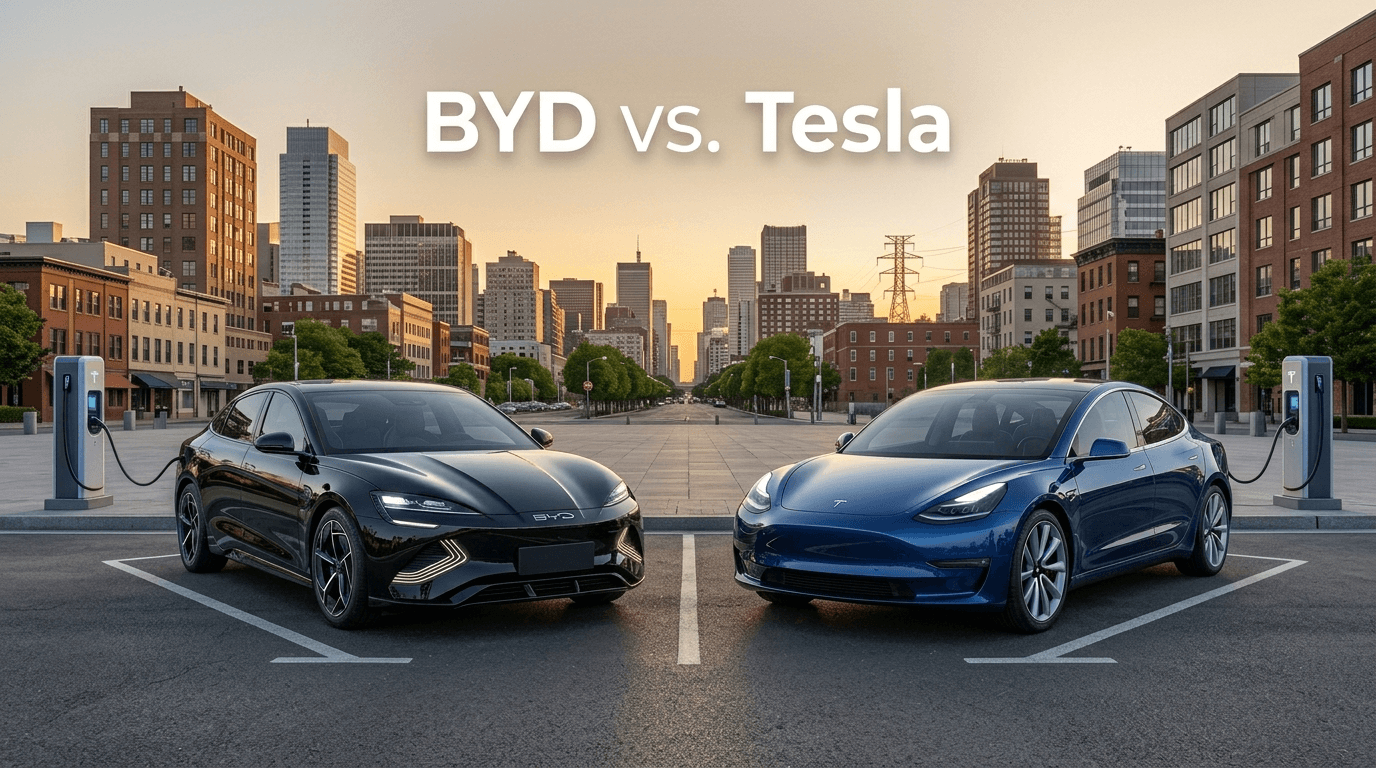
BYD vs. Tesla: The Ultimate Battle for Global EV Dominance
The global electric vehicle landscape has reached its most critical turning point. The question is no longer if legacy gas cars will be replaced, but who will control the platform that replaces them. The battle lines are drawn between Austin, Texas, and Shenzhen, China.
This is the definitive side-by-side analysis of Tesla and BYD (Build Your Dreams).
An analysis of current search engine rankings and AI overview platforms reveals three massive gaps in the existing Tesla vs. BYD coverage:
- The BEV vs. PHEV Confusion: Most articles mistakenly claim BYD outsold Tesla years ago by blending BYD’s Plug-in Hybrids (PHEVs) with their Battery Electric Vehicles (BEVs). Content must separate these two to maintain strict technical accuracy.
- The Tariff Blindspot: Existing content fails to evaluate how the latest international tariffs impact BYD’s aggressive pricing strategy in Europe and North America.
- Software vs. Hardware Disconnect: Ranking blogs treat both companies purely as automakers, failing to recognize that Tesla is valued as an AI/Robotics play, while BYD is engineered as a highly optimized industrial manufacturing pipeline.
Five-Year Financial & Sales Showdown (2021–2025)
The historical data reveals a dramatic shift in market leadership. While Tesla held an unquestioned lead at the start of the decade, BYD’s vertical integration has completely altered the volume metric.
Global Passenger BEV Deliveries (Units)
| Year | Tesla Global Deliveries | BYD Pure BEV Sales | BYD Plug-In Hybrid (PHEV) Sales |
|---|---|---|---|
| 2021 | 936,172 | 320,810 | 272,935 |
| 2022 | 1,313,851 | 911,140 | 946,239 |
| 2023 | 1,808,581 | 1,574,822 | 1,438,084 |
| 2024 | 1,789,226 | 1,764,992 | 2,248,000 |
| 2025 | 1,636,129 | 2,256,714 | 2,288,709 |
Revenue & Profit Margin Dynamics
- Tesla: Peak automotive gross margins reached over 26% in 2022 but compressed to 19.2%–21.1% due to aggressive global price cuts implemented to defend its market share. Total annual corporate revenue hovers near the $95B–$105B mark.
- BYD: Gross margins have steadily climbed, sitting firmly between 18.5% and 21%. Because BYD manufactures its own battery cells, microchips, and internal electronics, its cost insulation keeps it highly profitable even at rock-bottom retail prices.
Major Markets, Sales Footprint, and Active Lineups
The geographic distribution of these two giants reveals highly distinct areas of geopolitical and economic dominance.
Major Market Footprint
- Tesla: Dominates North America (holding over 50% of the US EV market share) and maintains a highly profitable presence in Europe and coastal China.
- BYD: Controls over 35% of the Chinese New Energy Vehicle (NEV) market. Having saturated its home market, BYD’s massive export engines are aggressively capturing Southeast Asia (Thailand, Indonesia), Latin America (Brazil), and the Middle East.
Current Core Product Portfolios
- Tesla Lineup: Model 3, Model Y, Model S, Model X, Cybertruck, and Tesla Semi. (Project Redwood/Model Q on the immediate horizon).
- BYD Lineup: Divided into the Ocean Series (Seagull/Dolphin/Seal), Dynasty Series (Han/Tang/Song/Yuan), and ultra-luxury sub-brands like Denza and Yangwang (U8/U9).
10 Major Advantages: BYD over Tesla
- Total Vertical Integration: BYD manufactures virtually every component of its vehicles in-house, including batteries, seats, and semiconductors, insulating it from supply chain crises.
- The Blade Battery Tech: BYD’s proprietary Lithium Iron Phosphate (LFP) Blade battery is highly compact, thermally stable, and widely considered the safest battery design in production.
- Unbeatable Price Ladder: BYD addresses the lower end of the market with cars like the Seagull, opening up EV ownership to buyers with budgets under $15,000.
- PHEV Flexibility: By offering ultra-efficient Plug-in Hybrids with over 1,200 miles of combined range, BYD captures buyers who aren’t ready to go 100% electric.
- Diverse Product Portfolio: From subcompact hatchbacks to rugged 1,100-hp off-roaders and commercial buses, BYD can pivot to any market segment.
- Immense Manufacturing Capacity: FinDreams (BYD’s battery division) produces so many cells that it actually sells them to its rivals, including Tesla.
- Rapid R&D Cycle: BYD updates its platforms and introduces new models at a pace that legacy automakers and Tesla struggle to match.
- Strong Government Backing: Deep industrial and structural alignment within mainland China provides massive infrastructure and scaling assistance.
- Global Regulatory Agility: BYD bypasses strict passenger vehicle tariffs in some regions by exporting commercial fleets and buses first to establish a local footprint.
- Aggressive Factory Expansion: Building assembly hubs in Hungary, Brazil, Thailand, and Uzbekistan allows BYD to skirt regional protectionist trade policies.
10 Major Advantages: Tesla over BYD
- Full Self-Driving (FSD) Lead: Tesla’s end-to-end neural network autonomy software (v12/v15) holds a massive data advantage over BYD’s driver assist systems.
- Unrivaled Charging Ecosystem: The Supercharger Network (NACS) remains the gold standard for charging speed, reliability, and plug-and-play user integration.
- Gigacasting Mastery: Tesla’s pioneering use of massive single-piece underbody castings reduces parts complexity and manufacturing footprints drastically.
- The Autonomy Option Value: Wall Street values Tesla as a software/AI platform, meaning its market capitalization isn’t chained to standard automotive multiples.
- Global Brand Prestige: Tesla carries a premium “tech-status” brand allure worldwide, allowing it to maintain higher average selling prices (ASPs).
- Software-Defined Architecture: Tesla’s central compute platform enables deeper, more transformative Over-the-Air (OTA) updates than traditional vehicle layouts.
- The Octovalve Thermal Efficiency: Tesla’s unified cabin-to-battery thermal loop ensures superior real-world winter range and efficiency metrics.
- North American Market Lock: Geopolitical walls and strict tariff frameworks protect Tesla’s domestic profit fortress from low-cost Chinese imports.
- Unboxed Next-Gen Innovation: The upcoming assembly architecture for Project Redwood aims to reduce factory space requirements by 40% and production costs by 50%.
- Tesla Energy Ecosystem: Megapack, Powerwall, and solar products give Tesla an energy-generation platform that directly stabilizes its automotive ecosystem.
Product-vs.-Product Matchups
To help car buyers choose, we look at the direct segment alternatives:
1. The Premium Sedan Battle: Tesla Model 3 vs. BYD Seal
The Model 3 offers crisp sports-sedan handling, unmatched software integration, and a highly minimalistic interior layout. The BYD Seal counters with a more traditional luxury interior, an arguably more aggressive exterior styling profile, cell-to-body structural packaging, and a significantly lower entry price point in neutral markets.
2. The Crossover Showdown: Tesla Model Y vs. BYD Sea Lion 7
The Model Y relies on its unmatched cargo packaging, flat-folding utility, and class-leading highway efficiency. The Sea Lion 7 targets buyers looking for a quieter cabin, softer physical switchgear, and a more compliant, less rigid suspension setup for urban commuting.
Design Languages Compared
Tesla’s Aesthetic: Strictly functional, aerodynamic minimalism. Tesla shapes its cars around a low coefficient of drag. Grilles are omitted entirely, panels are smooth, and cabins are stripped of physical buttons to funnel all user interaction through a central screen.
BYD’s Aesthetic: Expressive, emotional, and varied. Led by veteran European designers, BYD models utilize distinct styling paradigms like the Dragon Face on the Dynasty series or organic, wave-like marine themes in the Ocean series. Interiors feature rotating screens, extensive physical switchgear, and complex material textures.
Technology, Engineering, and Innovation Architecture: Who Holds the Edge?
While both companies build compelling vehicles, their engineering philosophies run on entirely different tracks.
TWO OPPOSING PHILOSOPHIES
↓ ↓
TESLA BYD
Software & Hardware &
AI-Centric Industrial scale
│ │
• Pure Vision Autonomy • LFP Blade Battery Tech
• 48-Volt Architecture • Multi-Brand Price Ladder
• Deep Software Integration • Total Component Control
Key Differences
- Autonomy: Tesla uses a Pure Vision approach, relying completely on high-resolution cameras and neural networks. BYD favors redundancy, combining LiDAR, radar, and cameras powered by computing platforms sourced from Nvidia and independent suppliers.
- Low-Voltage Systems: Tesla has successfully transitioned to an advanced 48V architecture starting with the Cybertruck to drastically trim copper weight. BYD largely maintains traditional low-voltage configurations for mass-market serviceability.
Corporate Lineage, Founders, and Leadership
- Tesla: Founded in 2003 by Martin Eberhard and Marc Tarpenning, but fundamentally shaped by Elon Musk, who took over as CEO in 2008. Musk’s leadership style is defined by a first-principles engineering approach, high risk tolerance, and a relentless public profile that anchors the brand’s culture.
- BYD: Founded in 1995 by Wang Chuanfu, a chemist who began the enterprise as a simple cell-phone battery manufacturer. Wang is an deeply analytical, quiet leader focused heavily on cost control and industrial self-reliance. Notably, legendary investor Warren Buffett (Berkshire Hathaway) took an early, highly validating stake in the company in 2008.
Financial Market Projections: 2026 to 2035
As of mid-2026, the financial markets evaluate these companies through two entirely different lenses.
Tesla (NASDAQ: TSLA)
- Current Standing: Market valuation consistently ranges between $1.3T and $1.5T, trading at a premium multi-hundred forward P/E ratio.
- 5-Year Outlook (2031): Driven by the commercial ramp of the Cybercab network, scaling of the FSD software subscription model, and utility-scale Megapack growth. Consensus base-case price targets hover near $500–$800.
- 10-Year Outlook (2036): Highly speculative. Bull cases (such as those modeled by ARK Invest) point to $2,500+ if Tesla cracks unsupervised physical AI and successfully deploys the Optimus humanoid robot platform at scale.
BYD (HKEX: 1211 / OTC: BYDDY)
- Current Standing: Market cap sits around $90B–$110B. It trades like a traditional automotive stock with healthy revenue generation and low single-to-double digit trailing P/E multiples.
- 5-to-10 Year Outlook: Focused heavily on cash generation, compounding global unit volume, and dominance across developing economic regions. Growth is tied to manufacturing raw units rather than software subscription loops, ensuring stable, predictable equity growth.
Who Wins the EV Race? What the Experts Say
Automotive and financial analysts agree that the term “winning” depends entirely on your metric:
The Volume Winner: BYD. Thanks to its sprawling manufacturing infrastructure and access to cheap component materials, BYD has permanently secured the global crown for unit volume. They can build millions of affordable cars faster and cheaper than any Western entity.
The Financial Winner: Tesla. By focusing on premium segments, building out an energy storage monopoly, and locking in millions of higher-margin software subscriptions through FSD, Tesla is projected to capture the lion’s share of industry profits.
What Would Happen if BYD Could Sell in the United States?
This is the million-dollar question that global automotive economists, policymakers, and Wall Street analysts are debating.
To give you the short answer: Yes, on a purely price-to-hardware basis, BYD would significantly damage Tesla’s market share in the United States if protectionist barriers were completely dropped. However, running over Tesla entirely implies a total victory, which ignores critical American market dynamics that favor Tesla.
If the 100% tariffs were lifted, the resulting market battle would likely unfold across three distinct fronts:
1. The $12,000 Seagull Effect would Cannibalize the Low End
The primary weapon BYD possesses is an unmatchable cost structure. Without tariffs, BYD could import the BYD Seagull or BYD Dolphin into the U.S. and retail them for $12,000 to $18,000.
- The Impact on Tesla: Currently, Tesla’s cheapest car is the Model 3 (hovering around $39,000 before tax credits). While Tesla is working on the $25,000 Model Q (Project Redwood), BYD already has millions of sub-$20k cars rolling off assembly lines.
- The Result: BYD would completely lock down the entry-level American market, preventing Tesla from capturing first-time, budget-conscious buyers.
2. The Plug-In Hybrid (PHEV) Blind Spot
Tesla only builds pure Battery Electric Vehicles (BEVs). In contrast, BYD is a master of Dual-Mode Plug-in Hybrids (PHEVs) like the BYD Shark pickup or Song crossover, which offer over 1,000 miles of combined gas-electric range.
- Many American buyers suffer from range anxiety and are hesitant to go 100% electric due to the vast distances between U.S. cities.
- BYD’s hybrids would act as a gateway drug for Americans, eating into the sales of the Tesla Model Y and Model 3 by offering a compromise that Tesla physically does not manufacture.
Where Tesla Would Stand Its Ground (Why BYD Wouldn’t Win Completely)
Despite BYD’s aggressive pricing, Tesla possesses three defensive moats that protect its home turf:
- The Supercharger Network: In America, the charging infrastructure is notoriously fractured. Tesla’s North American Charging Standard (NACS) is the gold standard. Even if a consumer bought a cheap BYD, they would still have to interact with an infrastructure that Tesla largely controls.
- Software and FSD (Full Self-Driving): American consumers view cars more like software platforms. Tesla’s advanced AI and FSD capabilities are vastly superior to BYD’s current driver-assist suites (such as its God’s Eye system, which has faced software maturity critiques). BYD is fundamentally a hardware company; Tesla is an AI company.
- Brand Prestige and Geopolitics: In the U.S., a vehicle is a status symbol. Tesla has achieved Apple-like brand equity. Furthermore, even without formal tariffs, a segment of the American buying public would remain hesitant to buy vehicles from a Chinese state-backed entity due to data privacy and national security concerns regarding connected vehicle technology.
The Real-World Parallel: Look at Europe and Canada
We don’t have to guess what would happen because we can look at neutral test markets. In regions with lower trade barriers, BYD’s pure BEV sales have aggressively caught up to Tesla, even briefly overtaking them globally. However, as seen in the Q1 2026 sales data, the moment domestic incentives shift or product refreshes land (like Tesla’s Model 3 Highland/Model Y Juniper), Tesla reclaims the #1 spot.
The Verdict: Without protectionism, BYD would not eliminate Tesla, but it would cap Tesla’s growth. BYD would dominate the under-$30,000 market and the hybrid segment, turning Tesla into a premium, high-margin luxury tech brand rather than the mass-volume everyman automaker Elon Musk wants it to be. Tariffs don’t save Tesla because its cars are bad; tariffs save Tesla because American labor and supply chains physically cannot compete with Chinese vertical integration.
Spread Some Love
Author