Table Of Content
- Peugeot 3008 (E-3008) Review: Specs, Price, and the US Market Reality
- Battery & Performance
- Battery & Range Trims
- Drivetrain & Performance Outputs
- Where is it Sold?
- US Cost vs. Tesla Model Y
- Is it a Good Family Vehicle?
- Pros
- Cons
- Quick Overview:
- Why the Peugeot 3008 Lags in American Popularity?
- Exterior & Interior Design Language
Peugeot 3008 (E-3008) Review: Specs, Price, and the US Market Reality
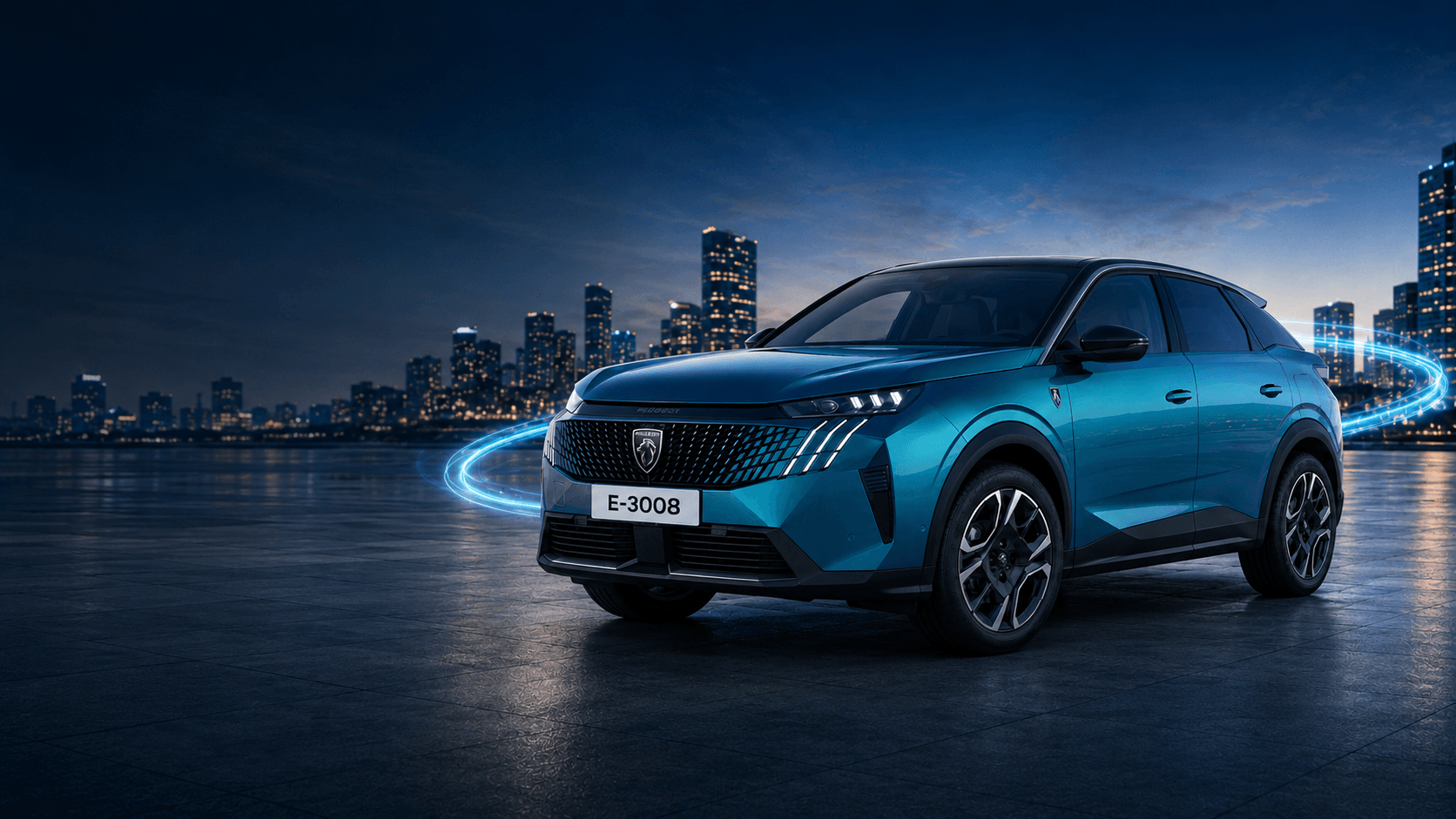
The Peugeot E-3008 has taken the European automotive landscape by storm, arriving as a stunning, hyper-futuristic declaration of the French brand’s premium electric intentions. Sitting squarely as the brand’s flag-bearing mid-size crossover, positioned precisely above the compact E-2008 and below the three-row E-5008, this model represents a monumental pivot for Peugeot on the global stage.
It is the very first vehicle built upon parent company Stellantis’s highly anticipated, purpose-built STLA Medium native EV architecture, making it the technical blueprint for the group’s global electric future. While American EV buyers cannot walk into a local dealership and purchase one due to strict U.S. import laws and Peugeot’s lack of a stateside retail network, this launch is a critical development that demands your immediate attention.
Packing an available 96.9 kWh long-range battery that delivers a jaw-dropping 435 miles of WLTP range, and showcasing a revolutionary 21-inch curved Panoramic i-Cockpit dashboard natively powered by ChatGPT, the E-3008 serves as the ultimate yardstick for what European EVs are capable of. It provides a fascinating, forbidden-fruit glimpse into the exact technology and engineering that will soon underpin the next generation of electric Jeeps, Chryslers, and Rams heading to American soil.
Peugeot 3008 (E-3008) Review: Specs, Price, and the US Market Reality
Simple Answer:
The Peugeot E-3008 is a modern electric SUV built on Stellantis’ new STLA Medium platform, offering up to 435 miles (WLTP) of range, 160 kW fast charging, and a premium 21-inch Panoramic i-Cockpit with ChatGPT integration. Its futuristic design, upscale interior, and practical family-focused features make it one of Europe’s most advanced EVs.
However, the E-3008 is not available in the United States due to Peugeot’s absence from the market, lack of certification, and no dealer or service network. For American buyers, it serves as a glimpse of the EV technology that could shape future Stellantis models.
Battery & Performance
The completely redesigned E-3008 sits on the STLA Medium platform, stepping away from legacy shared platform constraints to pack massive range ceilings.
Battery & Range Trims
- Standard Pack (73 kWh): Delivers a healthy 326 miles (WLTP) of range. In real-world mixed driving cycles, this maps closer to a respectable 260 miles.
- Long Range Pack (96.9 kWh): Generates a jaw-dropping 435 miles (WLTP) of range. This heavy-density pack can handle real-world highway driving up to 300 miles continuously at speed before needing a charge.
Drivetrain & Performance Outputs
- Electric 210: Single-motor Front-Wheel Drive (FWD) putting down 210 horsepower, executing a linear 0–62 mph sprint in 8.8 seconds.
- Electric 230 Long Range: Single-motor FWD pushing out 230 hp to offset the weight of the larger 96.9 kWh cell assembly.
- Electric 325 AWD: Incorporates an additional 110-hp motor block onto the rear axle to generate a combined 325 horsepower, slashing the 0–62 mph sprint time down to a rapid 6.0 seconds flat.
- Charging Interface: Maximizes standard European CCS2 parameters, accommodating DC fast charging inputs up to 160 kW. This restores the battery from 20% to 80% in 27 to 30 minutes utilizing an automated thermal battery pre-conditioning cycle link.
Where is it Sold?
The Peugeot 3008 is strictly distributed throughout Europe, the United Kingdom, Latin America, Australia, and select Middle Eastern networks. Despite early structural plans from parent company Stellantis to re-introduce the historic French brand to North America, those corporate strategies were permanently shelved. As of 2026, the Peugeot 3008 is absolutely not on sale in the United States.
US Cost vs. Tesla Model Y
| Vehicle Model & Grade | Battery Size | Base Price (UK/EU Conversion) | Direct U.S. Segment Equivalent |
|---|---|---|---|
| Peugeot E-3008 Allure FWD | 73 kWh | ~£36,995 ($47,100 USD) | Tesla Model Y Standard RWD ($39,990) |
| Peugeot E-3008 GT FWD | 73 kWh | ~£40,395 ($51,400 USD) | Tesla Model Y Long Range RWD ($44,990) |
| Peugeot E-3008 Long Range FWD | 96.9 kWh | ~€46,990 ($50,400 USD) | Tesla Model Y Long Range AWD ($47,990) |
| Peugeot E-3008 GT AWD | 73 kWh | ~£45,545 ($57,900 USD) | Tesla Model Y Performance AWD ($51,490) |
Is it a Good Family Vehicle?
Pros
- High-End Material Selection: The cabin ditches rigid gray plastics, wrapping passengers in high-grade textured fabrics and premium aluminum accents.
- Massive Practical Trunk: Delivers a substantial 520 liters of flat-floor cargo capacity, regardless of the large battery size.
- Top-Tier Safety Heritage: Standard packages incorporate advanced night-time pedestrian monitoring, post-collision braking safety layers, and intelligent lane-keeping metrics.
Cons
- Cramped Rear Headroom: The aggressive, sloping fastback rear roof styling pinches interior headroom for taller adult passengers in the rear seats.
- Euro NCAP Limitation: Earned an unexpected 4 out of 5 stars in safety assist tech scores due to conservative lane-keeping software responses.
Quick Overview:
| Pros | Cons |
|---|---|
| Premium interior materials | Limited rear headroom |
| Large 520L cargo space | 4/5 Euro NCAP safety-assist score |
| Advanced safety features | Conservative lane-keeping system |
Why the Peugeot 3008 Lags in American Popularity?
- Zero Dealership Network
- The LHD/RHD Misconception
- Severe Import Duty Penalties
- No Federal EV Incentive Options
- Absent Spare Part Pipelines
- No Domestic Service Capability
- The Fastback Pickup Stigma
- Muted Public Awareness
- No Front Storage Chamber
- Intense Local Brand Loyalty
Exterior & Interior Design Language
The exterior styling utilizes a gorgeous, aggressive fastback coupe-SUV silhouette. Up front, Peugeot’s trademark three-claw signature LED lighting structure flanks a body-colored matrix grille.
The interior execution is a true work of art centered around the Panoramic i-Cockpit. It features a massive, single 21-inch curved widescreen display hovering effortlessly above a small, sports-car-style steering wheel. Combined with texturized wrap-around dashboard fabrics and configurable touch-sensitive i-Toggles, the cockpit delivers a ultra-premium feeling that would easily impress luxury buyers in the United States.
Spread Some Love
Author