Table Of Content
- Battery Pack Chemistries & Charging Infrastructure
- Warranty Frameworks, Extended Coverage, and Exclusion Triggers
- Exterior Features, Aesthetics, and Assembly Craftsmanship
- Cabin Space, Comfort Ergonomics, and Interior Storage
- Master Technical Specification Sheet Ledger
- Safety Engineering, Crash-Test Rigor, and Sensor Suites
- Boot, Cargo Area, Frunk Space, and Total Volume Comparison
- Exterior Footprint: Dimensions, Wheelbase, and Curb Weights
- Tires, Wheels, Braking Systems, and Stopping Power
- Ten Features Found On the Model 3 But Absent on the Model Y
- Ten Features Found On the Model Y But Absent on the Model 3
- The Targeted Buyer Persona Decoders
- Who Is the Tesla Model 3 Engineered For?
- Who Is the Tesla Model Y Engineered For?
- 10 Critical FAQs: Tesla Model 3
- 1. How do you shift the updated Model 3 into Reverse or Drive without stalks?
- 2. Can you fit three infant car seats across the back row of a Model 3?
- 3. Does the Model 3 sedan suffer from water leaking into the trunk when it rains?
- 4. What is the top speed of the Model 3 Performance variant?
- 5. Is the rear screen in the Model 3 capable of playing audio through separate headphones?
- 6. How much range does the Model 3 lose over a year of typical ownership?
- 7. Does the base Model 3 RWD include the premium 17-speaker sound system?
- 8. Can you install an aftermarket tow hitch onto the Model 3?
- 9. Why does the turn signal button on the steering wheel blink automatically?
- 10. Does the Model 3 interior utilize real leather upholstery?
- 10 Critical FAQs: Tesla Model Y
- 1. Can you still order a 7-seat configuration on a brand-new Model Y?
- 2. What exactly is "Bioweapon Defense Mode" and how do I turn it on?
- 3. Can the Model Y tow a standard camper trailer safely?
- 4. Why does the Model Y ride firmer than a traditional luxury SUV?
- 5. Can you sleep comfortably inside the back of a Model Y?
- 6. Does the Model Y feature an automated mechanical cargo cover screen?
- 7. What happens to the range of a Model Y during sub-zero winter temperatures?
- 8. Are the rear doors on the Model Y equipped with emergency manual override releases?
- 9. What is the maximum height of an item you can load through the rear hatch door?
- 10. Does the Model Y include free unlimited Supercharging access?
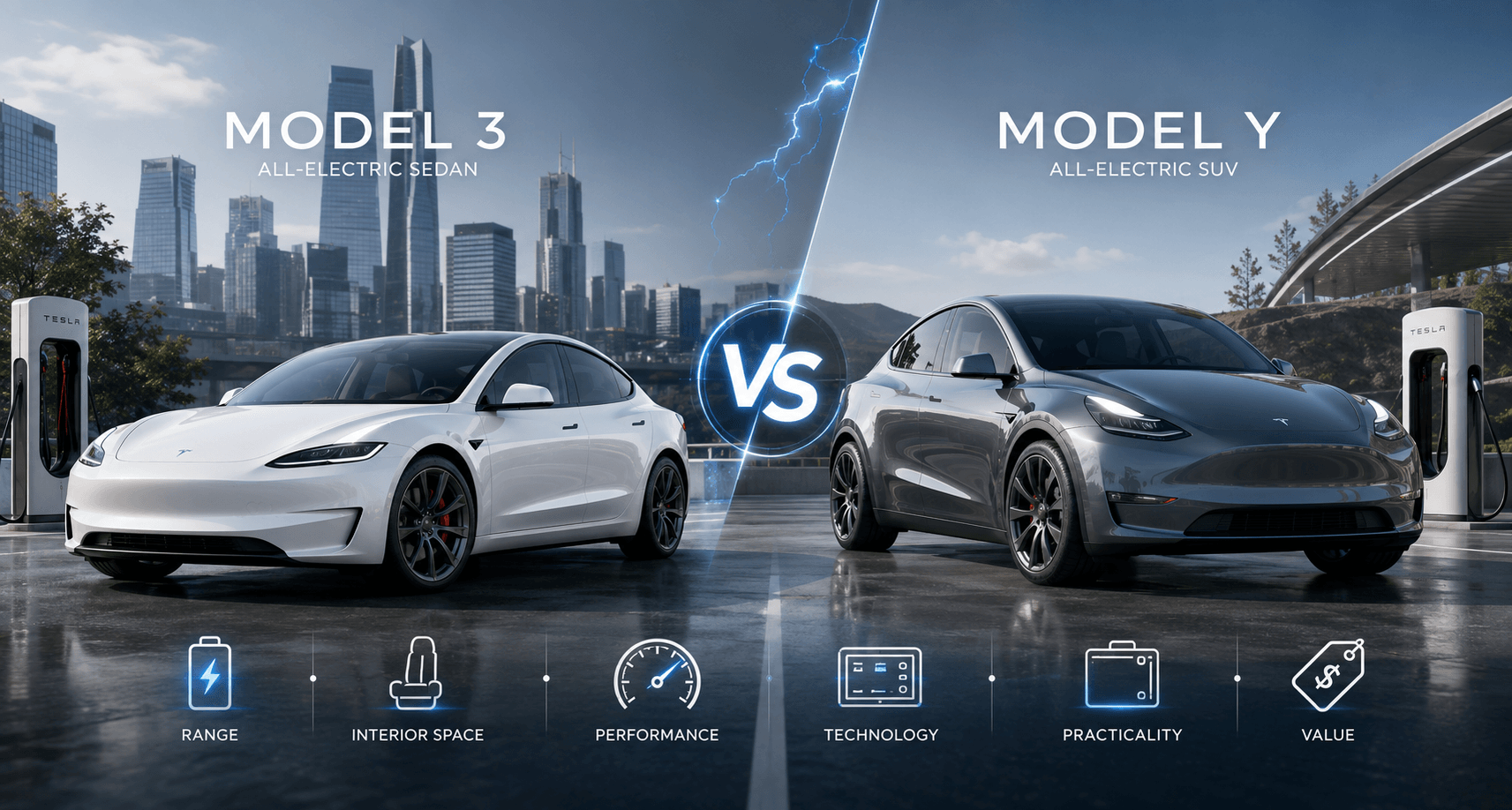
Tesla Model 3 vs Model Y Comparison: The 2026 Definitive Hardware & Real-World Utility Guide
The Tesla Model 3 and Tesla Model Y are the twin engines of the modern electric vehicle revolution. While they share a massive amount of DNA, including powertrain control modules, power electronics architectures, and thermal management systems, they target entirely different demographics.
The Model 3 is a traditional three-box sports sedan engineered for driver engagement, high aerodynamic efficiency, and athletic cornering.
The Model Y, by contrast, takes that identical technical core and stretches it upward, creating a high-riding, highly versatile compact crossover that maximizes cabin volume, seating height, and utilitarian storage space to suit modern family needs.
Battery Economy, Efficiency, and Range Metrics
The vehicle’s physical profile heavily impacts its energy efficiency. Because the Model 3 presents a much smaller frontal surface area to the oncoming wind, it slices through the air with far less aerodynamic resistance than the taller Model Y.
┌────────────────────────────────────────────────────────┐
│ AERODYNAMIC EFFICIENCY DIVIDER │
└────────────────────────────────────────────────────────┘
Tesla Model 3 Drag Coefficient: 0.219 Cd (Ultra-Sleek)
│
▼
Tesla Model Y Drag Coefficient: 0.230 Cd (Crossover Drag)
This aerodynamic advantage translates directly into superior real-world efficiency figures:
- Tesla Model 3 Standard RWD: Delivers an EPA-estimated 321 miles of range with a highly efficient combined rating of 138 MPGe (approx. 240 Wh/mi consumption).
- Tesla Model Y Standard RWD: Using a similar powertrain combination, it is limited to an EPA-estimated 321 miles but drops in overall energy economy down to 134 MPGe due to pushing a larger profile through the air.
- Long Range All-Wheel Drive Trims: The Model 3 Long Range stretches its highway capability out to 346 miles. The larger Model Y Long Range AWD hits a highly competitive 357 miles of range due to carrying a slightly larger cell pack, though its high-speed highway consumption remains roughly 8% less efficient than the sedan.
Battery Pack Chemistries & Charging Infrastructure
Tesla splits its manufacturing across two distinct cell chemistries, and understanding which pack resides beneath your floorboards dictates how you operate the vehicle daily:
- Standard Range (RWD Platforms): These variants utilize Lithium Iron Phosphate (LFP) battery packs manufactured by CATL. LFP cells contain no nickel or cobalt, making them highly stable, exceptionally durable, and resistant to thermal runaway. However, they possess lower energy density, which makes them heavier.
- Charging Behavior: LFP chemistry accommodates a maximum peak DC charging rate of 170 kW. Crucially, the internal BMS logic requires the owner to charge the pack to 100% at least once a week to safely calibrate the voltage sensors.
- Long Range / Performance (AWD Platforms): These premium configurations utilize high-density Nickel Manganese Cobalt (NMC) or Nickel Cobalt Aluminum (NCA) cylindrical cells. These chemistries offer significantly higher energy density per pound, minimizing total curb weight.
- Charging Behavior: Unlocks a higher peak charging ceiling of 250 kW, allowing a 10% to 80% charge cycle in roughly 20 to 22 minutes at a local Supercharger. Daily charging should be strictly restricted to 80% to avoid accelerated chemical degradation from high voltage stress.
- Infrastructure Interfacing: Both models are built with a native North American Charging Standard (NACS) inlet port on the rear driver-side quarter panel, giving them native access to the extensive, high-uptime Supercharger grid without requiring adapters.
Warranty Frameworks, Extended Coverage, and Exclusion Triggers
Tesla provides identical factory warranty terms for both platforms, but the mileage restrictions adjust depending on the battery chemistry selected:
- New Vehicle Limited Warranty: Comprehensive bumper-to-bumper protection covers 4 years or 50,000 miles (80,000 km), whichever milestones occur first.
- Battery & Drive Unit Warranty:
- Standard Range (LFP Chemistry): Covered for 8 years or 100,000 miles, guaranteeing a minimum of 70% operational capacity retention.
- Long Range / Performance (NMC Chemistry): Stretches mileage coverage out to 8 years or 120,000 miles for both the Model 3 and Model Y.
- Extended Service Agreements (ESA): Owners can purchase an official Tesla extended warranty through the mobile app before the base coverage expires. This adds 2 years or 25,000 miles of coverage for roughly $2,000 to $2,500 depending on the specific model trim.
- Critical Voiding Triggers: The high-voltage battery and drive unit warranty can be instantly voided if service technicians identify that the customer used a physical OBD aftermarket piggyback tracking device (such as specific performance tuners or power chips) that splices directly into the central CAN-bus lines, or if the structural battery pack casing shows deep impact gashes or mechanical punctures from off-road driving.
Exterior Features, Aesthetics, and Assembly Craftsmanship
The visual updates have created a distinct stylistic split between the two vehicles:
- Model 3 (Highland Architecture): Features razor-sharp, low-profile LED headlights, a fully smooth front fascia that eliminates old fog light cutouts, and single-piece integrated C-shaped rear taillights that raise directly up with the trunk lid. The design prioritizes minimal wind turbulence and zero panel-gap flutter.
- Model Y (Juniper Architecture): Takes a more futuristic approach, incorporating a prominent continuous front LED light bar strip running directly across the hood line, drawing inspiration from the Cybertruck. The rear taillight block is similarly unified by a singular translucent light bar accent display.
- Manufacturing Craftsmanship: Both models now extensively leverage Megacastings. By replacing over 70 individual stamped steel components with a single, massive high-pressure die-cast aluminum rear underbody structural assembly, Tesla has eliminated historic panel-alignment deviations. Exterior gaps are highly uniform across both platforms, and highway wind noise is effectively controlled.
Cabin Space, Comfort Ergonomics, and Interior Storage
While both interiors embrace an absolute minimalist philosophy, the vertical volume change completely reconfigures the passenger experience.
- Model 3 Sedan Layout: The driver and front passenger drop low into the chassis, creating a highly engaging, sports-car cockpit feel. The updated cabin wraps premium perforated materials around the dash, running a customizable ambient RGB LED light strip seamlessly from the front door panels through the base of the windshield. The center console features deep dual wireless charging pads, an integrated sliding cover plate, and a hidden storage cubby nestled beneath the center armrest.
- Model Y Crossover Layout: The front seats are mounted directly onto elevated structural steel risers. This creates a higher commanding seating position that grants a superior, clear view of the surrounding roadway. The roof is composed entirely of a single, continuous sheet of fixed panoramic safety glass without an intermediate structural center cross-beam, creating a bright, spacious greenhouse feel.
Master Technical Specification Sheet Ledger
The following comprehensive matrix contrasts the baseline technical numbers of the 2026 production iterations across their primary volume trims:
| Engineering Parameter | Model 3 Standard RWD | Model Y Standard RWD | Model 3 Long Range AWD | Model Y Long Range AWD |
|---|---|---|---|---|
| Powertrain Layout | Single Motor (Rear) | Single Motor (Rear) | Dual Motor (Front/Rear) | Dual Motor (Front/Rear) |
| Motor Type | AC Permanent Magnet | AC Permanent Magnet | Induction (F) / PM (R) | Induction (F) / PM (R) |
| System Output (Estimated) | 286 Horsepower | 286 Horsepower | 498 Horsepower | 498 Horsepower |
| Battery Chemistry Type | Lithium Iron Phosphate | Lithium Iron Phosphate | Nickel-Manganese-Cobalt | Nickel-Manganese-Cobalt |
| 0–60 mph Acceleration | 5.8 Seconds | 6.8 Seconds | 4.2 Seconds | 4.6 Seconds |
| EPA Certified Range | 321 Miles | 321 Miles | 346 Miles | 357 Miles |
| Peak Charging Acceptance | 170 kW Max DC | 170 kW Max DC | 250 kW Max DC | 250 kW Max DC |
| Onboard AC Charger Level 2 | 32 Amps (7.7 kW) | 32 Amps (7.7 kW) | 48 Amps (11.5 kW) | 48 Amps (11.5 kW) |
| Onboard Compute Suite | Hardware 4 (AI4) | Hardware 4.5 / AI4 | Hardware 4 (AI4) | Hardware 4.5 / AI4 |
| Starting Base MSRP (USD) | $36,990 | $39,990 | $47,490 | $48,990 |
Safety Engineering, Crash-Test Rigor, and Sensor Suites
Both platforms are designed to be among the safest vehicles on global roadways, consistently achieving perfect 5-Star Ratings across all evaluation categories from the NHTSA, Euro NCAP, and the Insurance Institute for Highway Safety (IIHS), earning the coveted Top Safety Pick+ distinction.
- Structural Defenses: The floor-mounted battery pack creates a naturally low center of gravity that significantly reduces the statistical probability of a vehicle rollover accident. The side sills are reinforced with extruded aluminum channels designed to crush systematically and absorb side-pole impacts, protecting the battery modules inside.
- Active Protection Kit: Both platforms use Tesla Vision, an all-camera active driver-assistance system that completely omits physical radar and ultrasonic sensors. Instead, an eight-camera high-resolution array feeds real-world panoramic data directly into the central processing unit.
- Autonomous Suite Capabilities: Standard Autopilot provides traffic-aware cruise control and automated lane-centering out of the box. Upgrading to Full Self-Driving (FSD) software unlocks automated street lane navigation, traffic light and stop sign recognition, and remote Summon capability across both chassis variants.
Boot, Cargo Area, Frunk Space, and Total Volume Comparison
Utility is the primary metric where the Model Y establishes an unassailable lead over its lower-slung sibling.
┌────────────────────────────────────────────────────────┐
│ TOTAL CARGO VOLUME CRUSH │
└────────────────────────────────────────────────────────┘
Tesla Model 3 Total Combined Storage: 24.1 Cubic Feet
│
▼
Tesla Model Y Total Combined Storage: 76.0 Cubic Feet
- The Loading Mechanism: The Model 3 utilizes a traditional sedan decklid opening. While the trunk cavity is surprisingly deep, the narrow physical loading aperture restricts your ability to insert tall, rigid items like large box appliances or mountain bikes.
- The Hatchback Advantage: The Model Y utilizes a massive, motorized rear liftgate door that opens from the roof line down to the bumper sill.
- Sub-Floor Storage Arrays: Both vehicles feature a deep trunk well underneath the main floor panel. However, the Model Y’s lower cargo cavity is significantly deeper, accommodating multiple carry-on suitcases completely out of sight.
- Front Trunk (Frunk) Metrics: The front hood storage volume is nearly identical, with the Model Y offering a slightly taller 4.1 cubic feet opening compared to the Model 3’s 3.1 cubic feet layout, perfect for isolating damp charging cables or grocery bags.
Exterior Footprint: Dimensions, Wheelbase, and Curb Weights
While they share structural hardpoints, the Model Y is physically wider, taller, and heavier across the board:
- Overall Length: Interestingly, the Model 3 sedan is marginally longer than the crossover variant, measuring 189.8 inches compared to the Model Y’s 188.8-inch overall span.
- Width & Stature: The Model Y is wider at 78.0 inches (excluding mirrors) compared to the Model 3’s 76.1-inch line. The most critical differentiator is height: the Model Y towers over the sedan at 63.4 inches tall, providing a full 6.6-inch vertical advantage over the Model 3’s low-slung 56.8-inch profile.
- Ground Clearance: The Model 3 rides low to the ground with a sport-tuned 5.4 inches of unladen clearance. The Model Y steps up to 6.6 inches of clearance, mitigating concerns regarding steep driveway scraping or light off-road path navigation.
- Curb Weights: The base Model 3 Rear-Wheel Drive scales in at a highly efficient 3,757 lbs (1,705 kg). The heavier crossover layout bumps the base Model Y RWD weight up to 4,061 lbs (1,842 kg), introducing an extra 304 lbs of unsprung mass that the electric motors must push.
Tires, Wheels, Braking Systems, and Stopping Power
Managing heavy electric vehicle mass requires robust tire specifications and high-thermal braking setups:
- Wheel Alternatives: Standard Model 3 packages roll on highly aerodynamic 18-inch Photon Wheels, upgradeable to 19-inch Nova arrays. The Model Y ships standard with 19-inch Gemini Wheels (featuring removable aero wheel covers), with premium options stepping up to 20-inch Induction rims.
- Tire Compounds: The Model 3 utilizes specialized low-rolling-resistance compound tires equipped with an internal polyurethane acoustic foam lining bonded to the inner tread face to absorb high-frequency highway tire hum. The Model Y uses reinforced extra-load (XL) rated tires to reliably handle its increased chassis weight.
- Braking Componentry: Both platforms run large four-piston fixed aluminum calipers at the front wheels, paired with single-piston sliding calipers clamping ventilated steel rotors at the rear.
- Stopping Distances: Thanks to its significantly lower curb weight and lower center of mass, the Model 3 executes a 60–0 mph emergency panic stop in a brief 112 feet. The heavier Model Y crossover covers roughly 118 feet under identical stopping conditions.
Ten Features Found On the Model 3 But Absent on the Model Y
- Rear Ventilated Seats: Front seats are cooled on both platforms, but only the Model 3 offers secondary-row cooling perforations on premium trims.
- Integrated Blind-Spot LED Safety Pods: Features a physical red warning light embedded directly inside the upper A-pillar speaker grilles.
- 360-Degree Double-Paned Acoustic Glass: Includes acoustic dampening treatment on the rear passenger windows and the sloping back windshield layer.
- Alcantara Texturized Door Inserts: Door cards feature high-grade synthetic suede fabrics wrapping seamlessly into the dashboard.
- A Completely Stalkless Steering System: Eliminates all steering column levers, forcing turn signals onto left-thumb steering buttons.
- Front Passenger Dashboard Airbag Diffuser: Airbag Deployment vents integrate a multi-stage physical deflector plate to minimize facial impact pressure.
- 8.0-Inch Rear Entertainment Screen: Mounted directly to the rear of the center console armrest, letting back-seat passengers adjust climate, seats, and watch streaming video.
- An Ultra-Low Drag Coefficient: Boasts a sleek 0.219 $C_d$ shape that stands as one of the most aerodynamic configurations on global roadways.
- Dual-Zone Variable Color Ambient Lighting: Features a fully adjustable continuous RGB light pipe tracing across the dash and footwells.
- Dynamic Smart-Shift Software Interfacing: Automatically predicts your intended gear selection (P-R-N-D) based on surrounding obstacle cameras upon startup.
Ten Features Found On the Model Y But Absent on the Model 3
- A True Motorized Liftgate Hatchback Door: The entire rear glass area swings open to accommodate vertical loading demands.
- Standard 3,500 lbs Factory Tow Rating: Long Range and Performance lines feature a structural hitch receiver chassis channel out of the box.
- Dedicated “Off-Road Assist” Software: Reconfigures motor torque vectors to continuously track traction limits over loose sand, ice, or deep mud tracks.
- Heated Second-Row Outboard Mechanical Latches: Incorporates standalone electronic heater grids inside the rear seat frames.
- Electronic Rear Seatback Quick-Release Switches: Features dual spring-loaded trunk wall triggers that instantly fold the rear seats flat.
- Bioweapon Defense Mode: Uses an expansive medical-grade HEPA air filtration system that creates positive cabin pressure to seal out viruses and toxic gases.
- Elevated Structural Seat Risers: Positions passengers significantly higher off the floor pan to reduce leg fatigue during long road trips.
- Independent Center Seat Ski-Pass-Through: The middle rear seatback folds down independently to accommodate long items while keeping both outer passenger seats usable.
- 6.6 Inches of Functional Ground Clearance: Delivers an extra 1.2 inches of ride height compared to the sedan to manage uneven road obstacles safely.
- A Completely Uninterrupted Panoramic Roof: Eliminates the central horizontal steel support beam found in the sedan, offering a completely open view of the sky.
The Targeted Buyer Persona Decoders
Who Is the Tesla Model 3 Engineered For?
The Model 3 is the ideal choice for driving enthusiasts, daily highway commuters, and single professionals or couples who prioritize range efficiency and sharp handling dynamics above all else. If you value a lower starting price, want the maximum driving distance possible out of an entry-level battery, and prefer a sporty, low-slung driving position, the Model 3 sedan remains the gold standard.
Who Is the Tesla Model Y Engineered For?
The Model Y is engineered specifically for active families, pet owners, weekend adventurers, and anyone transitioning out of a traditional mid-size SUV. If your weekly routine involves loading strollers, hauling bulky cargo boxes from hardware stores, accommodating tall adult passengers in the rear seats, or towing trailers, the Model Y’s interior volume and flexible hatchback liftgate make it the clear choice.
10 Critical FAQs: Tesla Model 3
1. How do you shift the updated Model 3 into Reverse or Drive without stalks?
You utilize the vertical Drive Strip located on the left edge of the central touchscreen. Swiping up selects Drive, while swiping down engages Reverse. If the screen ever freezes or goes blank, you can use the backup physical capacitive buttons located on the overhead console near the hazard light switch.
2. Can you fit three infant car seats across the back row of a Model 3?
It is extremely tight and generally not recommended with standard wide-base infant carriers. While it features dual LATCH anchor points on the outer rear seats, fitting a middle seat requires utilizing specialized slim-profile car seats.
3. Does the Model 3 sedan suffer from water leaking into the trunk when it rains?
Early production models (2018–2020) had a design flaw where rainwater would cascade off the rear window directly into the trunk cavity. Current production variants feature deep, re-engineered rain gutters and thick rubber weather seals that redirect water away from the trunk opening.
4. What is the top speed of the Model 3 Performance variant?
The Model 3 Performance features a upgraded rear drive unit that unlocks a top velocity ceiling of 163 mph (262 km/h), alongside track-focused adaptive suspension dampers.
5. Is the rear screen in the Model 3 capable of playing audio through separate headphones?
Yes. Rear passengers can pair individual Bluetooth headphones directly to the 8-inch screen, allowing them to watch movies or play games independently without distracting the front occupants.
6. How much range does the Model 3 lose over a year of typical ownership?
On average, a healthy battery pack will see roughly 2% to 4% capacity degradation within the first 12 months as the cell chemistry stabilizes. After this initial break-in period, the degradation curve flattens out significantly to less than 1% annually.
7. Does the base Model 3 RWD include the premium 17-speaker sound system?
No. The entry-level Standard RWD features a 9-speaker audio layout with a single amplifier. Upgrading to the Long Range or Performance lines unlocks the immersive 17-speaker premium audio configuration, complete with dual subwoofers and twin amplifiers.
8. Can you install an aftermarket tow hitch onto the Model 3?
While third-party hitches can be bolted to the structural rear bumper frame for bicycle racks, the Model 3 is not officially rated for towing in the United States. Towing heavy loads can jeopardize your warranty if a drive unit failure occurs.
9. Why does the turn signal button on the steering wheel blink automatically?
The capacitive steering wheel buttons use advanced software logic. If you initiate a lane change while utilizing Autopilot, tapping the button once triggers a single-blink automated sequence that turns off automatically once the vehicle’s cameras confirm the lane transition is complete.
10. Does the Model 3 interior utilize real leather upholstery?
No. Tesla transitioned entirely to a 100% vegan interior fabric design across its entire lineup. The seating surfaces are composed of a high-grade, proprietary synthetic material that resists staining and is far easier to clean than traditional cowhide leather.
10 Critical FAQs: Tesla Model Y
1. Can you still order a 7-seat configuration on a brand-new Model Y?
No. Tesla removed the tight, third-row 7-passenger option from the ordering catalog. Current production models are configured exclusively as highly spacious 5-passenger vehicles to optimize total rear cargo volume.
2. What exactly is “Bioweapon Defense Mode” and how do I turn it on?
It is a heavy-duty air filtration system that routes all incoming cabin air through a massive medical-grade HEPA filter block. Activating it via the climate menu spins up the main cabin fans to high speeds, creating positive air pressure inside the car to completely seal out exterior pollen, smoke, bacteria, and industrial pollution.
3. Can the Model Y tow a standard camper trailer safely?
Yes. Long Range and Performance lines equipped with the official factory tow package can tow up to 3,500 lbs (1,588 kg) with a maximum tongue weight rating of 350 lbs. It is important to note that towing a bulky, non-aerodynamic camper will cut your real-world driving range by roughly 40% to 50% due to wind resistance.
4. Why does the Model Y ride firmer than a traditional luxury SUV?
To ensure a high-riding crossover can handle corners safely without excessive body roll, Tesla tunes the suspension firmer than comfort-focused competitors like Lexus or Mercedes. However, the inclusion of Frequency Selective Damping (FSD) dampers helps absorb sharp road imperfections smoothly.
5. Can you sleep comfortably inside the back of a Model Y?
Yes, this is highly popular and known as Camp Mode. Because the second-row seats fold completely flat to form a continuous 6-foot floor with the trunk liner, you can place a twin-size mattress pad in the back. Camp Mode keeps the climate control running and the air filtered all night long.
6. Does the Model Y feature an automated mechanical cargo cover screen?
Yes, higher-tier trims come factory-equipped with a removable, multi-folding rigid cargo parcel shelf that shields items in your trunk area from being seen through the rear glass.
7. What happens to the range of a Model Y during sub-zero winter temperatures?
Like all EVs, the chemical reaction inside the battery slows down in freezing conditions. You can expect a temporary 20% to 30% reduction in real-world range in sub-zero weather as the car routes energy through its heat pump to keep the pack and the cabin warm.
8. Are the rear doors on the Model Y equipped with emergency manual override releases?
Yes. Inside the storage pocket of each rear door panel is a hidden rubber cap. Removing this cap exposes a physical mechanical release cable that can be pulled to open the doors manually if the vehicle ever loses all 12V electrical power.
9. What is the maximum height of an item you can load through the rear hatch door?
The rear hatchback clearance aperture allows you to load items up to 29.5 inches tall and 41 inches wide directly through the motorized liftgate frame.
10. Does the Model Y include free unlimited Supercharging access?
No. New vehicle purchases do not include free charging perks. Supercharging costs are billed directly to the credit card linked to your master Tesla account on a per-kilowatt-hour basis, depending on local utility rates and the time of day.