Table Of Content
How Much Does It Really Cost to Charge an Electric Car in India in 2026?
Buying an EV in India used to feel like something only early adopters or tech enthusiasts talked about. Not anymore. These days, more people are looking at electric cars for one simple reason – they’re much cheaper to run. And honestly, once you start looking at the numbers, it’s hard to ignore them.
One of the first questions buyers usually ask is how much to charge an electric car at home compared to using public charging stations. Fair question. After all, fuel prices keep climbing, and nobody wants a surprise electricity bill at the end of the month.
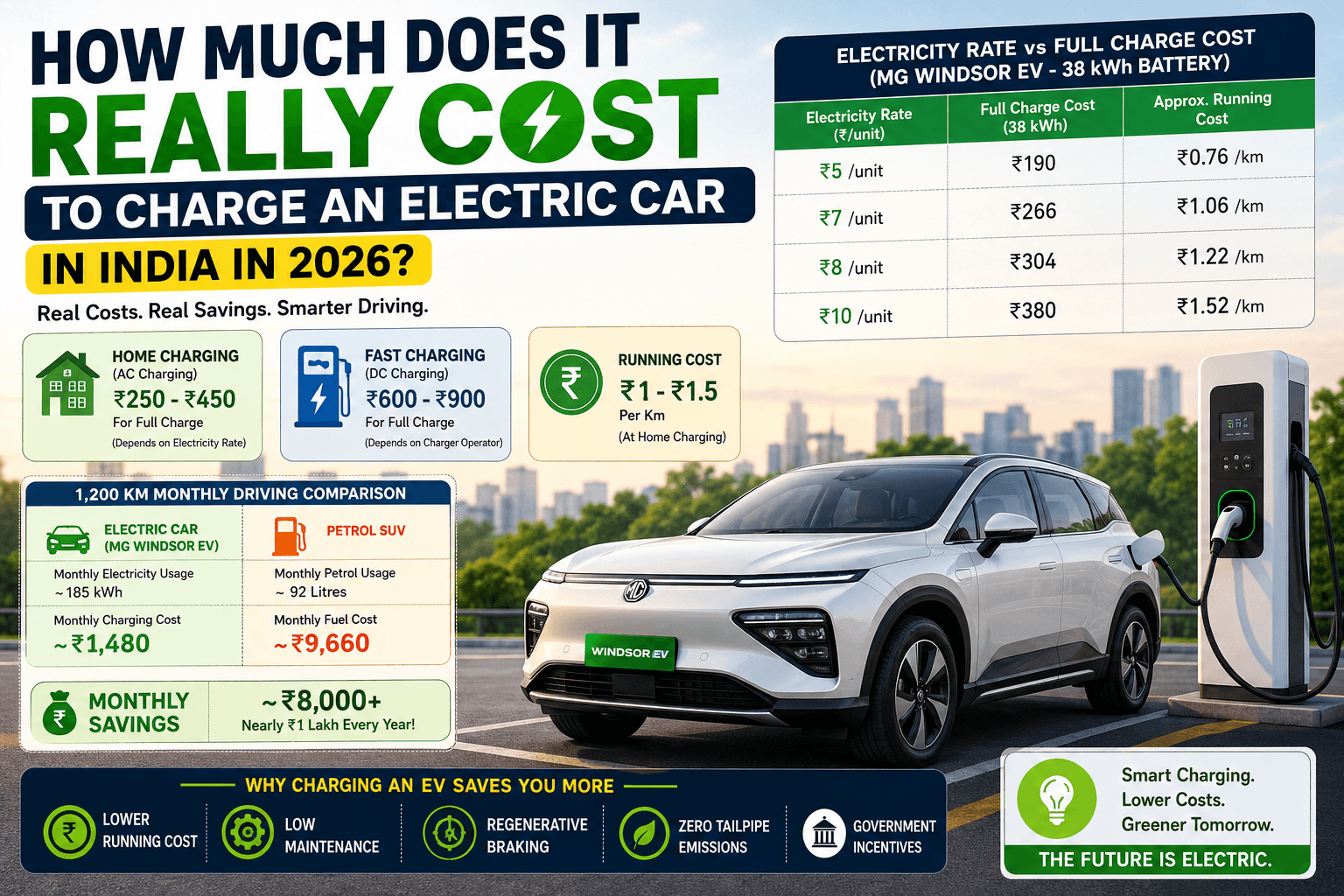
The reality? Charging an EV at home in India usually costs somewhere between ₹250 and ₹450 for a full charge, depending on your state and electricity slab. On the road, that roughly works out to about ₹1 to ₹1.5 per kilometre. Compare that with a petrol SUV and the difference starts looking… kind of ridiculous.
To make things easier to understand, let’s break down exactly how much to charge an electric car using the MG Windsor EV as an example. We’ll also look at electricity tariffs, home charging vs fast charging, monthly expenses, and whether EV ownership actually saves money long term.
How Much to Charge an Electric Car: Understanding the Basic Calculation
The math behind EV charging is actually pretty straightforward. Nothing overly technical here.
Every electric car battery has a capacity measured in kilowatt-hours, or kWh. Your electricity provider charges you per unit of electricity consumed – and 1 unit is basically 1 kWh.
So the formula goes like this:
Battery Capacity × Electricity Rate = Total Charging Cost
That’s it.
Once you know the cost of a full charge, you divide it by the distance your car can travel. That gives you the running cost per kilometre.
Let’s take the MG Windsor EV Excite variant.
Here are the basics:
- Battery pack: 38 kWh
- Claimed range: 332 km
- Real-world range: closer to 250 km in normal driving conditions
Now let’s assume your electricity rate is ₹8 per unit.
So:
- Full charging cost = 38 × ₹8 = ₹304
- Cost per kilometre = ₹304 ÷ 250 ≈ ₹1.22/km
That gives you a pretty realistic idea of how much to charge an electric car for everyday city use — office runs, traffic, AC on, weekend errands, all of it.
Now compare that with a petrol SUV giving around 12–14 km/litre. With petrol hovering around ₹105/litre in many cities, you’re spending roughly ₹7.5 to ₹9 per kilometre.
Big difference.
| Electricity Rate | Full Charge Cost (38 kWh) | Approx Running Cost |
| ₹5/unit | ₹190 | ₹0.76/km |
| ₹7/unit | ₹266 | ₹1.06/km |
| ₹8/unit | ₹304 | ₹1.22/km |
| ₹10/unit | ₹380 | ₹1.52/km |
Even at ₹10 per unit — which is already on the higher side for domestic electricity — an EV still ends up far cheaper than a petrol car.
How Much to Charge an Electric Car in Different Indian States
Here’s where things get a little tricky. India doesn’t have one standard electricity rate across the country. Every state has its own tariff structure, and on top of that, most states use slab-based billing.
So the more electricity you consume, the higher your rate may become.
In general though, residential electricity prices usually fall somewhere between ₹4 and ₹10 per unit.
A few rough examples:
- Punjab often lands around ₹8–₹10 depending on usage
- Delhi has subsidised rates for eligible households
- Gujarat and Madhya Pradesh are usually cheaper
- Maharashtra and Karnataka tend to sit somewhere in the middle or slightly higher
And then there’s Time-of-Day pricing in some states. Basically, electricity becomes cheaper during off-peak hours — mostly late at night.
Which, honestly, works perfectly for EV owners because most people plug in their car before bed anyway.
If you use a smart charger, things get even easier. You can schedule charging automatically during cheaper hours and forget about it completely. No waking up at 2 AM to switch chargers on or anything dramatic like that.
How Much to Charge an Electric Car Every Month?
A lot of people assume buying an EV means their electricity bill will suddenly explode. In most cases, it really doesn’t.
Let’s say your daily commute is around 40 km. A typical EV would consume roughly 6–7 kWh for that distance.
Over a month, if you drive around 1,200 km, your total electricity usage may land somewhere between 150 and 180 units.
At ₹8 per unit, your charging bill would roughly look like this:
- Around ₹1,200–₹1,440 per month
That’s usually less than what many people spend on weekend dining or coffee runs these days.
Now compare that with a petrol SUV covering the same monthly distance:
- Petrol expense = roughly ₹7,500–₹9,000 every month
So yeah… the savings add up surprisingly fast.
That’s why so many buyers researching how much to charge an electric car eventually start seriously considering the switch.
AC vs DC Charging: How Much to Charge an Electric Car Using Public Fast Chargers
Not all EV charging works the same way.
There are basically two main types:
- AC charging at home
- DC fast charging at public stations
Both have their place.
Home AC Charging
This is what most EV owners rely on daily.
You charge at residential electricity rates, which keeps costs low.
Typical numbers look something like this:
- Full charging cost = around ₹200–₹400
- Charging time = about 6–7 hours overnight
For most people, that’s more than enough. Plug the car in at night, wake up, and it’s ready to go.
Simple.
Public DC Fast Charging
Fast charging is a different story.
It’s much quicker — but definitely more expensive.
Most public fast chargers in India charge somewhere around ₹15–₹25 per unit.
So depending on the battery size:
- Full charging cost = around ₹600–₹900
That means how much to charge an electric car at a public DC station can easily become two to four times costlier than home charging.
Still, DC charging is incredibly useful when you need it.
Things like:
- Long highway drives
- Emergency charging
- Road trips
- Situations where you just don’t have time to wait
The smart approach? Use home charging for daily driving and depend on fast chargers occasionally. That balance usually works best for both convenience and cost.
Real-World Example: How Much to Charge an Electric Car for 1,200 km Monthly Driving
Let’s put all this into a more practical example.
Suppose you drive around:
- 1,200 km every month
- Roughly 40 km daily
The MG Windsor EV delivers around:
- 6.5 km per kWh in real-world conditions
So monthly electricity consumption comes to roughly:
- 185 kWh
At ₹8 per unit:
- Monthly charging cost = around ₹1,480
Now compare that with a petrol SUV.
Assume:
- Fuel efficiency = 13 km/litre
- Monthly petrol usage = about 92 litres
- Petrol price = ₹105/litre
Monthly fuel expense becomes:
- Close to ₹9,660
And that’s really where you understand how much to charge an electric car versus how much it costs to run a petrol vehicle. The gap is huge.
Monthly Savings
- EV charging = around ₹1,500
- Petrol expense = around ₹9,600
Potential savings:
- More than ₹8,000 every month
- Nearly ₹1 lakh yearly
Over five years or so, that’s a serious amount of money saved. Enough to offset a big chunk of the EV’s higher upfront price.
And we haven’t even touched maintenance savings yet — no oil changes, fewer moving parts, less brake wear because of regenerative braking… all that adds up too.
Conclusion: How Much to Charge an Electric Car in India?
So, in practical terms, how much to charge an electric car in India right now?
For most people charging at home, the running cost lands somewhere around ₹1 to ₹1.5 per kilometre. Even if you occasionally use public fast chargers, EVs still remain dramatically cheaper to run than petrol vehicles.
Take the MG Windsor EV example again. Driving around 1,200 km monthly could cost roughly ₹1,500 in electricity. A similar petrol SUV? Nearly ₹10,000 in fuel.
That’s not a small gap.
As charging infrastructure improves and more people install smart home chargers, understanding how much to charge an electric car is becoming a pretty important part of car-buying decisions. And honestly, once you sit down and do the math, EV ownership starts making a lot more sense than many people expect.
Additional Reading:
Spread Some Love
Author