Table Of Content
- Battery Durability: The 200,000-Mile Reality
- The Degradation Curve
- Manufacturing Consistency: From Fit and Finish to Precision
- The Factory Maturation Effect
- Cost of Ownership: Mechanical Simplicity
- Scheduled Maintenance Elimination
- Software Dependency: A Single Point of Failure?
- Long-Term Value and Retained Worth
- Retained Value Factors
- Comprehensive FAQs Regarding Tesla Reliability
Are Teslas Reliable? The Truth About Battery Longevity, Build Quality, and Long-Term Value
When car buyers transition from internal combustion engine (ICE) vehicles to electric vehicles, their definition of reliability undergoes a paradigm shift. There are no head gaskets to blow, no timing belts to snap, and no transmissions to fail. Instead, reliability is measured by battery health, software stability, and manufacturing consistency.
Battery Durability: The 200,000-Mile Reality
The single greatest fear for a prospective EV buyer is a catastrophic battery failure. However, real-world fleet statistics and laboratory telemetry paint an exceptionally durable picture.
The Degradation Curve
Lithium-ion batteries do not degrade linearly. Real-world fleet studies confirm that Tesla packs experience an initial step-down of 4% to 6% capacity loss within the first 15,000 miles as the battery chemistry stabilizes. After this initial dip, the degradation curve flattens significantly into a long, predictable plateau.
According to Tesla’s aggregated fleet data, Model 3 and Model Y Long Range packs retain an average of 85% of their original capacity at 200,000 miles.
- Chemistry Matters
- LFP (Lithium Iron Phosphate): Found in Standard Range models. These packs lack cobalt, making them structurally resilient. They can withstand over 1,000 to 1,500 full charge cycles and are designed to be charged to 100% weekly with negligible wear.
- NMC/NCA (Nickel-Based): Found in Long Range and Plaid variants. These cells offer superior energy density for long-distance driving but are more sensitive to voltage stress. Keeping these packs between 20% and 80% for daily use optimizes their chemical life.
Manufacturing Consistency: From Fit and Finish to Precision
Tesla’s historical weak point was not its engineering, but its assembly. Early production runs of the Model 3 (2018–2020) were notorious for uneven panel gaps, paint thinness, and interior rattles.
The Factory Maturation Effect
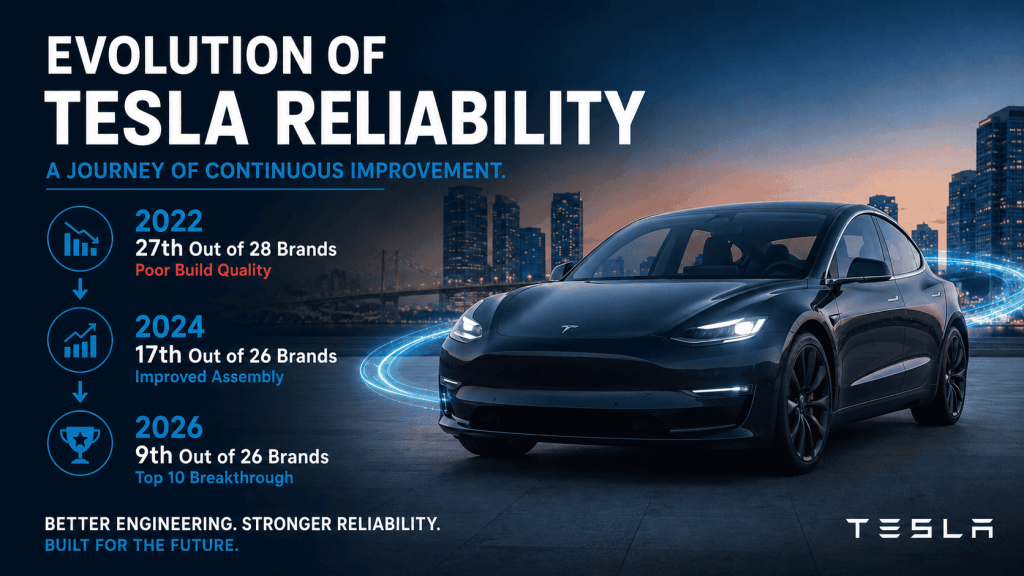
By 2026, Tesla’s manufacturing reliability has dramatically improved. Because Tesla has avoided major, frequent physical redesigns of the Model 3 and Model Y platforms, their gigafactories (specifically Shanghai and Berlin) have perfected the assembly tolerance.
- Gigacasting Overhauls
The implementation of Mega-Castings, where dozens of stamped steel pieces are replaced by a single, massive die-cast aluminium rear and front underbody structural section—has eliminated hundreds of potential failure points, welds, and alignment shifts. The only notable outlier in 2026 is the Cybertruck, which still scores lower in initial quality tracking due to the complex nature of its unpainted stainless-steel panels and its bleeding-edge 48V electrical network.
Cost of Ownership: Mechanical Simplicity
An internal combustion engine vehicle contains over 2,000 moving parts. A Tesla drive unit contains roughly 20. This mechanical simplicity alters the long-term cost profile of the vehicle.
Scheduled Maintenance Elimination
With a Tesla, traditional maintenance intervals are completely re-imagined:
- No Engine Oil Changes: Saves an average of $150–$300 annually.
- Brake Longevity: Because of aggressive regenerative braking, the electric motors slow the vehicle down, feeding energy back to the battery pack. Consequently, physical brake pads and rotors frequently last past 150,000 miles without replacement.
- The Tire Trade-off: Teslas are heavy due to the low-slung battery packs, and they deliver instant, linear torque to the tarmac. This combination causes them to consume tires roughly 20% faster than equivalent gas vehicles. Regular tire rotation every 6,250 miles is mandatory to maintain even tread life.
Software Dependency: A Single Point of Failure?
A Tesla is fundamentally a software-defined asset. While traditional automakers use dozens of isolated electronic control units (ECUs) from various third-party suppliers, Tesla utilizes a centralized computer architecture.
- The Double-Edged Sword of Over-the-Air (OTA) Updates
- The Advantage: If a component like the braking system or battery cooling algorithm needs optimization, Tesla deploys a global OTA software patch overnight. This eliminates the necessity of physical dealership recalls for minor engineering calibration errors.
- The Disadvantage: If the primary infotainment MCU (Media Control Unit) freezes, or if a firmware update contains a regression bug, vital secondary vehicle functions—such as climate adjustments, steering wheel resistance modifications, or safety chime readouts, can be temporarily compromised.
Long-Term Value and Retained Worth
The second-hand market for Teslas has stabilized significantly after the volatile pricing drops of 2023 and 2024.
Retained Value Factors
Because Teslas receive continuous software feature updates, a five-year-old Model Y features nearly identical software capabilities, safety processing frameworks, and user interfaces as a factory-fresh 2026 model. This preventational feature protection helps buffer the car against technological obsolescence, keeping secondary market demand robust.
Furthermore, high-mileage vehicle tracking shows that structural items, drive units, and core electronics routinely pass the 250,000-mile mark without systemic degradation, solidifying the car’s multi-decade usability.
Comprehensive FAQs Regarding Tesla Reliability
No. Tesla’s high-voltage battery packs are designed to last between 300,000 and 500,000 miles. Fleet data shows an average capacity retention of 85% at the 200,000-mile milestone.
Cold weather does not permanently degrade or damage the battery chemistry, but it temporarily slows down chemical reactivity. This results in a temporary 20% to 30% reduction in real-world range as the car uses energy to keep the cabin and the battery pack warm.
Tesla provides an 8-year warranty on the battery and drive units. The mileage cap is 100,000 miles for standard RWD models, 120,000 miles for Long Range trims, and 150,000 miles for the Model S, Model X, and Cybertruck, all guaranteeing at least 70% capacity retention.
Yes. Tesla’s current generation of permanent magnet and induction motors are engineered for one million miles of operational life, requiring virtually no fluid or mechanical gear maintenance over their service lifecycle.
Tesla’s ranking rose because they have kept their vehicle platforms (Model 3 and Model Y) physically consistent for multiple years. This allowed factory production lines to mature and resolve mechanical assembly issues without the disruptions caused by frequent redesigns.
Yes, provided you activate Car Wash Mode via the central touchscreen. This setting rolls up all windows, locks the automated charge port door, deactivates automatic windshield wipers, and allows for conveyor-safe neutral rolling.
Suspension components, specifically upper control arms, ball joints, and lateral links, are the most common mechanical items requiring replacement due to the high weight of the battery pack interacting with rough road infrastructure.
Occasional Supercharging on road trips does not cause measurable harm. However, relying exclusively on high-voltage DC fast charging daily can cause accelerated degradation over a multi-year window due to increased internal thermal stresses compared to low-voltage AC home charging.
Phantom drain is the slow loss of battery charge while the vehicle is parked. It is not a sign of battery defect, but rather energy consumed by onboard systems like Sentry Mode security cameras, cabin overheat protection, or frequent mobile app wake pings.
The Model 3 and Model Y utilize a hybrid construction of high-strength steel and aluminium panels, making them highly resistant to structural corrosion. The Cybertruck uses an unpainted stainless-steel alloy that can develop minor exterior surface spots from industrial rail dust, which can be cleaned with standard stainless-steel cleaners.
Older Tesla models used traditional lead-acid 12V batteries that typically failed every 2 to 3 years. Newer models utilize a proprietary 16V Lithium-ion auxiliary battery designed to last the entire functional lifecycle of the car.
If a Tesla sits at 0% for an extended period, the battery can enter a bricked state, where the chemical cell voltage drops too low to accept a charge safely, necessitating a full pack replacement. If you hit 0%, plug the vehicle into a power source immediately.
Early Model S and Model X units (2012–2017) suffered from screen yellowing or memory chip failures. Current production units use automotive-grade screens with hardened processors that resist thermal cycling and do not experience structural screen degradation.
While standard tires fit, it is highly recommended to use EV-certified tires. These tires feature reinforced sidewalls to handle the heavy battery weight and specialized foam dampening linings inside the tire tread to minimize road noise in the absence of a loud internal combustion engine.
The software system is highly reliable in terms of uptime and processing performance. However, because it runs on a Pure Vision camera framework without radar or LiDAR, its accuracy can be temporarily limited by heavy rain, direct blinding sunlight, or thick mud obstructing the exterior camera lenses.
Yes, in colder climates where road salt is heavily utilized, the lack of mechanical braking action can cause rust accumulation or caliper binding. Tesla officially recommends physically applying the brakes firmly once a week or servicing/lubricating the brake calipers annually in winter regions.
Yes. Tesla opens its service documentation, diagnostic software, and parts catalog to independent repair shops. However, advanced repairs involving the internal electronics of the high-voltage pack are typically restricted to Tesla-authorized service technicians or specialized EV engineering facilities.
No. Aesthetic modifications like vehicle wraps, chrome deletes, or ceramic coatings do not affect the factory powertrain or battery warranty, provided the installation process does not damage or obstruct any ultrasonic sensors or camera arrays.
Model 3 and Model Y use manual push-handles that are mechanically reliable. The motorized auto-presenting door handles on older Model S units are a known point of wear; replacing an out-of-warranty motorized handle assembly typically costs between $300 and $500 at a service center.
Insurance premiums are generally higher for Teslas, but this is not due to mechanical unreliability. It is driven by the high cost of body repairs and specialized structural parts following a collision, alongside the high likelihood that an impact affecting the structural battery chassis could cause the insurer to write off the vehicle as a total loss.
Spread Some Love
Author