“YOU PARK WHERE YOU WANT TO”: Elon Musk Confirms Massive Tesla FSD Memory Upgrade to Solve #1 Parking Problem
The conversational battleground over autonomous vehicles has shifted away from high-speed highway merges and unprotected left turns. According to extensive in-car telemetry logs gathered by Tesla’s driver-feedback systems, safety-critical driving errors have dropped to near-zero margins. Instead, an entirely new friction point has emerged at the tail end of assisted trips: the parking lot.
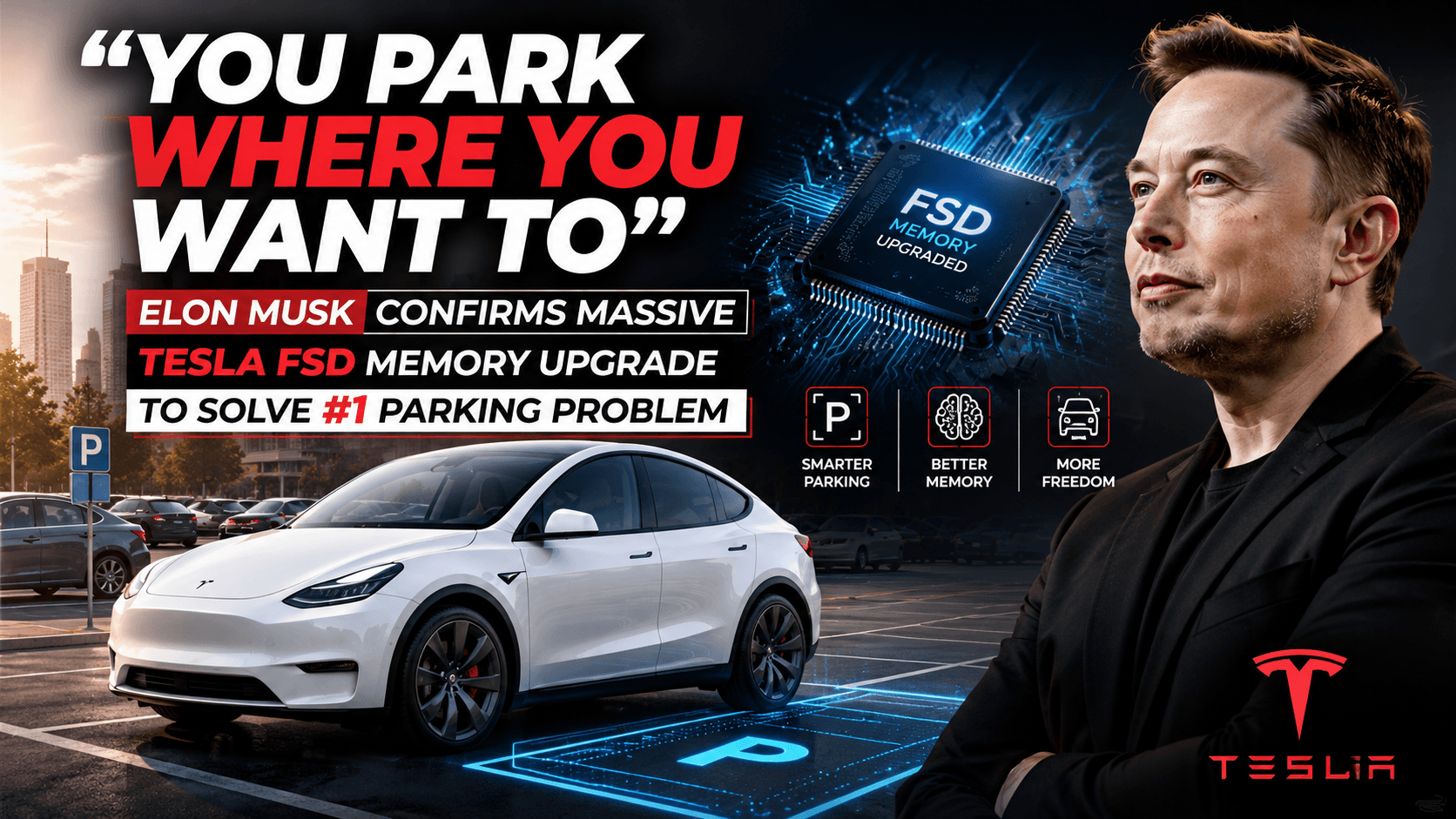
Responding to a wave of user data indicating that destination parking is now the primary reason owners take back control of their vehicles, Tesla CEO Elon Musk confirmed that upcoming versions of Full Self-Driving (Supervised) will introduce persistent, location-aware memory networks. Rather than letting the car blindly pull into the first available space it encounters, the vehicle will actively learn, recall, and navigate to your highly personalized parking spots.
1. The FSD Version 14.3.4 Rollout: Introducing the Arrival Prompt
The infrastructure for this update is landing on consumer touchscreens via the FSD (Supervised) v14.3.4 over-the-air (OTA) firmware release.
The primary quality-of-life update in version 14.3.4 is an interactive Destination Dialogue Box that dynamically pops up on the navigation map as the vehicle approaches its target location. Before executing a low-speed maneuver, the car communicates its intent clearly by highlighting available parking zones directly on the display panel. Early beta testers inside Tesla’s Early Access Program have noted that the interface removes the sudden uncertainty of final maneuvers, offering a deliberate execution layout that mirrors a corporate robotaxi experience.
2. Elon Musk’s Mandate: Memory-Based Parking
While version 14.3.4 introduces clear interface adjustments, Elon Musk outlined the core engineering shift under development. When confronted with user telemetry data showing that owners frequently disengage FSD the second a vehicle enters a commercial lot, Musk confirmed the development of persistent driver-preference tracking:
“Upcoming releases of FSD will remember your parking preferences, so that the car goes to the right location at your home, office, school drop off, etc. Destination parking is by far the biggest reason people now intervene with FSD. Critical safety interventions are extremely rare.”
THE EVOLUTION OF FSD PARKING LOGIC
FSD v14.1 (Arrival Options): Manual selection between Lot, Street, or Driveway.
↓
FSD v14.3.4 (Intent Dialog): Pre-maneuver popups notify driver of parking zones.
↓
Upcoming FSD Suite (Neural Memory): Persistent habit tracking overrides generic slots.
The forthcoming neural network logic will eliminate generic space matching. If an owner consistently bypasses tight front spaces at their gym to park in a vacant corner lot away from other vehicles, the car’s spatial reasoning algorithms will log those coordinate variables to its persistent local memory array. On future runs, the car will drive straight to that preferred zone without requiring human input.
3. Decoding the ‘Where’ Problem on Forums and Social Channels
On platforms like Reddit (r/teslamotors), X, and enthusiast forums, owners are actively cataloging why current parking mechanics demand human override steps.
While the vision-based Tesla Vision camera stack is mechanically capable of parallel or perpendicular parking with high precision, the car lacks social context. Users report that current versions of the software frequently gravitate toward disabled spaces, stop abruptly inside painted crosshatched loading zones, or attempt to pull over directly in front of active sidewalk pedestrian ramps.
Enthusiasts note that the drop a pin navigation trick serves as a temporary fix, but a true neural memory update will eliminate lot navigation errors entirely by matching the vehicle’s spatial behavior with its owner’s personal habits.
4. The Broader Mobility Horizon: The Final Robotaxi Anchor
For evauthority.net readers, this technical adjustment is a foundational step in Tesla’s broader autonomous business strategy.
To safely scale a driverless ride-hailing network (The Tesla Network) or deploy the newly certified Tesla Cybercab, a vehicle must do more than just navigate from point A to point B. It must safely execute passenger handoffs, locate designated drop-off lanes, and position itself correctly inside dense commercial garages without blocking public traffic.
By utilizing its active customer fleet as a crowd-sourced training network to map global parking preferences, Tesla is systematically building a high-fidelity database of commercial arrival spaces, securing an immense logistical advantage over traditional ride-sharing competitors.
Tesla FSD End-to-End Parking DemoThis video is highly relevant because it shows real-world footage of how Tesla’s end-to-end neural networks interpret parking lot markers and handle real-time spatial path planning during the final approach of an assisted drive.
Verifiable References & Technical News Bibliography
- Tesla Support Systems Directory: Full Self-Driving (Supervised) Core Features, Autopark Limitations, and Active Vision Telemetry. Official Tesla FSD Framework. [Factual verification of automated lane tracking and vision-only camera processing constraints].
- Tesla Corporate Executive Briefing: Statements on Destination Parking Interventions and Fleet Telemetry Data. Verified via official communication channels from Elon Musk (@elonmusk). Published June 17, 2026. [Direct quote parameters and intervention percentage logs].
- Teslarati Autonomous News Desk: Tesla Full Self-Driving is getting a major parking upgrade, Elon Musk says. Reported by Joey Klender. Published June 17, 2026. [Analysis of Early Access Program test results, parking orientation preferences, and neural mapping trends].
- The Times of India Tech Index: Tesla unveils FSD 14.3.4 with a smart parking twist: Could this small change transform every arrival? Global Tech Desk Aggregator. Published June 18, 2026. [Technical breakdown of version 14.3.4 destination dialogue prompts, regional rollout permissions, and user experience telemetry].
- Basenor Automotive News Logs: FSD Intervention Data: Parking Is Now the #1 Problem. Research editorial filed June 2026. [Statistical breakdown of zero-intervention 850-mile test runs and the software shift from road safety to lot navigation].
- InsideEVs Global EV Database: Tesla’s FSD Can Finally Park, Though Sometimes It Aims For The Sidewalk. Tracked by Andrei Nedelea via field testing data. [Analysis of version 13.2 through 14.1 parking maneuvers and camera-proximity tracking limitations].
Spread Some Love
Author