Table Of Content
- 1. Spotted Testing: The Secret On-Road Spy Shutter Campaigns
- The San Bruno Sighting
- The Giga Texas Drone Drops
- 2. Hard Spec Sheet: The Leaked Technical Blueprints
- 3. Transforming Mobility: The Core Threat to Uber & Lyft
- 4. The Blueprint: "The Tesla Network" App Integration
- The Hybrid Fleet Architecture
- Bibliographic References & Data Sources
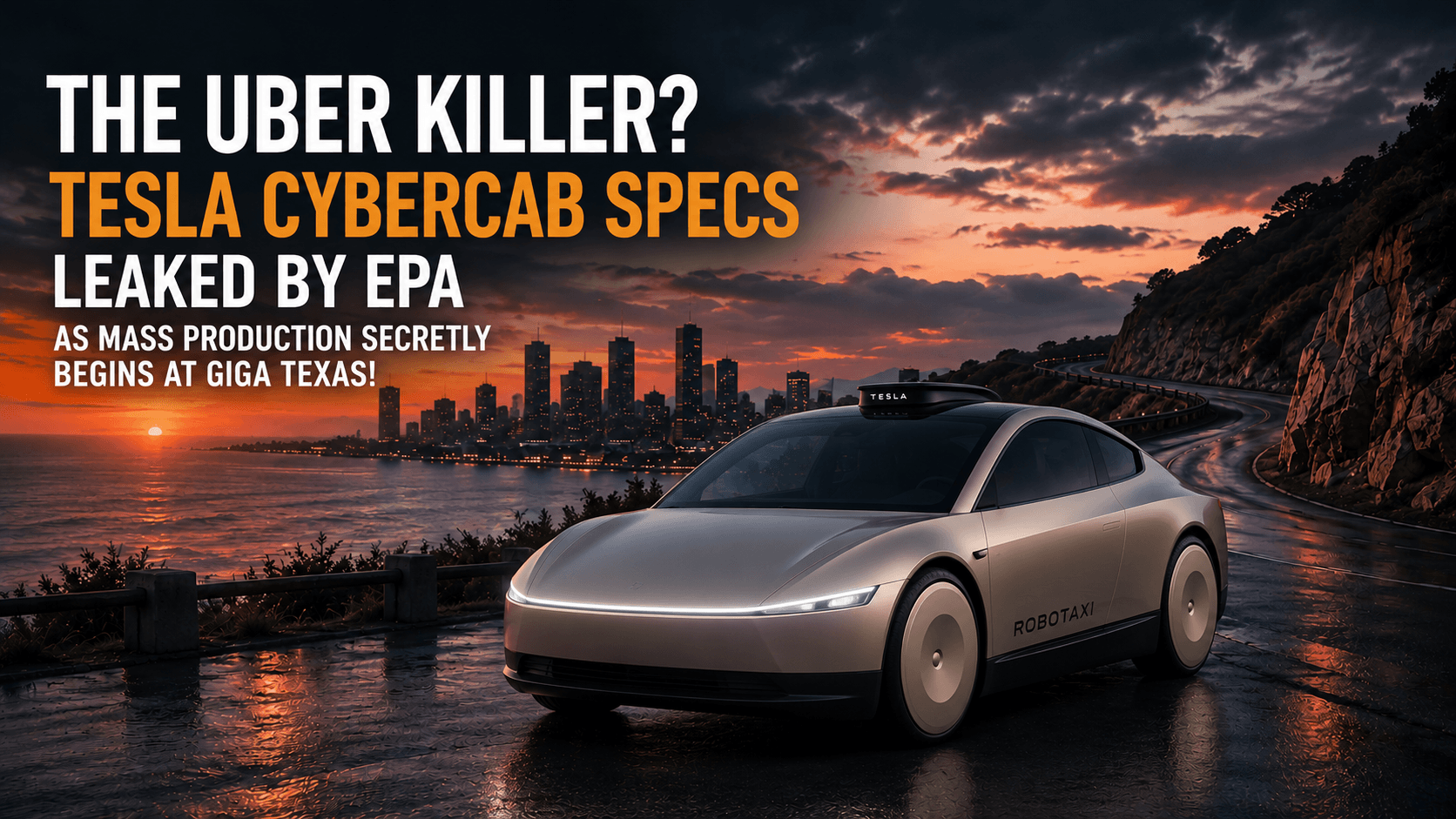
THE UBER KILLER? Tesla Cybercab Specs Leaked by EPA as Mass Production Secretly Begins at Giga Texas!
The landscape of global ride-hailing changed forever this week. While the mainstream media was focused on traditional vehicle sales, the United States Environmental Protection Agency (EPA) published an official Certificate of Conformity for test group TTSLV00.0L1A.
The subject? The 2026 Tesla Cybercab.
This massive regulatory green light officially classifies the steering-wheel-free, pedal-less two-seater as a fully street-legal battery-electric Zero Emission Vehicle (ZEV) across all 50 states. But the real shockwave is hitting Wall Street: the regulatory filing fully exposes the highly guarded mechanical blueprints, exact battery capacities, and real-world range metrics of the car designed to drive Uber and Lyft into permanent extinction.
1. Spotted Testing: The Secret On-Road Spy Shutter Campaigns
While the public introduction date was legally registered as May 29, 2026, Tesla has been quietly running high-intensity durability shakedowns across American road networks.
The San Bruno Sighting
A gold-wrapped Cybercab development mule was captured charging at a public Supercharger station in San Bruno, California. Photographed up close by local resident Robert G. (credited via Carscoops), this “V_001 Engineering Prototype” revealed a fascinating development phase: it temporarily retained a physical Model 3-style steering wheel and center screen. Automotive engineers note that early hand-built prototypes utilize these conventional controls to allow safety drivers to quickly step in and evaluate NVH (Noise, Vibration, and Harshness) or monitor early steer-by-wire software calibration loops.
The Giga Texas Drone Drops
Simultaneously, famous industrial drone operator Joe Tegtmeyer (credited via X) captured clear aerial footage of completely steering-wheel-free production Cybercabs rolling directly off the assembly lines at the Giga Texas Crash Testing Facility. The factory vehicles showcased white-painted, aerodynamically staggered rear alloy wheels, integrated front bumper tow hooks, and official manufacturer validation labels on the tires—confirming that structural crash-compliance and safety evaluation sequences are running at full scale.
2. Hard Spec Sheet: The Leaked Technical Blueprints
The official EPA certification documents dismantle a year of intense industry speculation. By optimizing every component for high-load urban delivery, Tesla has built a unique, front-wheel-drive powertrain envelope.
- The Battery Core: Shunning expensive large-capacity architectures, the Cybercab features a highly compact, lightweight 47.6 kWh Lithium-ion pack operating at a nominal 326V. Built with an energy density of 154 Wh/kg, the pack balances total vehicle weight against highly efficient urban cell management.
- Powertrain & Power: The car moves away from Tesla’s typical rear-wheel-drive bias, utilizing an efficient Front-Wheel-Drive (FWD) layout paired with an single-speed automatic transmission. It is propelled by a three-phase permanent magnet AC motor generating 163 kW (219 Horsepower).
- The Weight Conundrum: The vehicle registers a total curb weight of 3,113 lbs (1,412 kg). While this is roughly 750 lbs lighter than a standard Model 3 sedan, it is heavier than analysts predicted for a two-seat cabin with no steering matrix, pointing to a highly reinforced subframe and robust structural crash shields surrounding the front cabin compartment.
- True Real-World Range: In perfect laboratory conditions, the unadjusted raw EPA test cycle logged an impressive 418.2 city miles and 375.4 highway miles. Once the standard 0.7 EV correction multiplier is factored in to account for dynamic air conditioning loads and passenger variations, the official window-sticker range settles at 293 miles (471 km) from a single charge cycle.
- Wireless Charging Efficiency: The Cybercab completely omits a physical charge port, relying entirely on wireless inductive charging pads. The EPA documents reveal that a full replenishment from a wall connection requires 53.365 kWh of energy—representing a 12% heat-loss gap inherent to high-kilowatt wireless induction technology.
3. Transforming Mobility: The Core Threat to Uber & Lyft
The mathematical reality of scaling the Cybercab presents an immediate threat to modern ride-hailing networks like Uber and Lyft. Currently, the operational cost of an app-based human-driven ride-hail fluctuates between $1.50 and $2.00 per mile, with the human driver claiming roughly $0.50 to $0.70 of that margin.
By eliminating human driver inputs, removing mechanical components to trim part counts down by 50% compared to a Model 3, and achieving a record-shattering operational consumption index of just 165 Wh/mi, Tesla has driven structural operating costs down to an astonishing $0.20 to $0.40 per mile.
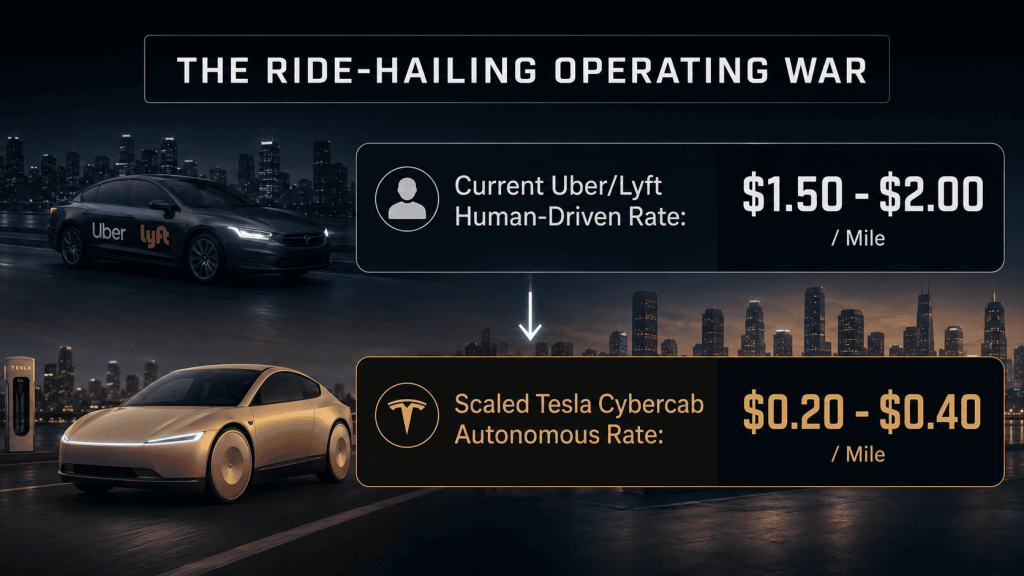
Even when factoring in corporate fleet oversight, commercial cleaning logistics, and insurance margins, a scaled Cybercab fleet can easily turn a profit while charging consumers $0.80 per mile. This aggressive pricing strategy will undercut human-operated networks, making traditional ride-hailing economically unviable in major metropolitan markets.
4. The Blueprint: “The Tesla Network” App Integration
Tesla is not planning to merely sell this vehicle to individual consumers for $30,000; it is launching a fully vertical logistics infrastructure dubbed The Tesla Network.
The Hybrid Fleet Architecture
The smartphone ride-hailing platform functions through a two-pronged approach:
- The Corporate Fleet: Tesla will directly own, deploy, and service hundreds of thousands of base Cybercabs stationed inside major urban city centers, taking care of automated cleaning and induction charging via central robotic hubs.
- The Consumer Lever: Individual consumer Tesla owners can tap a single button inside their personal smartphone app to instantly opt their privately owned Model 3, Model Y, or Cybercab into the public autonomous ride-hailing grid while they are asleep or working. Tesla will manage the dispatch routing software and payment pathways, collecting a clean 25% to 30% platform software toll on every single autonomous mile traveled, creating a massive, high-margin software revenue stream.
Bibliographic References & Data Sources
- Electrek Transportation Registry: Tesla Cybercab full specs revealed: 3,113 lbs, 219 HP, 48 kWh via official EPA certification. Written by Fred Lambert. Published June 15, 2026. [Analysis of Certificate Summary Information for test group TTSLV00.0L1A].
- Teslarati Regulatory Wire: Tesla Cybercab snags huge regulatory green light that readies it for public roads. Reported by the Teslarati Editorial Board. Published June 15, 2026. [Factual confirmation of ZEV certification and Clean Air Act conformity protocols].
- Carscoops Spotter Network: Cybercab Spotted Up Close, Steering Wheel, Panel Gaps And All. Photography and engineering insights provided by Robert G. Compiled by Stephen Rivers. Published March 12, 2026. [Analysis of San Bruno gold V_001 development prototype].
- CleanTechnica Autonomous Markets: Why Robotaxis Will Struggle To Compete vs. The Mass Economics of App Transport. Published June 15, 2026. [Calculations covering per-mile transportation cost variances and Uber network margins].
- ACKO Drive Technology Index: Tesla Cybercab Full Technical Specifications Leaked out of USA EPA Filing. Certified and published June 16, 2026. [Technical breakdowns of front-wheel drive architecture, induction charging variances, and specific energy densities].
- Giga Texas Industrial Drone Logs: Production Run Tracking of Steerless Cybercabs at Austin Assembly Arrays. Visual telemetry captured and parsed by Joe Tegtmeyer via X platform logs. Dispatched February 20, 2026. [Confirmation of tire marker tags and NHTSA evaluation vehicle hooks].
Tesla’s Robotaxi Infrastructure Explored
This video is highly relevant because it bypasses mainstream hype to break down the actual real-world infrastructure, deployment costs, and network scaling challenges that Tesla faces as Cybercab production officially begins.
Spread Some Love
Author




RELATABLE
“YOU PARK WHERE YOU WANT TO”: Elon Musk Confirms Massive Tesla FSD Memory Upgrade to Solve #1 Parking Problem
THE MID-WAY TITAN: Leaked Austin Production Logs Confirm 6-Seat Tesla Model Y L Hitting the US This September!