Table Of Content
- Why Tesla Unbundled the Charger
- Technical Grid: Level 1 vs. Level 2 Portable Units
- 1. The NEMA 5-15 Configuration (Level 1 Trickle Charging)
- 2. The NEMA 14-50 Configuration (Level 2 Mid-Tier Charging)
- Residential Installations: Hardwired Charging Stations for Tesla
- Technical & Circuit Layout Parameters
- Tesla Charger: Civic Clearance Laws, Structural Load Calculations, and Permitting
- High-Speed Public Supercharging vs. Level 2 Home Charging
- Tesla Model-Wise Baseline Charging Hardware Packages
- Tesla Model 3 & Model Y (Standard & Juniper lines)
- Tesla Model S & Model X
- Tesla Cybertruck
- Tesla Chargers: Financial Architecture: Replacement & Spare Component Costs
- Essential Tesla Charger Maintenance Tips
- 21 Technical FAQs on Tesla Chargers & Residential Integration
- Verifiable Technical Charging Bibliography
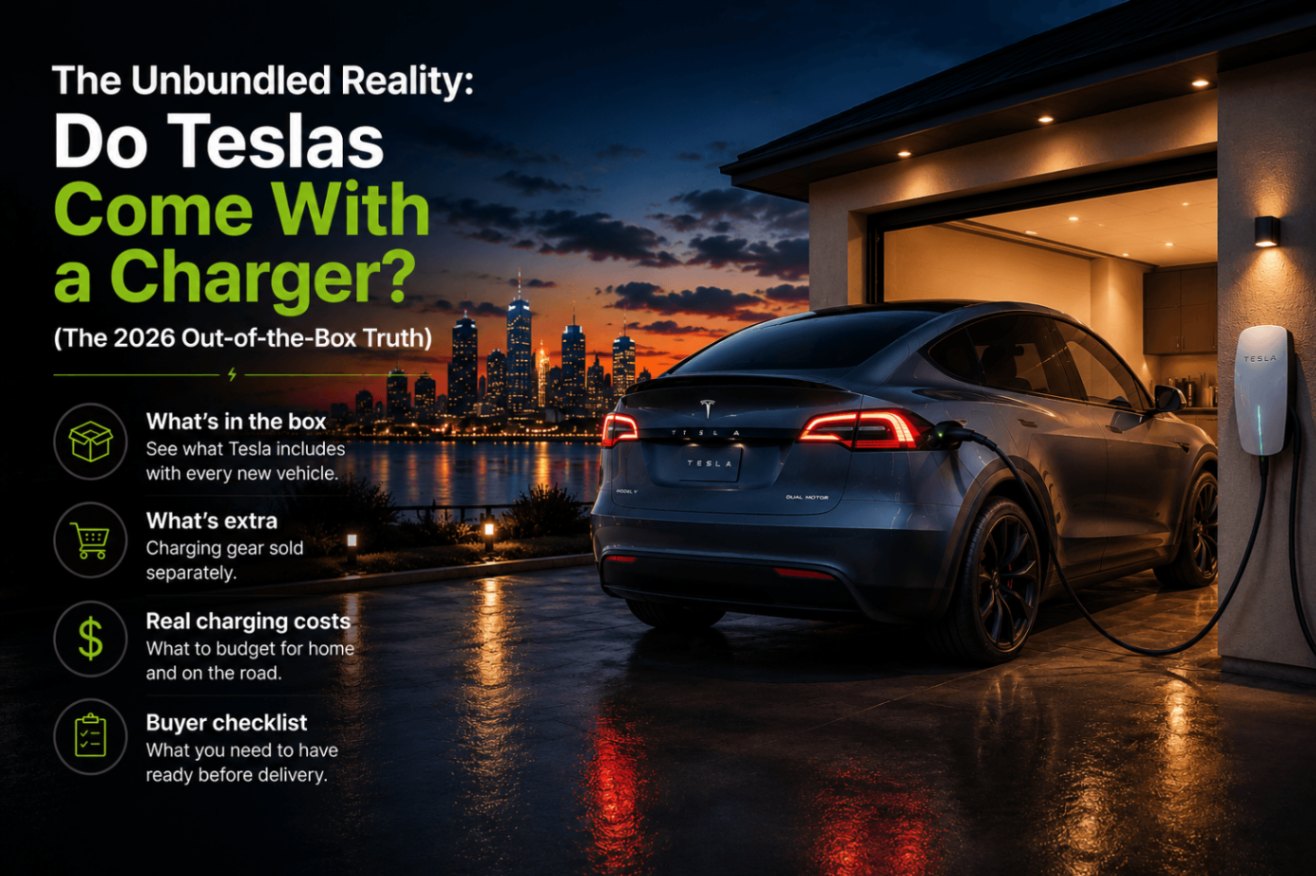
The Unbundled Reality: Do Teslas Come With a Charger? (The 2026 Out-of-the-Box Truth)
The clear, unequivocal answer is no. Since April 2022, no new Tesla vehicle delivered in North America comes factory-equipped with a home charging cable or portable adapter assembly included in the base price. When you pick up your car on delivery day, the only charging accessory resting inside the trunk compartment is a compact J1772 adapter, which allows the vehicle’s native NACS inlet port to accept power from generic public Level 2 charging stations.
Why Tesla Unbundled the Charger
Tesla eliminated the bundled portable charging cable based on extensive fleet telemetry data. Company analytics revealed that the vast majority of owners either used high-speed public Supercharger hubs exclusively or had already installed a high-output, hardwired home station. Unbundling the hardware reduced electronic waste and allowed Tesla to lower the retail price of the standalone portable adapter kit for those who truly needed it.
Technical Grid: Level 1 vs. Level 2 Portable Units
If you require a portable charging backup solution, you must purchase the official Tesla Mobile Connector Bundle ($300). This kit operates across two distinct configurations depending on the adapter faceplate swapped onto the control block:
PORTABLE MOBILE CONNECTOR SPECS
NEMA 5-15 Adapter (Level 1 Trickle)
-> 120 Volts / 12 Amps (1.4 kW Output) ──► Adds ~3-5 Miles of Range / Hour
│
▼
NEMA 14-50 Adapter (Level 2 Fast)
-> 240 Volts / 32 Amps (7.6 kW Output) ──► Adds ~30 Miles of Range / Hour
1. The NEMA 5-15 Configuration (Level 1 Trickle Charging)
- Electrical Parameters: Draws power from a standard 120-volt three-prong household outlet at a continuous 12 Amps, delivering a minor 1.4 kW power stream.
- Energy Draw & Time: Consumes roughly 1.4 kilowatt-hours of grid electricity per hour. Replenishing an 82 kWh Long Range battery pack completely from 10% to 80% requires an extensive 41-hour continuous plug session.
- Daily Utility: Adds approximately 3 to 5 miles of driving range per hour, making it suitable strictly as an emergency option or for low-mileage drivers who park undisturbed for long periods over the weekend.
2. The NEMA 14-50 Configuration (Level 2 Mid-Tier Charging)
- Electrical Parameters: Plugs directly into a heavy-duty 240-volt industrial utility outlet (identical to those powering large home clothes dryers) on a 50-amp dedicated circuit breaker, outputting a continuous 32 Amps (7.6 kW power ceiling).
- Energy Draw & Time: Consumes 7.6 kilowatt-hours of grid energy hourly. It executes that same 10% to 80% battery replenishment loop in a highly manageable 7.5 hours.
- Daily Utility: Supplies up to 30 miles of range per hour of charge, comfortably restoring a completely depleted family vehicle overnight.
Residential Installations: Hardwired Charging Stations for Tesla
For the fastest, most reliable home charging setup, Tesla recommends bypassing portable outlets entirely to hardwire a dedicated Tesla Wall Connector ($450) or a Universal Wall Connector ($600) directly into your home’s electrical subpanel.
Technical & Circuit Layout Parameters
- The Circuit Requirements: To unlock the maximum charging output of 11.5 kW, the station must be hardwired with thick-gauge copper wiring to a dedicated 60-amp double-pole circuit breaker inside your electrical panel. Under continuous loading guidelines, the station will draw a steady 48 Amps of current.
- Onboard Rectifier Bottlenecks: The true charging speed is governed by your vehicle’s internal hardware capabilities:
- Standard Range RWD Trims: Limited to an internal 32-Amp AC-to-DC onboard rectifier cap. Wiring these cars to a 60A station will not increase charging speeds; the vehicle will automatically throttle the intake down to 7.7 kW maximum (approx. 30 miles of range/hour).
- Long Range / Performance Trims: Built with a full 48-Amp onboard rectifier array, allowing them to utilize the station’s maximum 11.5 kW output to gain up to 44 miles of range per hour.
Tesla Charger: Civic Clearance Laws, Structural Load Calculations, and Permitting
Mounting a high-draw, continuous electrical asset like an 11.5 kW EV charger to a residential home requires strict adherence to local building regulations and safety codes:
- The Load Calculation Requirement: Before an electrician can run conduit, they must submit an official National Electrical Code (NEC) load calculation to your local city or county building department. If your home runs on a legacy 100-amp service panel and already operates high-draw appliances (like a central air conditioning unit, electric oven, and hot water heater), the city may deny the permit until you perform a full panel service upgrade to a modern 200-amp layout.
- The Permits Process: You must secure a formal Residential Electrical Permit from your local building authority before installation begins. Once the hardwired station is mounted and wired, a city building inspector must visit the site to review the grounding rods, verify the conduit thickness, and check the torque settings on the breaker lugs. Passing this inspection secures your formal Certificate of Approval, keeping your homeowner’s insurance policy compliant if a unrelated electrical issue ever occurs.
High-Speed Public Supercharging vs. Level 2 Home Charging
Understanding the distinct operational roles and hardware boundaries of public fast charging versus home charging clarifies your options:
- Level 2 Home Chargers (AC Architecture): The Wall Connector feeds raw Alternating Current (AC) straight to your parked car. The vehicle’s internal onboard rectifier must manually convert that AC stream into Direct Current (DC) before it can enter the battery cells. Because this conversion generates minimal heat, Level 2 home charging can run continuously for hours with near-zero cell stress, making it the most cost-effective and chemically gentle method for daily use.
- Tesla Superchargers (DC Fast Charging): These massive public stations completely bypass your car’s small onboard rectifier. The Supercharger cabinet converts massive amounts of grid AC power into intense Direct Current (DC) up to 250 kW outside the vehicle, pumping electricity straight into the high-voltage pack at up to 400V–800V. This level of power demands active battery cooling and precise preconditioning, and should be reserved for long-distance road trips to minimize long-term cell wear.
Tesla Model-Wise Baseline Charging Hardware Packages
The following breakdown charts the exact charging equipment included at vehicle delivery alongside internal hardware processing limitations:
Tesla Model 3 & Model Y (Standard & Juniper lines)
- Included Equipment: One J1772 public adapter plug and one Sentry Mode USB storage drive.
- Internal Hardware Cap: Standard RWD variants are capped at 32 Amps (7.7 kW); Long Range and Performance lines support up to 48 Amps (11.5 kW).
Tesla Model S & Model X
- Included Equipment: One J1772 public adapter plug, one premium center console accessory kit, and a 1-year Premium Connectivity trial.
- Internal Hardware Cap: All model trims come equipped with a full 48-Amp (11.5 kW) onboard charger configuration as standard equipment.
Tesla Cybertruck
- Included Equipment: One J1772 public adapter plug and one integrated high-capacity Powershare Home Backup Adapter system.
- Internal Hardware Cap: Features an upgraded, heavy-duty onboard bi-directional charging array accepting up to 48 Amps (11.5 kW), with full support for emergency Vehicle-to-Home (V2H) grid exporting.
Tesla Chargers: Financial Architecture: Replacement & Spare Component Costs
If your charging gear is damaged out of warranty, you can purchase replacement units directly through the Charging tab inside the official Tesla Mobile App Shop:
- J1772 Public Charging Adapter Replacement: $50
- Tesla Mobile Connector Bundle (Full Portable Kit): $300
- NEMA 5-15 or NEMA 14-50 Standalone Adapter Faceplates: $45 each
- Tesla Wall Connector (Standard NACS 24-foot cable hardwired unit): $450
- Tesla Universal Wall Connector (Built-in J1772 auto-latch matrix station): $600
Essential Tesla Charger Maintenance Tips
- Regularly Inspect Handle Contact Pins: Look inside the plug head periodically to ensure no dirt, insects, or corrosion are blocking the silver NACS pins.
- Avoid Cord Coiling Tensions: Wrap the charging cable loosely around the Wall Connector housing; tight, sharp loops can kinking internal copper wires over time.
- Keep the Connector Fully Docked: Always return the handle to its wall cradle when not in use to protect the delicate electronic communication pins from rain and moisture.
- Verify Breaker Set-Screw Torque: Have an electrician periodically check that the main subpanel breaker lug screws are torqued down tight to prevent heat spikes.
- Wipe Down Exterior Casing Panels: Clean the outer plastic shield using a damp microfiber cloth; never spray a high-pressure hose directly at the unit.
- Keep Firmware Updated via Wi-Fi: Ensure your Wall Connector is connected to your home’s 2.4 GHz Wi-Fi network to receive automated over-the-air performance updates.
- Protect the Handle from Hard Drops: Dropping the plastic handle onto hard concrete driveways can crack the outer casing, compromising its weather sealing.
- Monitor Cord Heat Levels: Feel the cable during active charging; if it feels hot to the touch rather than warm, reduce the charge current via the app and call an electrician.
- Use High-Quality Industrial Outlets: If using a Mobile Connector with a NEMA 14-50 plug, ensure your electrician installs a commercial-grade outlet (such as a Hubbell or Bryant brand) that can handle continuous heavy loads safely.
- Keep Clear of Weed Weed Whackers: Install the charging conduit high enough to prevent accidental damage from lawn mowers and weed trimmers near outdoor driveways.
- Clear Away Winter Ice Build-ups: Brush away heavy snow and ice from the top of an outdoor Wall Connector casing to prevent moisture from seeping into the seals during freezes.
21 Technical FAQs on Tesla Chargers & Residential Integration
Yes, you can use the portable Tesla Mobile Connector paired with a standard NEMA 5-15 adapter plug. However, this level 1 trickle charge is very slow, adding only 3 to 5 miles of driving range per hour of connectivity.
Yes, every new Tesla vehicle includes a standard J1772 adapter in the trunk at delivery, allowing you to use non-Tesla public Level 2 charging stations across North America out of the box.
While the hardware costs $450, professional installation by a licensed electrician typically ranges from $500 to $1,500 for labor, permits, and materials, depending on how close your electrical panel is to your parking space.
If the station is a standard Wall Connector, a non-Tesla EV will require a third-party NACS-to-J1772 adapter. However, the Tesla Universal Wall Connector ($600) features a built-in, auto-latching mechanical adapter that natively charges any EV on the market.
The Tesla Battery Management System (BMS) continuously monitors internal cell temperatures. If ambient garage temperatures spike, the car will reduce its power intake to protect the battery pack until things cool down.
Yes. Tesla’s official advice is to keep the car plugged in whenever it is parked. The onboard computer manages the battery automatically, drawing power straight from your home grid to run health routines without cycling or wearing out the battery cells.
Not necessarily. If your home has a 100-amp or 150-amp panel, you can configure the Wall Connector’s internal dip switches to a lower output level (such as 24 or 32 Amps) or pair it with a smart dynamic load-shedding monitor to avoid an expensive electrical service upgrade.
The Wall Connector will shut down immediately to protect itself from grid surges. Once utility power is restored, the station will run a self-diagnostic check and automatically resume charging your vehicle.
Yes. The Tesla mobile app allows you to adjust the charging rate dynamically from 5 Amps up to your station’s maximum output limit, giving you full control over your home energy usage on the fly.
The vehicle is running its onboard thermal management system pumps and radiator cooling fans. Charging batteries generates heat, and the car cycles liquid coolant through the floor pack to keep temperatures within an optimal window.
The Tesla Wall Connector comes factory-equipped with an extra-long 24-foot (7.3-meter) tethered cable, allowing you to plug in your vehicle easily even if the station is mounted several paces away from your bumper.
Yes. The station features a rugged, weather-sealed enclosure rated for both indoor and outdoor installations, and is designed to operate safely through rain, snow, and extreme seasonal temperature swings.
This software feature allows up to six Tesla Wall Connectors mounted on the same property to connect to each other over Wi-Fi. They will intelligently share a single circuit breaker’s total power capacity, distributing current safely based on how many cars are plugged in at once.
To achieve the maximum 11.5 kW (48 Amps continuous) charging rate, you must connect the station to a dedicated 60-amp double-pole circuit breaker using properly rated wiring.
Yes. If your home features solar panels and a Tesla Powerwall battery backup system, you can use the app’s “Charge on Solar” feature to ensure your car draws power exclusively from excess clean energy generated by the sun.
A blinking red LED indicates an internal system fault or an installation wiring error. Count the number of sequential blinks and cross-reference them with the troubleshooting chart in the official installation manual to pinpoint the issue.
While it is physically possible, Tesla highly recommends hiring a certified, licensed electrician. Incorrect wiring can present a fire hazard, violate local building codes, and potentially void your home insurance policy if an electrical issue occurs.
Yes. Both the Mobile Connector and the hardwired Wall Connector incorporate advanced internal ground-fault circuit interrupter (GFCI) electronics to stop power flow instantly if a short circuit or voltage surge is detected.
Only if the generator produces a clean, pure sine wave power signal and is properly bonded to a true electrical ground. Most standard portable construction generators produce electrical noise that will cause the car’s sensitive onboard charger to reject the power stream for safety.
You can use the in-car screen or smartphone app to restrict your charging sessions to off-peak night windows (e.g., 11:30 PM to 5:30 AM) when your utility company offers discounted electricity rates, cutting your charging costs by up to 50%.
The legacy Gen 1 units could support up to 40 Amps. Current Gen 2/3 Mobile Connector units are electronically capped at a maximum output of 32 Amps, matching the physical limitations of standard NEMA 14-50 configurations perfectly.
Verifiable Technical Charging Bibliography
ExtremeTech Automotive Registry: Tesla Ends Included Mobile Connectors With New Vehicle Shipments. Reported by Ryan Whitwam. [Historical baseline verification of the April 2022 inventory shift].
Tesla Support Systems Reference Directory: Home Charging Architecture, Mobile Adapter Engineering, and Universal Wall Connector Upgrades. Official Tesla Charging Support. [Factual verification of unbundling parameters, $300/$450 pricing points, and J1772 inclusion metrics].
National Fire Protection Association (NFPA): National Electrical Code (NEC) Article 625: Electric Vehicle Charging System Equipment Regulations and Continuous Load Calculations. [Permitting framework verification data].
Tesla Wall Connector Gen 3 Installation Manual: Section 2.4: Circuit Breaker Configurations, Onboard Rectifier Amp Adjustments, and Ground-Fault Interrupt Thresholds. [Official Engineering Blueprint]. [Verification of 60A/48A constraints and 24-foot cord lengths].
Exspenditure Home Technical Index: Tesla Universal Wall Connector Deep-Dive Evaluation & Bi-Directional Power Sharing Metrics. Published April 2026. [Analysis of Powershare grid capabilities and smart load management integrations].
Spread Some Love
Author