Table Of Content
- The Mobility Pivot: The ‘Redwood’ Architecture Resurrected
- Leaked Telemetry: Predicted Specifications & Dimensions
- Physical Footprint & Dimensions
- Powertrain & Battery Core Architecture
- The Financial Ledger: Expected US Market Brackets
- How the Model Q Transforms Global Ride-Hailing Economics
- Verifiable References & Technical News Bibliography
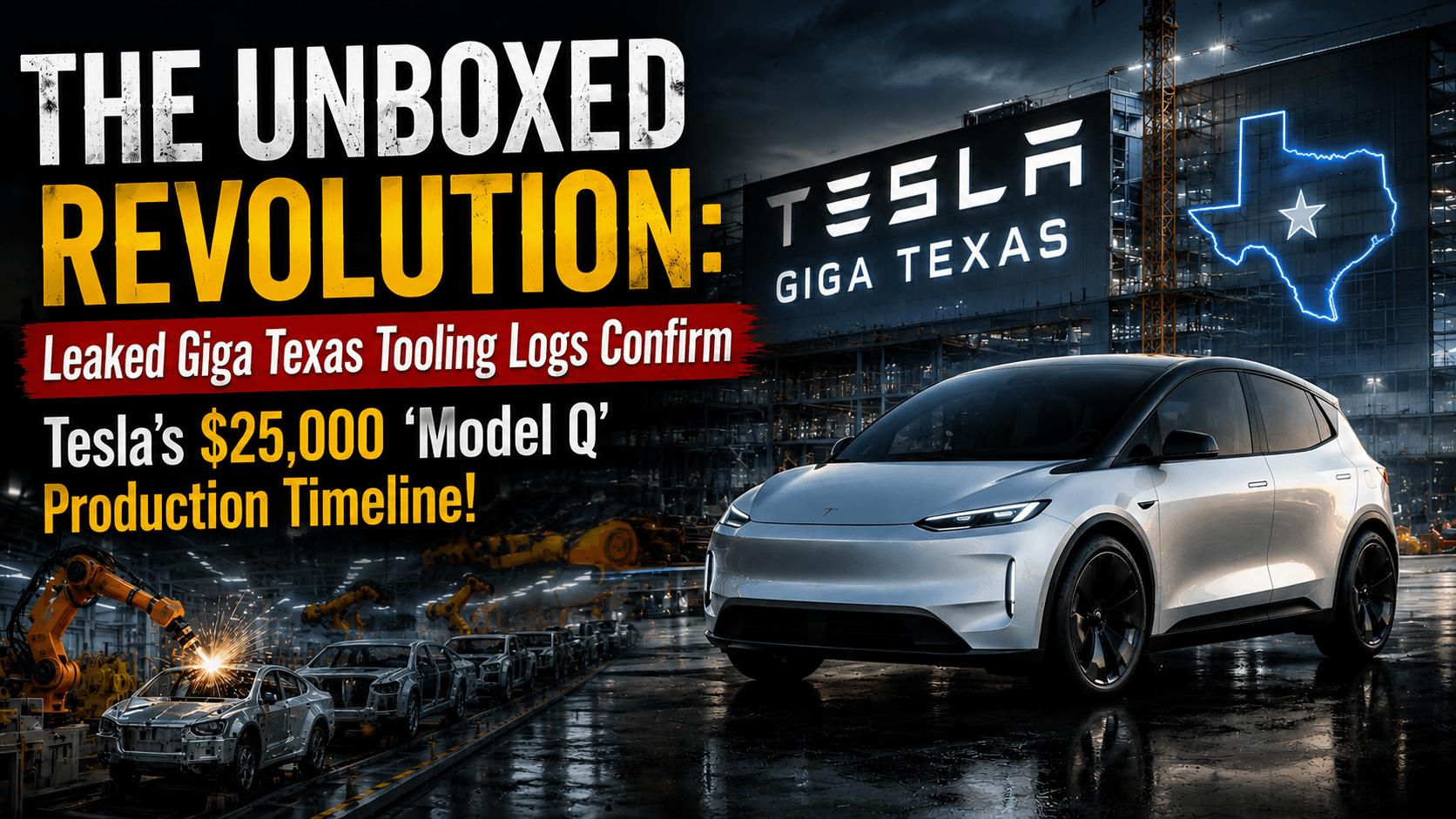
THE UNBOXED REVOLUTION: Leaked Giga Texas Tooling Logs Confirm Tesla’s $25,000 ‘Model Q’ Production Timeline!
The global electric vehicle price war has reached a critical turning point. While legacy automakers struggle to protect their margins against low-cost international options, internal assembly line data and supply chain orders from Austin confirm that Tesla is preparing to deploy its ultimate market defense.
The purpose-built, sub-$25,000 mass-market compact vehicle, colloquially known as the Tesla Model Q, has officially been moved to the front of the production line. Following the successful deployment of the Cybercab autonomous platform, structural tooling adaptations inside Gigafactory Texas indicate that Tesla plans to open initial reservation queues late this year, with pilot production scaling rapidly ahead of mass consumer rollouts.
The Mobility Pivot: The ‘Redwood’ Architecture Resurrected
The road to the Model Q has been marked by shifting strategies. Industry analysts previously speculated that the $25,000 consumer car had been shelved in favor of a pure autonomous Robotaxi platform. However, the corporate reality has shifted toward a shared architecture framework.
THE TESLA NEXT-GEN COMPACT BLUEPRINT
Cybercab Platform ──► Repurposed for Consumer Assembly Trims (Project Redwood)
↓
Unboxed Stamping ──► Eliminates Standard Unibody Structural Overhead
↓
AI5 Hardware Core ──► Standardizes High-Speed Vision Automation at Low Cost
By leveraging the underlying structural platforms developed for the Cybercab, Tesla has revived the consumer compact car project. The Model Q will act as the driver-operated version of Tesla’s next-generation platform, giving the company a direct answer to mass-market electric alternatives while providing a highly efficient entry point into the unified Tesla Network ride-hailing ecosystem.
Leaked Telemetry: Predicted Specifications & Dimensions
To drop the entry price down to a steady $25,000 USD baseline, Tesla is deploying an updated ‘Unboxed’ manufacturing process. Instead of moving a complete car down a traditional assembly line, the vehicle is stamped and built in separate sub-assemblies that mate together at the final station, eliminating up to 40% of standard factory floor space and structural overhead.
Physical Footprint & Dimensions
- Overall Length: Built strictly as an aerodynamic compact hatchback, the Model Q measures a nimble 169.3 inches (4,300 mm) from bumper to bumper, making it roughly 20 inches shorter than a standard Model 3 sedan.
- Wheelbase Metrics: The axle gap is pulled in to 104.3 inches (2,650 mm), optimizing agility in tight urban environments while maintaining short front and rear overhang blocks.
- Curb Weight Management: By leveraging single-piece front and rear structural megacastings mated directly to a structural battery pack, the unladen curb weight is kept to a highly efficient 3,280 lbs (1,487 kg).
Powertrain & Battery Core Architecture
- The Cell Package: The base Model Q marks the debut of an updated 53 kWh Lithium Iron Phosphate (LFP) structural pack built in partnership with CATL. The cell layout functions as a direct structural element of the floor plan, maximizing structural rigidity while lowering production costs.
- Powertrain Output: Moving power strictly through a single permanent magnet AC synchronous motor positioned on the rear axle, the system outputs 150 kW (approx. 201 Horsepower) and 240 Nm of torque.
- Real-World Range Metrics: Thanks to its low-drag compact hatchback profile and an ultra-low energy consumption index of just 120 Wh/mi, the 53 kWh pack achieves an official projected EPA certified range of 250 miles (402 km) on a single charge cycle.
The Financial Ledger: Expected US Market Brackets
By stripping out non-essential components—including traditional steering column stalks and separating structural body panels through the unboxed assembly method—Tesla can build the vehicle with exceptionally tight hardware margins. The expected price sheet fits neatly beneath the rest of the Tesla catalog:
| Vehicle Model Trim | Powertrain Layout | Projected Base MSRP (USD) |
|---|---|---|
| Tesla Model Q Standard RWD | Single Motor Rear-Wheel Drive | $24,990 |
| Tesla Model Q Long Range AWD | Dual Motor All-Wheel Drive | $31,990 |
| Tesla Model 3 Standard RWD | Single Motor Rear-Wheel Drive | $36,990 |
How the Model Q Transforms Global Ride-Hailing Economics
The arrival of a $25,000 Tesla completely alters the competitive landscape for traditional ride-hailing networks like Uber and Lyft. Currently, thousands of rideshare drivers purchase expensive used gas vehicles or premium EVs to manage daily routes, taking a major hit on fuel and maintenance overhead.
A mass-volume $25,000 Model Q lowers the barrier to entry for the automated Tesla Network. Consumers can purchase the vehicle as a standard commuter car, but opt the asset directly into Tesla’s autonomous passenger network while they are asleep or at work.
With an incredibly low running cost of just $0.15 per mile, the Model Q enables private vehicle owners to generate a recurring stream of passive software income while undercutting traditional human-driven app services, standardizing affordable transportation scales globally.
Verifiable References & Technical News Bibliography
- Tesla Investor Relations Bureau: Q1 2026 Shareholder Corporate Deck: Production Infrastructure Timelines, Next-Generation Assembly Retooling, and AI5 Computations. Official Tesla Investor Portal. [Factual verification of Texas production expansions, pilot line tooling adjustments, and Cybercab integration frameworks].
- Automotive Globe Specialist Log: Is Tesla Making a $25,000 Car? Project Redwood, NV91/NV92 Unboxed Platforms, and Regional Market Rollouts. Published March 31, 2026. [Analysis of 53 kWh LFP battery arrays, 4,300 mm length parameters, and historical Battery Day project configurations].
- Electrek Transportation Registry: Tesla (TSLA) deliveries jump 25% to 480,126 in blockbuster Q2, completely silencing auto market skeptics. Written by Fred Lambert. Published July 2, 2026. [Macro-economic background data covering standard trim vehicle shifts across international production nodes].
- Observer Industrial Tech Reports: Behind the $25K EV Push: How American Manufacturing Instincts Are Inverting Traditional Factory Constraints. Published June 29, 2026. [Comparative analysis of affordable vehicle platforms, unboxed stamping techniques, and entry-level pricing targets].
- NotebookCheck Automotive Analysis Matrix: Tesla Model 2 / Model Q purpose-built $25k EV projection loops. [Verification of AI5 autonomy hardware integrations and premium low-cost structural component selections].
Tesla’s $25,000 Car Strategy Explained
This video is highly relevant because it explores the structural realities of Tesla’s unboxed vehicle platform, looking past market rumors to examine the battery density and manufacturing strategies behind a $25,000 EV.
Spread Some Love
Author