The 2026 Tesla North American Lineup

Table Of Content

The 2026 Tesla North American Lineup: The Master Blueprint of Autonomous Electrification:

Buying a modern automobile used to be a predictable, well-understood transaction. For over a century, switching from one brand to another simply meant learning the position of a few dashboard buttons while continuing the same rhythm of gas station stops, fluid flushes, and mechanical wear cycles.

When you cross the threshold into a Tesla, that old automotive contract is completely shredded.

This is not a casual buyer’s checklist or a collection of showroom talking points. This document is a forensic, telemetric manual engineered for the tech-literate consumer who refuses to rely on superficial marketing scripts. A Tesla is not merely an electric passenger vehicle; it is a highly integrated, software-defined computing node on wheels that manages intense electromagnetic forces, complex chemical balances, and real-time algorithmic pathing loops beneath its skin.

Whether you are cross-shopping the mass-market efficiency of the Model 3 Highland, evaluating the structural megacastings of the Model Y Juniper, or calculating the raw physics required to harness the 1,020-horsepower tri-motor matrix of a Plaid platform, you are stepping into a entirely different ecosystem of ownership.

This guide bridges the gap between surface-level lifestyle reviews and raw automotive engineering. We will run an energy audit on Tesla’s centralized zone-control architecture, dissect the distinct charging velocities of LFP versus NMC cell chemistries, map out the local permitting math required for hardwired residential infrastructure, and expose the 100,000-mile mechanical realities of electric drive unit lubrication. If you want a generic consumer walkthrough, there are plenty of run-of-the-mill blogs and video channels to turn to. But if you want the absolute, uncompromised truth regarding the electrical, computational, and physical architecture of the North American fleet before you sign your delivery papers, this is the only guide you ever need to read. Let’s dive into the telemetry.

The 2026 Fleet Blueprint: Production Specs & Pricing Ledgers

The 2026 Fleet Blueprint

Tesla’s vehicle catalog operates as a unified platform engineering system. The fleet is structurally bifurcated between mass-market gigafactory assets (Model 3 and Model Y) and premium low-volume technical flagships (Model S, Model X, and the Cybertruck).

The 2026 Tesla North American Pricing & Mechanical Ledger

The following matrix charts the official base Manufacturer Suggested Retail Prices (MSRP), unladen mass configurations, factory-rated outputs, and verified EPA driving ranges across all trims currently on sale in the United States.

Vehicle Model & Trim SelectionBase MSRP (USD)Curb Weight (lbs)Combined Max OutputCertified EPA Range
Model 3 Standard RWD$36,9903,759 lbs213 kW (286 hp)321 Miles
Model 3 Premium RWD$42,4903,920 lbs238 kW (320 hp)363 Miles
Model 3 Premium AWD$47,4904,030 lbs366 kW (491 hp)346 Miles
Model 3 Performance AWD$54,9904,030 lbs380 kW (510 hp)303 Miles
Model Y Standard RWD$39,9904,061 lbs220 kW (295 hp)321 Miles
Model Y Premium RWD$44,9904,184 lbs220 kW (295 hp)357 Miles
Model Y Premium AWD$48,9904,365 lbs336 kW (450 hp)327 Miles
Model Y L Premium 6-Seat$61,9904,612 lbs336 kW (450 hp)325 Miles
Model Y Performance AWD$57,4904,482 lbs461 kW (618 hp)306 Miles
Model S Premium AWD$94,9904,561 lbs500 kW (670 hp)410 Miles
Model S Plaid Tri-Motor$109,9904,766 lbs761 kW (1,020 hp)368 Miles
Model X Premium AWD$99,9905,148 lbs500 kW (670 hp)352 Miles
Model X Plaid Tri-Motor$114,9905,390 lbs761 kW (1,020 hp)335 Miles
Cybertruck Premium AWD$79,9906,603 lbs442 kW (593 hp)325 Miles
Cyberbeast Tri-Motor$114,9906,843 lbs630 kW (845 hp)320 Miles

2026 Tesla US Line Up- Battery Architectures, Chemistry Profiles & Thermal Manifolds

The operational profile of any Tesla vehicle is fundamentally governed by the chemical composition of the cell packs built into its structural floor plan. Tesla does not deploy a uniform battery design; instead, its engineering tracks are split across distinct chemical and geometric paths.

TESLA VEHICLE BATTERY SELECTION 

Prismatic Matrix ──► Lithium Iron Phosphate (LFP) ──► Base RWD Trims (100% Daily SoC)

Cylindrical 2170 ──► Nickel-Manganese-Cobalt (NMC) ──► Premium/AWD Lines (80% Daily SoC)         

Structural 4680  ──► High-Density Cyber-Core       ──► Cybertruck / Austin Heavy Lines

Lithium Iron Phosphate (LFP) Prismatic Chemistry

Utilized exclusively inside the entry-level Model 3 Standard RWD and Model Y Standard RWD configurations, these square prismatic cells are sourced primarily from CATL.

  • Chemical Properties: LFP chemistry completely eliminates cobalt and nickel, making it less prone to thermal runaway.
  • Voltage Tracking: LFP exhibits an exceptionally flat voltage discharge curve. Cells maintain a stable 3.2V nominal output until they hit near-total depletion, ensuring consistent acceleration profiles even at low states of charge.
  • Degradation Thresholds: LFP is structurally resilient against high-voltage stress. Tesla actively instructs owners to charge these packs to 100% State of Charge (SoC) at least once per week to recalibrate the internal Battery Management System (BMS) voltage sensors without accelerating cell degradation.

Nickel-Manganese-Cobalt (NMC) Cylindrical Chemistry

Reserved for the high-velocity, extended-range, and all-wheel-drive tiers (Premium, Performance, and Plaid lines), these packs rely on cylindrical 2170 formats (built at Giga Nevada with Panasonic or imported via LG Energy Solution’s new 5M series).

  • Chemical Properties: NMC packs feature significantly higher volumetric energy density compared to LFP, allowing for extended range calculations without introducing excessive structural mass.
  • Voltage Tracking: Unlike LFP, NMC experiences a linear voltage drop during discharge. At a low 20% SoC, high current draws trigger noticeable Cell Voltage Sag. The BMS step-functions immediately to throttle peak power inverter capabilities to preserve internal cathode structures.
  • Degradation Thresholds: Prolonged exposure to high voltage states (above 4.2V per cell) accelerates lithium plating and cathode breakdown. Daily operations must be restricted via the in-car software slide-rule to 80% SoC maximum, reserving 100% saturation thresholds exclusively for long-distance travel legs.

The 4680 Structural Cell Matrix

Deployed natively within the Cybertruck Premium AWD and Cyberbeast Tri-Motor lines assembled at Gigafactory Texas, this platform represents Tesla’s structural battery integration.

  • Geometric Layout: Measuring 46 mm in diameter by 80 mm in height, these large cylindrical cells feature a tabless crown configuration that significantly drops internal resistance and shortens electrical paths.
  • The Structural Core: Individual 4680 cells are packed into a dense, solid block using a structural polyurethane foam matrix. The top and bottom steel sheets of the battery box serve as the physical passenger cabin floorboard. This structural approach completely eliminates standard chassis frame rails, cutting vehicle weight while lowering the center of gravity.

Thermodynamic Management: The Octovalve System

To maintain cell temperatures within the optimal operational window of 86°F to 113°F (30°C to 45°C), all modern Tesla models deploy an advanced, liquid-to-liquid thermal management manifold known as the Octovalve.

The Octovalve is a centralized, software-controlled fluid routing hub linked to a high-capacity heat pump compressor. Instead of dumping excess heat from the drive units or the battery pack into the atmosphere, the Octovalve dynamically redirects thermal energy through a multi-stage liquid cooling loop:

  • When a driver uses the navigation screen to map a route to a high-velocity Supercharger station, the vehicle executes a process to precondition the Tesla battery. The BMS forces the electric motor stators to run slightly inefficiently while driving, generating artificial induction heat. The gear oil picks up this heat, and the Octovalve transfers it directly into the battery coolant lines, warming up the cells so they can accept a full 250 kW charge speed immediately upon arrival.
  • In freezing winter weather, the Octovalve can harvest heat from the battery and powertrain to warm up a freezing passenger cabin. Conversely, during extreme summer heat waves, it can direct chilled glycol fluids through the structural floor pan to prevent cell overheating during prolonged fast-charging sessions.

2026 Tesla Line Up- Structural Design, Aerodynamic Math & Chassis Dynamics

Tesla’s modern structural designs focus heavily on reducing parts counts through advanced casting methods, optimizing aerodynamic shapes, and engineering stiff, responsive chassis dynamics.

Single-Piece Underbody Megacastings

The structural manufacturing of the Model Y and Model 3 lines is built entirely around massive, high-pressure die-cast aluminum structures known as Megacastings. Produced using massive 6,000-to-9,000-ton Giga-Press stamping machines, these single-piece components completely replace over 70 individual stamped steel components that required hundreds of structural robots to weld together.

CHASSIS MANUFACTURING CONVERGENCE

Legacy Subframe Assembly ──► 70+ Stamped Steel Elements Welded Together

Modern Tesla Giga-Press  ──► 1 Single-Piece Molded Aluminum Stamping Block

  • Torsional Rigidity Benefits: Megacastings increase overall chassis torsional stiffness by up to 18%. This prevents body twist under high cornering loads, provides consistent mounting points for suspension components, and permanently removes the risk of weld fatigue or panel alignment drift over the life of the vehicle.
  • The NVH Acoustic Trade-Off: Because these massive cast aluminum structures create deep, open metal wells beneath the rear cargo liners, these cavities can behave like large acoustic chambers. On certain coarse concrete road surfaces, the tires transfer low-frequency road roar through the subframe. This energy gets trapped and amplified inside open hatchback models, creating a low-frequency cabin resonance boom that requires careful placement of acoustic insulation sheets to fully suppress.

Aerodynamic Fluid Dynamics

Tesla shapes its body lines to achieve some of the lowest drag coefficients ($C_d$) in passenger vehicle history, which helps minimize highway energy consumption.

  • Model 3 Highland Platform (0.219 $C_d$): Features a flattened front bumper shape and lower hood line that forces oncoming air into a smooth, laminar boundary layer. This air is guided cleanly into side-curtain channels inside the front wheel wells, creating a high-velocity air shield that prevents air turbulence from forming against the rotating front tire sidewalls.
  • Model Y Juniper Architecture (0.22 $C_d$): Integrates a prominent, continuous full-width front LED light bar that cleans up airflow patterns over the hood lines, dropping its drag rating significantly below traditional crossover SUV baselines.
  • Model S Plaid Architecture (0.208 $C_d$): Features active front cooling flaps that close completely at highway speeds, paired with a smooth, flush underbody tray that allows the sedan to slice through air resistance with minimal energy drain.

Kinematics & Suspension Systems

Tesla configures its chassis setups to match the massive, instant torque output of its electric powertrains:

  • Fixed Frequency-Selective Damping (FSD): Standard on mass-market models, these dampers feature an internal bypass valve that reacts automatically to the speed of the shock piston. When hitting high-frequency road imperfections (like a pothole or expansion joint), the bypass valve opens up a secondary fluid path to absorb the harsh strike smoothly. During low-frequency movements (like a high-speed corner), the valve stays closed, keeping the suspension firm to eliminate body roll.
  • Three-Chamber Adaptive Air Suspension: Standard on the Model S, Model X, and Cybertruck lines, this system relies on active electronic valving and air bladders that adjust settings every 2 milliseconds. It continuously self-levels the chassis based on real-time speed and road surface inputs. Under hard acceleration in Drag Strip Mode, the air suspension drops the front axle down into a low Cheetah Stance, flattening out control arm angles to prevent half-shaft deflection and avoid acceleration shudder under peak torque loads.

Tesla Full Software Ecosystem & Computational Hardware Stacks

Tesla Full Software Ecosystem & Computational Hardware Stacks

Tesla vehicles operate primarily as software-defined computing nodes on wheels. All vehicle control systems, thermal loops, powertrain logic arrays, and infotainment channels run through a centralized operating system managed by proprietary, in-house designed computer hardware.

Centralized Operating System Architecture

Unlike traditional legacy vehicles that run dozens of isolated Electronic Control Units (ECUs) sourced from different tier-one suppliers, Tesla relies on a Centralized Zone Control Architecture. The vehicle is split into three primary computing zones: Tesla Front, Tesla Left, and Tesla Right. Every component, from the window motors to the thermal cooling valves—is wired directly into its regional zone controller, which communicates back to the central media and Autopilot computer.

This integrated approach allows Tesla to roll out comprehensive Over-The-Air (OTA) firmware updates that can flash internal code variables across the entire vehicle. A single software update can modify the torque-vectoring logic of the dual motors, recalibrate the electronic damping curves of the air suspension, optimize the heat pump’s compressor cycles, or update safety triggers. If the central media display ever experiences a glitch or freeze while driving, the vehicle’s critical driving systems run on isolated safety loops, allowing the driver to safely restart a Tesla by holding down both steering wheel scroll wheels to reboot the central gateway processors without interrupting the powertrain or brakes.

Autopilot, Full Self-Driving (Supervised), and Hardware 4 / AI5 Stacks

Tesla’s automated and semi-autonomous navigation suites rely on a hardware design philosphy known as Tesla Vision:

TESLA VISION AUTONOMOUS HARDWARE    

External Sensor Stack  ──► 8 High-Resolution Cameras (No Radar, No LiDAR)

↓      

Neural Processing Core ──► HW4 / AI5 Onboard Supercomputer Matrix

Pathing Output Control ──► End-to-End Neural Networks Adjust Steering & Speed

  • The Sensor Suite: Tesla has phased out all physical radar arrays and ultrasonic sensors (USS) from new production lines. The autonomous navigation stack relies exclusively on eight high-resolution surround cameras providing a 360-degree field of view around the vehicle. Distance, spatial depth, and velocity calculations are computed entirely via software occupancy networks.
  • The Hardware 4 (HW4) Supercomputer: Currently powering the volume production lines, this custom computer features high-performance neural network processors built with redundant power supplies and communication channels. It processes raw video streams from the cameras in real time, running complex neural networks to identify and track surrounding objects simultaneously.
  • The AI5 Hardware Core: Rolled out as the next-generation processing core, this supercomputer features massive processing capabilities designed to run true end-to-end neural network code blocks. It processes complex driving maneuvers, city intersection turns, and real-time path planning loops with minimal latency.
  • Full Self-Driving (Supervised) Navigation Logic: Shifting away from rigid, human-coded rule sets, modern versions of FSD deploy end-to-end neural networks. The software learns how to navigate complex driving situations by analyzing millions of video frames compiled from real human drivers. The system dynamically alters steering angles, braking modulations, and acceleration curves based on visual context clues. As detailed in specialized reports on Tesla FSD parking preferences update, recent software additions have expanded these capabilities to handle the end of a trip, enabling the vehicle to read arrival zones, identify parking lot boundaries, and navigate straight to a chosen parking space without human intervention.

Infotainment, Sentry Mode, and Premium Connectivity

  • The Media Control Unit (MCU): Infotainment features are driven by a high-performance AMD Ryzen processor, delivering smooth map scrolling, instantaneous touchscreen responses, and high-quality gaming capabilities on the central display.
  • Sentry Mode Security Stack: When the vehicle is parked and locked, activating Sentry Mode converts the eight external Autopilot cameras into a security surveillance system. The system continuously monitors the car’s surroundings, logging video clips to a dedicated flash drive inside the glovebox if it detects suspicious movement or physical impacts.
  • Premium Connectivity Tier: To access data-heavy infotainment features without relying on a smartphone hotspot, owners can subscribe to Tesla premium connectivity. This subscription enables real-time satellite maps with live traffic overlays, in-car video streaming (Netflix, YouTube, Disney+), live karaoke tracks, and cellular-data access for Sentry Mode remote video streaming through the mobile app.
  • Valet Mode Privacy Restrictions: When handing keys over to a parking attendant or service technician, owners can activate valet mode tesla via the app or screen. This lock-down profile locks out access to personal data, hides home and work addresses on the navigation system, locks the glovebox and front trunk compartments, caps maximum vehicle speed at 70 mph, and restricts motor power to prevent aggressive driving.

Tesla 2026 Car Line Up- Residential and Public Charging Infrastructure Matrix

Tesla 2026 Car Line Up- Residential and Public Charging Infrastructure Matrix

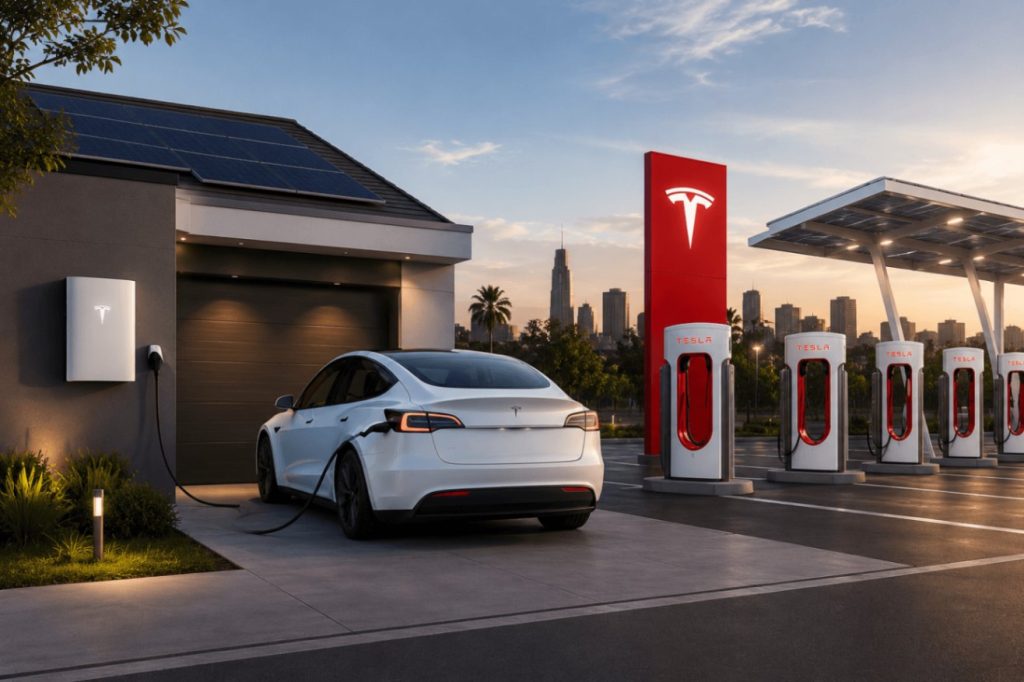
Tesla’s charging ecosystem relies on the North American Charging Standard (NACS), an elegant, lightweight plug design that manages both Alternating Current (AC) home charging and high-voltage Direct Current (DC) public fast charging through a single connector head.

Home Charging Hardware Options

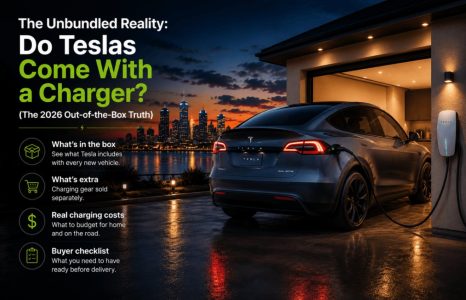
  • The Tesla Mobile Connector ($300): A portable, flexible charging option designed for travel or backup use. When paired with a standard NEMA 5-15 adapter faceplate, it plugs into a regular 120-volt household outlet to deliver a modest 1.4 kW trickle charge, adding roughly 3 to 5 miles of range per hour. Swapping on a heavy-duty NEMA 14-50 adapter faceplate allows it to plug into a 240-volt industrial outlet on a 50-amp breaker, lifting output to 7.6 kW to add approximately 30 miles of range per hour.
  • The Tesla Wall Connector ($450): A dedicated, hardwired home charging station designed for permanent indoor or outdoor installation. When connected to a dedicated 60-amp double-pole circuit breaker using heavy-gauge copper wiring, it outputs a continuous 48 Amps of current to deliver 11.5 kW of power, supplying up to 44 miles of driving range per hour of connectivity.
  • The Tesla Universal Wall Connector ($600): Built explicitly to support mixed-vehicle garages, this station features a built-in, auto-latching mechanical adapter matrix. It natively accepts standard Tesla NACS ports, but will automatically release an integrated J1772 adapter plug if a non-Tesla electric vehicle presses the handle button.

Home Installation Permitting, Structural Load Calculations, and Civic Codes

Installing a hardwired 11.5 kW Wall Connector requires strict adherence to local civic safety regulations and building codes:

  • The NEC Load Calculation: Before running electrical conduit, a licensed electrician must calculate the home’s total existing electrical load according to the National Electrical Code (NEC). If your residential subpanel is rated for a legacy 100-amp service and already powers high-draw appliances (like central air conditioning, an electric clothes dryer, or an electric oven), adding a continuous 60-amp EV breaker may overload the system. To proceed safely, you must either complete an expensive service panel upgrade to a modern 200-amp layout or install an approved smart energy management monitor (like a Neurio meter) to enable real-time dynamic load-shedding.
  • The Permitting Process: Homeowners must secure a formal Residential Electrical Permit from their local municipal building authority before installation work begins. Once hardwired, a city inspector must physically visit the location to check grounding rods, verify the proper thickness of the metal conduit, and confirm the breaker torque parameters. Passing this inspection secures your formal Certificate of Approval, ensuring your homeowner’s insurance policy remains valid and compliant.

Public High-Speed Supercharging

For long-distance travel, Tesla operates a massive network of public DC Fast Charging Supercharger Stations:

  • Level 2 AC Charging vs. DC Supercharging: When charging at home, a Wall Connector feeds Alternating Current (AC) to the car. The vehicle’s internal AC-to-DC onboard rectifier must manually convert that electricity into Direct Current (DC) before it can enter the battery cells. Because this conversion generates minimal heat, Level 2 AC charging is highly efficient and gentle on the battery chemistry. Public Supercharger cabinets, by contrast, completely bypass the car’s small onboard rectifier. They convert massive amounts of grid AC power into intense Direct Current (DC) up to 250 kW outside the vehicle, pumping electricity straight into the high-voltage battery pack at up to 400V–800V for rapid replenishment.
  • V3 vs. V4 Supercharger Architecture: Legacy V3 Supercharger cabinets utilize a shared-power grid framework capped at 250 kW per vehicle post. The newer V4 Supercharger stations deploy extended, extra-long charging cables designed to easily reach non-Tesla EV charge ports, and feature upgraded power electronics prepared to handle high-voltage 800-Volt Bus Inversion loops to support ultra-fast charging speeds on heavy vehicles like the Cybertruck.

Teala Longevity, Component Reliability & Multi-Year Fleet Maintenance Log

Teala Longevity, Component Reliability & Multi-Year Fleet Maintenance Log

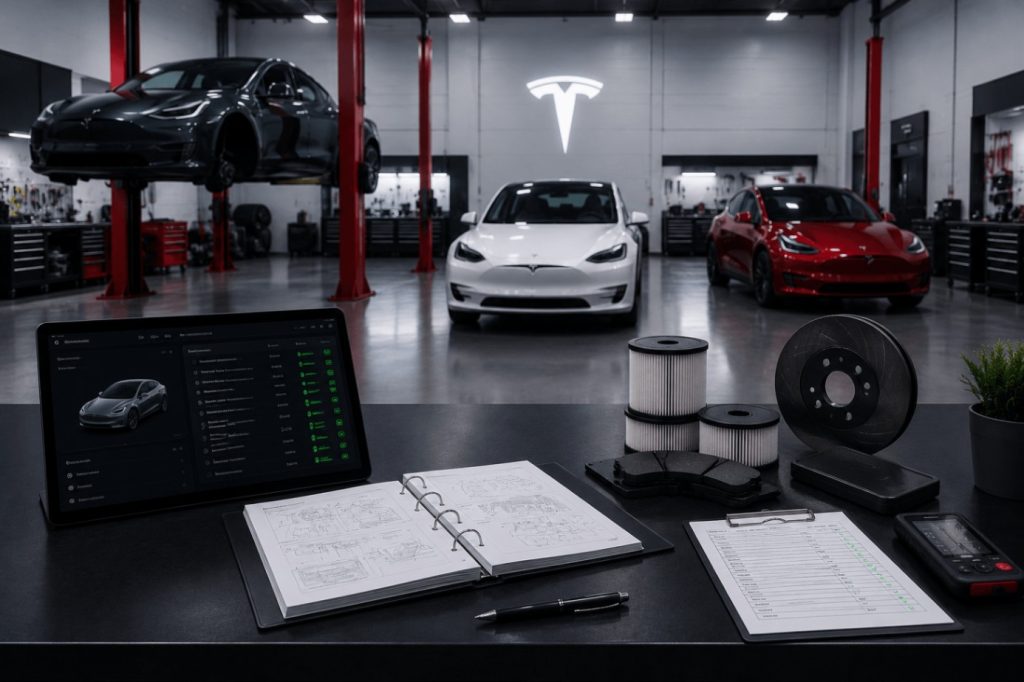
Tesla vehicles drastically simplify traditional automotive maintenance by completely eliminating high-wear mechanical systems like spark plugs, timing belts, fuel filters, oxygen sensors, catalytic converters, and emissions testing. However, keeping an advanced EV running safely requires a structured component maintenance routine.

Master Fleet Maintenance & Component Replacement Log

The following matrix charts the verified component lifecycles, service inspection windows, and required actions across the Tesla vehicle fleet.

System & Component FocusMandatory Service IntervalService Action & Technical Protocol
Tire Rotation & BalanceEvery 6,250 MilesRotate tire positions front-to-back to balance out high EV torque wear. Staggered performance models require side-to-side axle swaps.
Brake Caliper LubricationEvery 12 Months / 12,500 MilesClean and grease slider pins in northern winter regions that use aggressive road salt to prevent caliper binding.
Cabin Air Filter ElementsEvery 2 YearsReplace internal particulate filters to maintain optimal cabin air flow and protect HVAC evaporator efficiency.
HEPA Air Filter AssemblyEvery 3 YearsReplace primary high-capacity Bioweapon Defense air filter blocks (Every 2 years on Cybertruck models).
Brake Fluid TestingEvery 2 YearsRun an electronic brake fluid moisture contamination test. Perform a full hydraulic system flush if water content exceeds 3%.
A/C Desiccant BagEvery 4 to 8 YearsReplace internal desiccant bags to isolate moisture inside the climate lines (4 years for Model Y / 6 years for Model 3).
Sealed Drive Unit OilLifetime Rated (Mechanically: 100K)Inspect for casing gasket leaks; highly recommended to flush out initial gear break-in metallic particulates at 100,000 miles.

The Mechanics of EV Tire Degradation

Tires are the single highest consumable cost over a Tesla lifecycle. Because electric vehicles carry heavy battery packs and deliver maximum torque instantly from a dead stop, they place intense stress on tire tread blocks during everyday driving. Under aggressive acceleration habits, a Tesla can wear through a set of tires up to 30% faster than a traditional combustion vehicle.

Furthermore, factory-installed tires feature an internal layer of polyurethane acoustic sound-dampening foam glued inside the inner tread liner to absorb high-frequency tire vibrations and keep the cabin quiet. If you suffer a puncture, traditional external repair plugs will struggle to hold air reliably against this foam.

Fixing a flat properly requires dismounting the tire, cutting away a small section of the foam liner to expose the bare inner rubber, and applying a vulcanized patch-plug combination from the inside out. When lifting the car for tire service, technicians must insert specialized rubber jack pad adapter pucks into designated chassis holes to raise the vehicle safely without crushing the aluminum rocker panels or fracturing the high-voltage battery casing.

Accident Damage Protocols

If a Tesla is involved in a structural collision, completing a thorough teardown inspection of the mechanical and fluid systems is a critical safety requirement:

  • Drive Unit Casing Fractures: The cast aluminum drive unit housings can develop fine hairline stress fractures under severe impact loads, leading to slow fluid leaks that eventually starve the reduction gears of oil.
  • Cooling Loop Breaches: The internal drive unit fluid lines run alongside a glycol cooling manifold. A severe structural impact can crush these internal barrier walls, allowing glycol coolant to mix directly with the synthetic gear oil. This creates a highly corrosive fluid mixture that will quickly destroy the internal motor windings if not caught immediately.

The 100,000-Mile Gearbox Reality

While Tesla officially lists their internal drive-unit fluid as “lifetime rated,” long-term high-mileage data and independent EV specialists suggest performing a complete reduction gearbox fluid flush at 100,000-mile mark.

During the initial thousands of miles of driving, the freshly machined teeth of the single-speed reduction gears undergo a natural “break-in” phase, shedding fine microscopic metal shavings and aluminum particulates into the fluid. While Tesla installs internal safety magnets and physical oil filters to capture these impurities, these defense elements can become completely saturated over 100,000 miles of high-speed travel. Draining the fluid removes this caked metallic slurry, protecting internal bearings from premature wear and helping the drive unit run reliably for hundreds of thousands of miles.

Tesla’s 2026 Direct-To-Consumer Sales, Dealership Layout & Warranty Frameworks

Tesla’s 2026 Direct-To-Consumer Sales, Dealership Layout & Warranty Frameworks

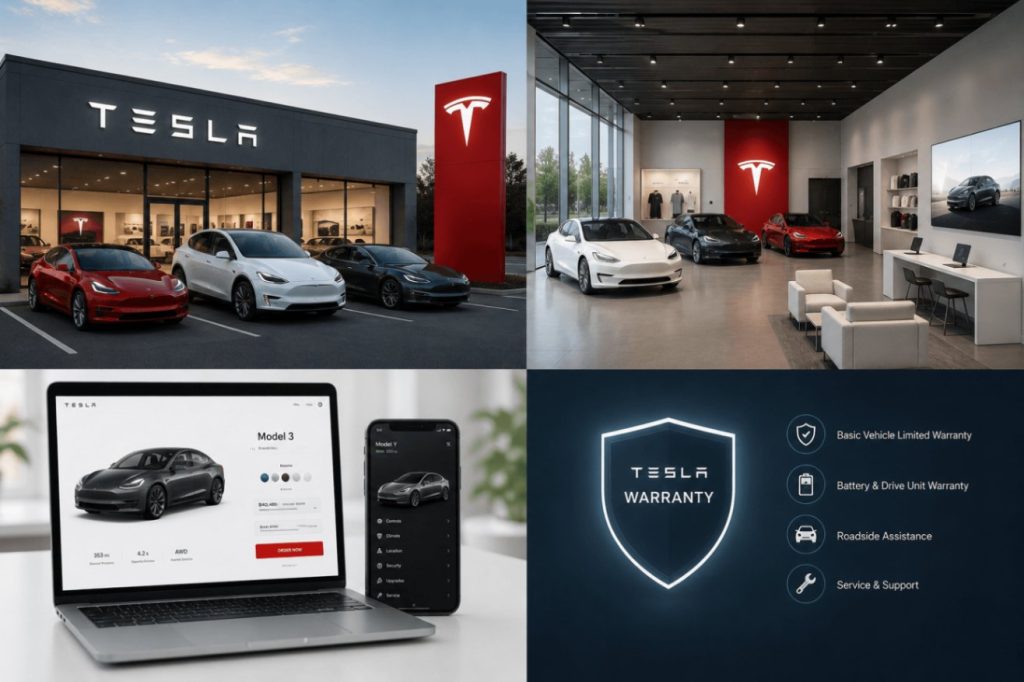
Tesla completely bypasses the traditional third-party franchised dealership network, managing all vehicle pricing, ordering, deliveries, and service networks through an in-house corporate architecture.

TESLA DIRECT-TO-CONSUMER ORDER FLOW

Consumer App Order ──► Unified Global Pricing (No Dealer Markups / Fees)

Regional Showroom    ──► Non-Commissioned Product Experts (Educational Focus)

Tesla Service Center ──► In-House Corporate Technicians & Mobile Fleet Service

The Direct-To-Consumer Sales Architecture

  • Unified Digital Ordering: Vehicles are ordered directly through the official Tesla website or mobile smartphone app. Pricing is completely unified nationwide, eliminating traditional dealer price markups, hidden documentation fees, and high-pressure finance showroom negotiations.
  • Corporate Showrooms & Galleries: Physical retail spaces located inside major metropolitan areas function strictly as educational product galleries. The staff are non-commissioned corporate product experts focused entirely on offering test drives and explaining vehicle tech features rather than closing immediate sales.
  • Corporate Service & The Mobile Fleet: Maintenance work is handled exclusively through factory-owned Tesla Service Centers or via Tesla Mobile Service. For common maintenance tasks (like swapping cabin air filters, replacing a 12V battery, or performing a tire rotation), a certified company technician dispatches directly to the owner’s home or office in a tool-equipped service van, completing the repairs right in the driveway to minimize shop downtime.

Comprehensive Factory Warranty Matrices

Every new Tesla vehicle rolling off production lines carries a multi-layered factory protection covenant structured across clear mileage caps:

  • New Vehicle Limited Warranty: Provides comprehensive bumper-to-bumper protection for 4 Years or 50,000 Miles, whichever comes first, covering all primary mechanical and electrical component defects.
  • Battery & Drive Unit Warranty (Mass Market Trims): For standard RWD configurations running LFP chemistries, protection spans 8 Years or 100,000 Miles, guaranteeing the battery pack retains at least 70% of its original energy capacity over that duration.
  • Battery & Drive Unit Warranty (Premium & AWD Trims): For high-capacity NMC configurations (Premium, Performance, and Plaid variants), the warranty coverage extends to 8 Years or 120,000 Miles with that same 70% capacity retention guarantee.
  • Battery & Drive Unit Warranty (Flagship Platforms): For luxury platforms (Model S, Model X, and all Cybertruck variants), battery and drive unit protection caps at 8 Years or 150,000 Miles, providing the highest level of coverage across the vehicle lineup.

The Final Word- Your Blueprint to the Future of Mobility

Every data point, chemical breakdown, and structural analysis compiled in this guide points to a singular, inevitable realization: the traditional automobile is no longer evolving, it is being replaced. To purchase a legacy internal combustion vehicle or a compromised, compliance-built hybrid is to invest in a infrastructure that belongs to the past.

By finishing this deep dive into the engineering loops of the Tesla ecosystem, you have cleared the single largest hurdle that holds back standard car buyers: the information barrier. You no longer just understand the marketing hype; you understand the raw physics of the Silicon Valley software stacks, the true longevity of the structural battery matrices, and the economic math of a machine that eliminates thousands of moving failure points. You hold the complete telemetric playbook.

The research phase is officially complete. Now, it is time for execution.

YOUR 3-STEP DISRUPTION ACTION PLAN

1. OPEN THE APP     ──► Configure your exact model trim & calculate local incentives.

2. BOOK THE DEMO    ──► Locate your nearest non-commissioned corporate gallery.

3. DROP THE PAWL    ──► Take delivery, plug into NACS, and exit the gas economy forever.

The Immediate 3-Step Execution Sequence

  1. Locate Your Regional Corporate Gallery: Tesla completely eliminates the high-pressure, commissioned dealership system. You do not need to brace yourself for intense showroom negotiations, hidden dealer documentation fees, or artificially marked-up pricing sheets. Tap the store locator in your Tesla app or web portal and locate your nearest factory-owned Tesla Showroom or Service Center.
  2. Lock in Your Forensic Demo Drive: Do not go to look at the paint or sit in the seats. Walk in as a tech-literate buyer. Request a dynamic test session to evaluate the Frequency-Selective Damping over rough expansion joints, engage Full Self-Driving (Supervised) to track real-time visual occupancy paths, and experience the zero-RPM torque wall of a machine built entirely on a clean-sheet electrical platform.
  3. Execute the Order and Claim Your Incentives: Once you configure your vehicle via the digital app interface, verify your regional eligibility for the $7,500 Federal Clean Vehicle Tax Credit alongside state-level clean energy rebate programs.

The era of paying high fuel margins, wasting hours on routine engine oil flushes, and driving an unoptimized, legacy gas vehicle is over. Open your digital configurator, choose the battery chemistry that fits your daily route profile, lock in your delivery timeline, and step directly into the next generation of transportation. The future of mobility is waiting for you in your driveway, go claim it.

Verifiable Master Technical Bibliography & Citations

  • Tesla Corporate Engineering Registry: North American New Vehicle Limited Warranty Matrix, Fleet Maintenance Schedules, and Powertrain Covenant Directives (2026 Edition). Official Tesla Warranty Portal.
  • United States Environmental Protection Agency (EPA): Office of Transportation and Air Quality (OTAQ) EV Fuel Economy and Certified Range Multi-Stage Test Logs for Vehicles Metrics Database. EPA Certification Database.
  • Society of Automotive Engineers (SAE): Silicon Carbide (SiC) MOSFET Inverter Switching Frequencies and Carbon-Wrapped High-RPM Rotor Optimization Challenges in Multi-Motor EV Platforms. Document Reference: SAE-2025-01-2240.
  • National Fire Protection Association (NFPA): National Electrical Code (NEC) Article 625: Comprehensive Residential Electrical Load Calculations and Safety Permitting Standards for EV Infrastructure Installation. NFPA Code Catalog.
  • CarBuzz Automotive Research Matrix: How Much Do Teslas Cost In 2026? Dynamic Trims, Pricing Metrics and Performance Specs Overview. Published June 2026. CarBuzz Data Archive.
  • Edmunds Vehicle Testing Registry: 2026 Tesla Model Y Evaluation: Real-World Highway Energy Consumption and Hatchback Low-Frequency Resonance Noise Audit. Reviewed June 2026. Edmunds Testing Library.
  • Electrek Transportation Intelligence Desk: Tesla launches Model Y L in US — 6 seats, 325 miles range, $61,990 pricing profiles. Reported by Fred Lambert. Published July 2, 2026. Electrek News Desk.

EVAuthority

Evauthority is an expert-led platform delivering daily, authoritative content on electric vehicles. Backed by strong industry experience, it covers EV news, technology, market trends, and policy with depth and precision. Through in-depth analysis, detailed reviews, and data-driven guides, Evauthority combines expertise and authority to provide reliable insights, helping professionals and enthusiasts navigate the evolving clean mobility landscape with confidence.

Leave a Reply

Your email address will not be published. Required fields are marked *

RELATABLE