Table Of Content
- The Chemistry Problem
- The Thermal Engineering Solution
- Step-by-Step Execution: How to Precondition All Tesla Models
- Method 1: Active Navigation (The Dynamic In-Route Trigger)
- Method 2: On-Demand Remote Activation (The Smartphone Trick)
- Method 3: Scheduled Departure (The Set-It-and-Forget-It Route)
- Method 4: The Physical Button Hardware Workaround
- n Things That Can Go Wrong If You Don't Precondition
- Preconditioning vs. Fast Charging: What is the Difference?
- Climate Resilience: How Extreme Weather Alters the Process
- Official Tesla Recommended Preconditioning & Charging Schedule
- 15 Technical FAQs on how to Precondition a Tesla Battery
What is Tesla Battery Precondition and Why Does it Matter
FACT- There is no one single button on your Tesla that can precondition your car’s battery with a single push or click!
For any internal combustion engine vehicle, preparing for a long drive or a quick refueling stop requires nothing more than turning a key and pulling up to a gas pump. For a Tesla owner, however, maximizing performance and efficiency requires a completely different vocabulary—and at the top of that list is battery preconditioning.
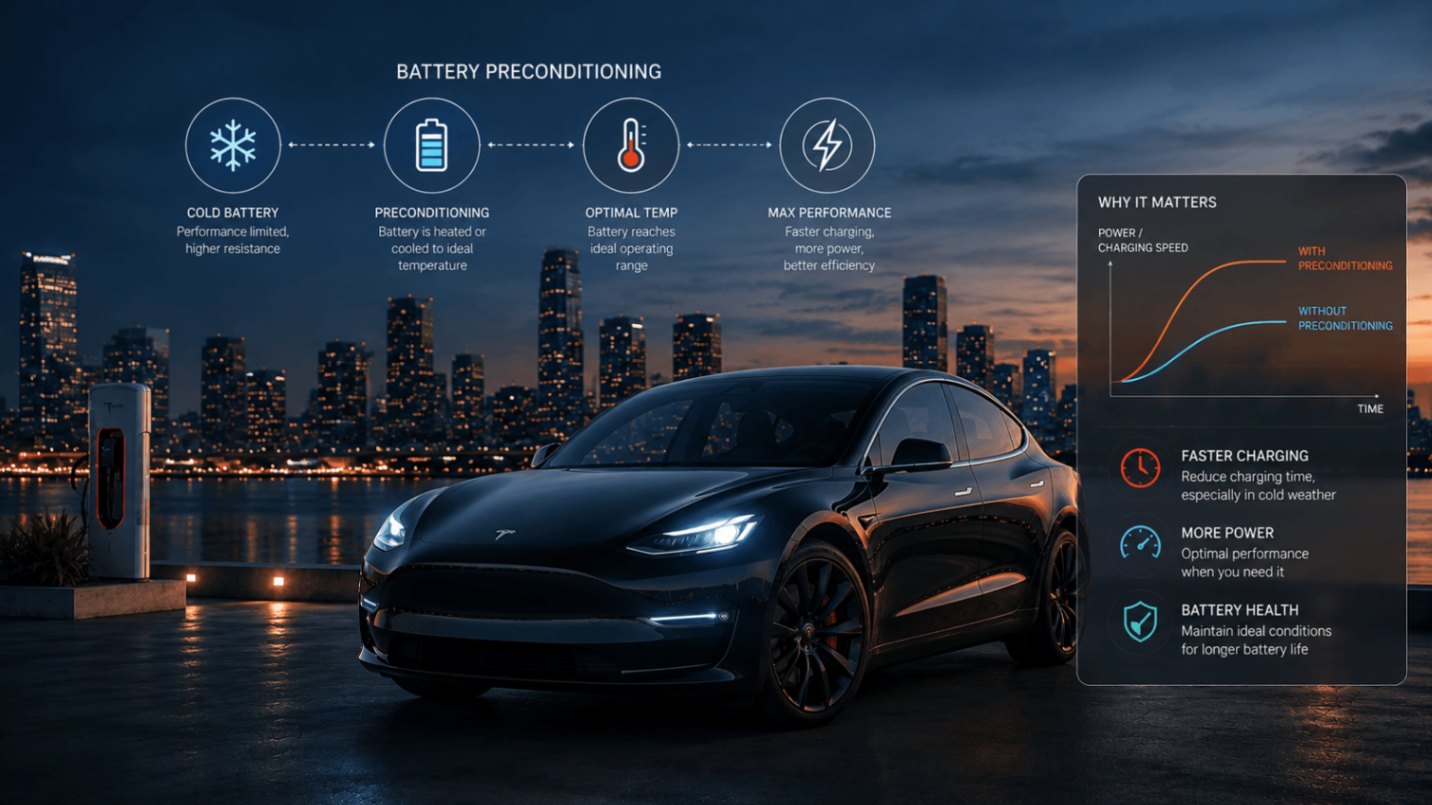
Every single Tesla owner must understand this vital process because it directly dictates the daily usability, charging speed, and long-term lifespan of their vehicle. An electric vehicle’s battery is an intricate, highly sensitive chemical ecosystem; when it is too cold, its internal resistance spikes, throttling your public Supercharging speeds down to a crawl and temporarily eliminating your regenerative braking.
By mastering how and when to trigger battery preconditioning, whether through a smartphone app on a freezing winter morning or automatically via the navigation screen on a cross-country road trip, you are doing far more than just shaving 20 minutes off your next charging session. You are actively shielding your high-voltage pack from destructive cell wear, optimizing your real-world driving range, and ensuring that your car is always operating at peak efficiency.
In short, understanding battery preconditioning is the single most effective habit you can develop to get the absolute most out of your investment. To understand preconditioning, you must understand that an EV battery is highly sensitive to temperature.
The Chemistry Problem
At a molecular level, a lithium-ion battery relies on the movement of lithium ions back and forth through a liquid electrolyte solution between the anode and cathode. When the battery drops below 50°F (10°C), this electrolyte fluid thickens and becomes viscous. This increases internal chemical cell resistance, slowing down the flow of ions.
If you attempt to jam massive amounts of electrical current into a cold battery (such as plugging into a 250 kW Supercharger), the ions cannot absorb into the anode quickly enough. Instead, they accumulate on the surface, a destructive phenomenon known as lithium plating, which permanently destroys battery capacity and causes accelerated degradation.
The Thermal Engineering Solution
Preconditioning is the process of intentionally manipulating the internal temperature of the battery pack to bring it to its optimal thermal envelope before an event occurs.
TESLA THERMAL TARGET HORIZONS
Daily Driving Target: ~68°F to 86°F (20°C to 30°C)
-> Optimizes range, cabin comfort, and full regenerative braking.
↓
Supercharging Target: ~104°F to 122°F (40°C to 50°C)
-> Lowers internal resistance to accept up to 250 kW safe current intake.Tesla achieves this without standalone resistive block heaters. Instead, the vehicle utilizes its central Octovalve manifold and heat pump network to harvest waste heat from the cabin electronics, or it intentionally feeds conflicting currents into the drive unit’s electric motor coils (stator heating). This creates artificial heat while the vehicle is stationary, which is then safely distributed into the battery coolant loop.
Step-by-Step Execution: How to Precondition All Tesla Models
Tesla does not offer a direct, standalone manual button in the vehicle UI to turn on battery heating on a whim. Instead, you must trigger the vehicle’s automated logic tracks using one of these paths:
Method 1: Active Navigation (The Dynamic In-Route Trigger)
This is the most effective method for high-speed charging preparation.
- Enter your destination into the in-car navigation screen.
- Select an official Tesla Supercharger or a verified Third-Party DC Fast Charger (such as an EVgo or Electrify America station, fully supported following the 2025.2 software update).
- The vehicle will dynamically evaluate its current distance, ambient air temperature, and battery state.
- Anywhere from 15 to 45 minutes before arrival, a clear notification will display on the screen header: “Preconditioning battery for fast charging.”
Method 2: On-Demand Remote Activation (The Smartphone Trick)
Ideal for warming the vehicle on cold mornings before leaving your home.
- Open the Tesla Mobile App on your smartphone.
- Navigate to the Climate panel.
- Tap Turn On or slide the temperature selector to your desired setting.
- By initiating the cabin climate control, the car’s central computer automatically boots up the battery thermal loop to simultaneously warm up the high-voltage pack. Let it run for 30–45 minutes in winter weather.
Method 3: Scheduled Departure (The Set-It-and-Forget-It Route)
Perfect for daily commuters looking to maximize home wall-connector efficiency.
- On the central touchscreen, tap Controls > Schedule (or access the “Schedule” panel in your mobile app).
- Select your location (e.g., “Home”) and tap Precondition.
- Set your target departure time (e.g., 7:30 AM) and select the specific days of the week.
The car will intelligently back-calculate exactly when to awaken itself, ensuring the cabin is comfortable and the battery cells are fully conditioned precisely at your departure window.
Method 4: The Physical Button Hardware Workaround
For enthusiasts who demand absolute manual control without using the navigation map, you can purchase aftermarket hardware accessories like the S3XY Buttons or S3XY Knob (by Enhance). These devices tap directly into the vehicle’s OBD-II data bus via a specialized commander module, allowing you to map a physical button click to manually force the Tesla software to run its battery preheating algorithms on demand.
n Things That Can Go Wrong If You Don’t Precondition
- Severe Charging Speed Throttling: A cold battery will reject high charging inputs. Your initial Supercharging speeds could be throttled down to a crawling 20 kW to 40 kW instead of peaking at 250 kW.
- Double the Session Wait Time: Road-trip charging sessions that normally take 15 minutes can stretch past 45 to 60 minutes as the car spends your paid station time slowly heating the battery using the charging current.
- Loss of Regenerative Braking: Driving off on a freezing morning without preconditioning disables regen braking. A dashed line will appear on your power bar, meaning the car will not slow down when lifting off the throttle, forcing you to rely entirely on mechanical friction brakes.
- Accelerated Cell Degradation: Forcing intense currents into unconditioned cells induces structural lithium plating micro-damage, leading to a permanent drop in your long-term total battery life.
- Drastic Winter Range Reduction: Starting a trip with a frozen pack forces the car to divert massive amounts of energy straight from the battery while driving to heat itself up, slashing your real-world driving range by up to 30%.
- Sudden Power Restrictions: Acceleration limits can be temporarily capped, making the car feel sluggish when trying to merge onto highway spaces until the pack achieves minimum threshold temperatures.
- Inability to Charge at Extremely Low Temperatures: In deep sub-zero arctic freezes, a frozen battery may completely refuse to accept any current from a home outlet until it goes through an extended emergency low-draw warm-up process.
- Increased Financial Costs: Spending excessive time idling at public fast chargers due to slow intake speeds drastically raises your charging costs if the station bills you by the minute.
- Cabin Climate Deprivation: If you plug into a high-voltage charger with a freezing battery, the car will divert all available thermal energy down to the pack, occasionally cutting off or reducing cabin heater warmth for the occupants inside.
Erratic Range Estimation Mapping: The trip planner computer can experience tracking errors, forcing it to dynamically recalculate and lower your projected arrival battery percentages mid-trip as it accounts for unexpected thermal overhead driving demands.
Preconditioning vs. Fast Charging: What is the Difference?
While inherently linked during a road trip, these are two entirely separate functional stages:
- Preconditioning is a Preparatory Stage: It is a net consumer of energy. The car uses its internal energy resources (either drawing from the wall connector or drawing down its own battery capacity while driving) to run its motors or heat pumps to mechanically heat or cool the battery cells to a precise target temperature. No energy is being stored in the cells during this window.
Fast Charging is an Accumulation Stage: This is the act of connecting the car to an intense external high-voltage DC power supply (such as a 400V–800V Supercharger stack) to actively pump electrons into the cells, increasing the battery’s state of charge (SoC).
Climate Resilience: How Extreme Weather Alters the Process
Icy & Freezing Climates
In sub-zero conditions, preconditioning is a defensive battle against fluid viscosity and cell stagnation. The car must pour maximum energy into generating heat.
- Pro Tip: Keep the car plugged into a home wall outlet while doing this. If you precondition a frozen battery unplugged in a driveway, it can consume 3% to 5% of your total range just to warm itself up before you even put the vehicle in gear.
Scorching Summer Climates
Preconditioning is just as vital in hot weather, but the objective flips entirely. When ambient temperatures exceed 95°F (35°C), a battery can quickly overheat under driving loads.
- The Summer Operation: Preconditioning switches the Octovalve over to a cooling loop, utilizing the AC compressor and modern heat exchangers to chill the glycol coolant running through the battery pack down to a safe, stable operating envelope before you arrive at a fast charger, preventing thermal throttling from heat buildup.
Official Tesla Recommended Preconditioning & Charging Schedule
To maximize performance and slow down cell wear, Tesla recommends a disciplined approach to daily charging logic:
┌────────────────────────────────────────────────────────┐
│ DAILY THERMAL & CHARGING ENGINE │
└────────────────────────────────────────────────────────┘
NMC / NCA Packs (Long Range & Plaid Trims):
-> Set Daily Charge Limit: 80%
-> Only charge to 100% for long-distance road trips.
-> Utilize Scheduled Departure to finish charging right as you leave.
│
▼
LFP Packs (Standard Rear-Wheel Drive Trims):
-> Set Daily Charge Limit: 100%
-> Charge to 100% at least once a week to calibrate the BMS.
-> Preconditioning via app or schedule is mandatory for winter morning regen.
Always leave your vehicle plugged in whenever it is parked during seasonal temperature swings. This allows the car’s Battery Management System (BMS) to draw current straight from the municipal grid to regulate cell temperatures overnight, entirely bypassing battery-drain penalties.
15 Technical FAQs on how to Precondition a Tesla Battery
Yes, it will function as long as your battery state of charge is above 20%. If your battery drops below 20%, the car will automatically disable preconditioning to prevent you from accidentally stranding yourself.
This is completely normal. The structural aluminum battery tray expands and contracts minutely as high-temperature glycol coolant rapidly cycles through the pack, causing the metal housing sheets to make popping or thumping sounds.
For typical near-freezing winter mornings, a full cell conditioning cycle requires 30 to 45 minutes to thoroughly stabilize the immense physical mass of a 1,000-pound battery pack.
No, there is no direct toggle to disable it. If you want to bypass it on a road trip, you would have to manually input the physical street address of the charger instead of selecting the station point of interest on the navigation screen. However, this is highly discouraged due to the slow speeds and cell wear it causes.
The snowflake indicates that your battery pack is too cold to deliver full power performance or complete regenerative braking. Preconditioning the car using your smartphone app will warm the pack and clear the snowflake icon.
No. Activating individual seat heaters or steering wheel warmers only draws minor low-voltage current. To heat the battery pack, you must turn on the primary cabin climate controls or trigger a departure schedule.
Yes. Modern production models utilize an optimized fifth-generation heat pump manifold that reduces the total energy required to heat the battery pack by nearly 15% compared to early model iterations.
Yes. If you say “Navigate to EVgo Fast Charger” or “Navigate to closest Supercharger,” the navigation system registers the location as a fast-charging node and initiates preconditioning automatically.
The car is running its radiator cooling fans and AC compressor at high speeds to reject heat from the battery coolant loop, keeping the pack safe from extreme thermal buildup before you plug into a fast charger.
No. If you activate the climate system via the app manually, the car will run its preconditioning and climate algorithms for a maximum of 2 hours before shutting down automatically to preserve energy if a door is never opened.
Yes, if the car is actively plugged into your wall connector while the cycle runs. This is the most cost-effective method, as it draws power straight from your home panel instead of draining your car’s battery.
LFP (Lithium Iron Phosphate) chemistry has a higher internal resistance profile in cold weather. It degrades in performance faster than NMC packs when chilled, meaning the BMS must heat it more aggressively to achieve full charging acceptance.
Yes. If one of the internal thermal sensors inside the sealed battery pack fails or outputs faulty telemetry, the BMS will lock out automated preconditioning for safety and display a service alert on the touchscreen.
The car will still charge safely, but you may experience slower initial speeds. The vehicle will continue to warm the battery using the incoming station current until it hits its target thermal window, at which point the charging speed will climb.
No, preconditioning and Sentry Mode run on entirely separate logic loops. Sentry Mode manages exterior security cameras, while preconditioning handles high-voltage thermal system state controls.
Tesla battery preconditioning for 3rd party rapid charging
This video is highly relevant because it walks through how the over-the-air system architecture allows the vehicle to optimize its thermal battery management dynamically, especially when navigating to public rapid chargers.
Spread Some Love
Author